Most B2B data providers are built for North American markets and extended to APAC as an afterthought. The result is thin contact fill rates, outdated firmographics for regional mid-market companies, and near-zero coverage for buyers whose LinkedIn profiles are written in Japanese, Korean, Mandarin, or Bahasa Indonesia.
If your outbound motion is expanding into Asia-Pacific, whether that is Australia, Japan, Singapore, India, South Korea, or Southeast Asia, your US-primary data provider is probably returning 40 to 60% of what actually exists in that market.
This guide compares the APAC company data providers that actually cover the region, so you can evaluate each one on coverage depth, multilingual search, and ICP filtering quality rather than marketing claims alone.
Quick Comparison: APAC B2B Data Providers at a Glance
The table below summarizes how each provider stacks up on the dimensions that matter most for APAC outbound. Detailed breakdowns follow below.
| Provider | APAC Coverage | Multilingual Search | ICP Filtering | Pricing | Best For |
|---|---|---|---|---|---|
| Pintel.ai | Global incl. full APAC | Yes (auto-expanded) | Profile-level, plain-English | Contact sales | Global GTM teams incl. APAC |
| Lusha | Strong APAC contact data | Limited | Firmographic only | From $29/user/mo | APAC contact data depth |
| Apollo.io | APAC present, thinner outside AUS | No | Basic prompt (incomplete) | From $49/user/mo | SMB teams, AUS and English APAC |
| ZoomInfo | APAC limited, US-primary | No | Firmographic only | Contact sales | US enterprise with APAC add-on need |
| Cognism | EU-primary, APAC very limited | No | Firmographic only | Contact sales | EU outbound, not APAC |
| LinkedIn Sales Navigator | Global LinkedIn profiles | No (English search only) | Keyword and firmographic | From $99/user/mo | LinkedIn-native engagement for APAC |
| EasyLeadz | India-specific | English only | Basic | From $49/mo | India-only outbound teams |
This comparison is based on first-hand platform knowledge, publicly available product information, and commonly reported user experiences. Contact each vendor directly for the latest pricing and product details.
How to Choose the Right APAC Data Provider
Choosing between APAC company data providers is not just a coverage question. Regional company intelligence varies significantly by sub-region, and a provider strong in Australia may have near-zero coverage for Japan or Indonesia. Before reading the full breakdown, use these three questions to narrow the field:
- Which APAC sub-region is your primary target? Australia and Singapore have strong English-profile coverage across most providers. Japan, Korea, and Southeast Asia need multilingual search to find buyers effectively. India benefits from India-specific providers or global platforms with strong South Asia coverage.
- Do you need contact data only, or also company intelligence and ICP filtering? Some providers are contact databases. Others layer firmographic filtering and buying signals on top. The need determines whether a standalone data provider or a full prospecting platform is the right frame.
- Is APAC your primary market or an expansion market? Teams going all-in on APAC need a platform built for multilingual prospecting. Teams adding APAC to an existing US-primary motion can often start with their current provider and supplement with a regional specialist for gaps.
With those questions answered, the tool breakdowns below give you what each provider actually delivers for APAC outbound.
Pintel.ai
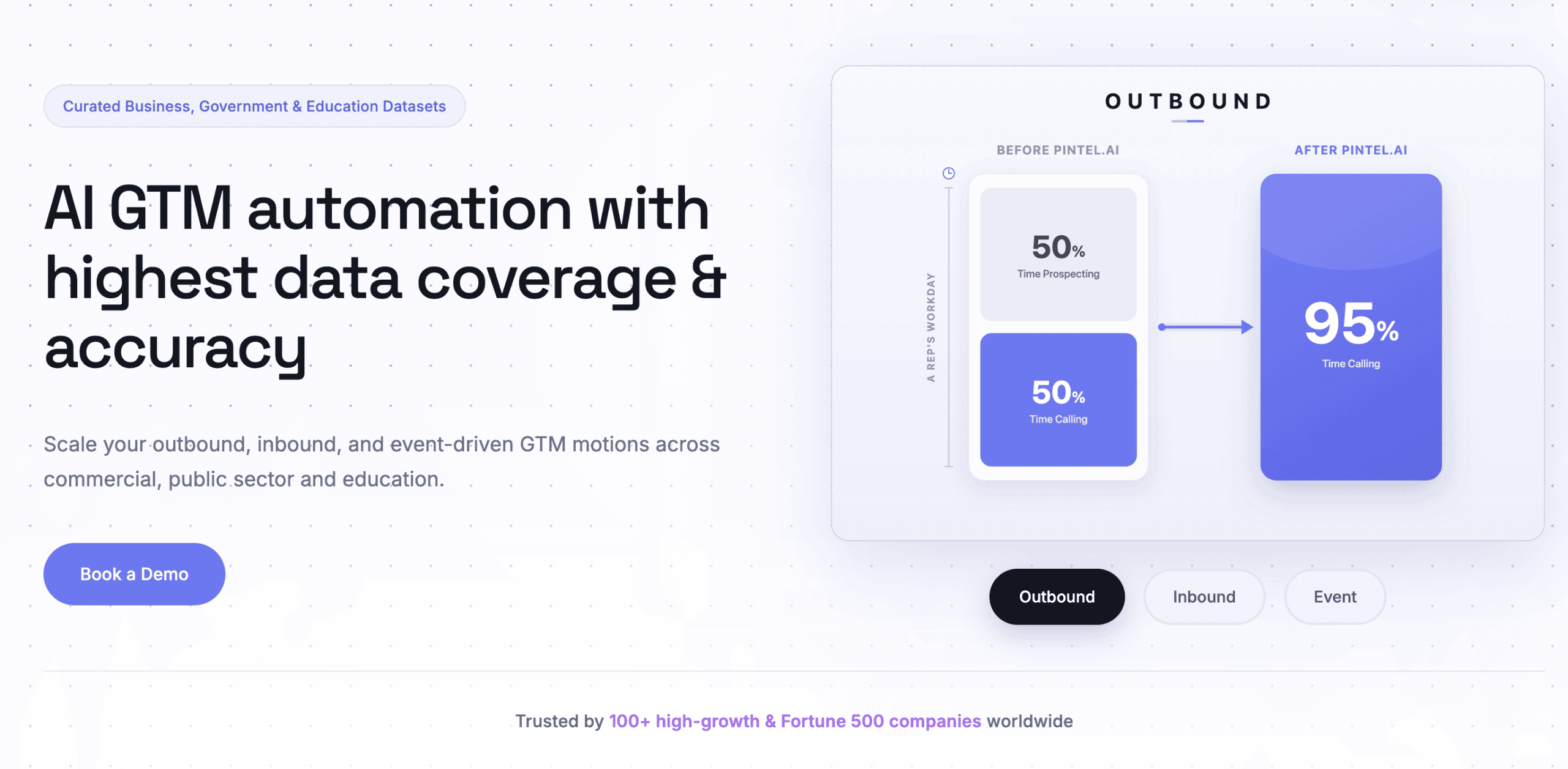
Pintel.ai is the strongest choice for APAC outbound teams because it is the only platform on this list that combines multilingual title expansion, waterfall enrichment across 30+ providers, and plain-English ICP filtering in a single workflow.
How it sources APAC data: Pintel combines proprietary APAC company data with waterfall enrichment across multiple regional and global providers in sequence, starting with the highest-accuracy source for that sub-region. This multi-source architecture keeps contact fill rates high across Japanese, Korean, Indian, and Southeast Asian prospect lists, where single-provider coverage often drops sharply.
What makes it different for APAC specifically: Pintel auto-expands title searches into native-language equivalents. A search for “Head of Procurement” in Japan automatically includes the Japanese-language equivalent title. A search for “Sales Director” in South Korea returns Korean-language profiles alongside English ones. Teams prospecting non-English APAC markets see two to three times more contacts than English-only keyword search returns.
ICP filtering: Instead of firmographic filters (industry code, headcount, revenue), Pintel lets teams write their ICP in plain English: “companies building enterprise SaaS that have an internal DevOps function.” It evaluates each company profile against that description, not against metadata fields. This removes false positives before outreach starts.
Strengths for APAC:
- Auto-translates title searches into Japanese, Korean, Mandarin, Bahasa, and other APAC languages at the search layer
- Combines proprietary APAC company data with waterfall enrichment across 30+ vetted providers, weighted by regional coverage quality for each APAC sub-region
- Decision-maker contact enrichment finds and enriches relevant decision-makers within target ICP companies with verified email addresses, phone numbers, and professional details.
- Plain-English ICP filtering at the profile level, not the firmographic field level
- Multi-signal account scoring: structural signals (funding, hiring, leadership changes, etc.), contextual signals (topic research), and behavioral signals (website, review engagement)
- Non-traditional APAC data sources: local business directories, government procurement records, sector-specific databases not covered by LinkedIn or standard providers
- Global platform. US, EMEA, APAC, and LATAM in one workflow with no regional cap
Limitation: Lower market visibility than established platforms like ZoomInfo, though built for teams prioritizing multilingual prospecting and ICP precision.
Pricing: Contact sales
Best for: Global GTM teams generating B2B leads across APAC as part of a broader international sales strategy, especially those targeting non-English-speaking markets including Japan, South Korea, and Southeast Asia.
Security and compliance: ISO 27001 certified, SOC 2 (AICPA), GDPR compliant, HIPAA compliant, CCPA compliant, and VAPT certified.
Lusha
Lusha sources contact data through a combination of LinkedIn profile scraping, community contributions (users submit and verify data), and third-party partnerships. For APAC, it has stronger contact depth than ZoomInfo or Apollo for English-language markets, but search is English-only and non-English profiles are not reliably surfaced.
How it works in practice: The Lusha Chrome extension lets SDRs pull email and direct dial data while browsing LinkedIn profiles. This is the most common use pattern for APAC outreach, visiting a LinkedIn profile, pulling the contact data, adding to a sequence. It works well for Australia, Singapore, and English-speaking India professionals.
Pricing model: Lusha uses a credit system. Each contact lookup costs one or more credits depending on data type (email vs. mobile). Teams need to manage credit budgets, especially for high-volume APAC list building.
Strengths for APAC:
- Chrome extension for real-time contact lookup on LinkedIn profiles without entering the platform
- Lower price point than ZoomInfo, accessible for smaller teams adding APAC to their stack
- Direct mobile number coverage for supported markets
Limitations:
- English-keyword search only. Japanese, Korean, and Southeast Asian native-language profiles are not surfaced reliably
- Credit model adds friction for high-volume APAC list building at scale
- No ICP filtering beyond firmographic fields, false positives still need manual cleanup
- Non-traditional APAC sectors (manufacturing, local businesses, public sector) are poorly covered
Pricing: From $29/user/mo; Pro and Enterprise tiers higher
Best for: Teams doing APAC outreach primarily in Australia, Singapore, and English-speaking India, who want quick LinkedIn-based contact lookup without a complex platform setup.
Apollo.io
Apollo bundles its contact database with built-in email sequencing, A/B testing, and CRM sync. For APAC, it covers Australia and Singapore reasonably well in English, but coverage drops significantly for Japan, Korea, and non-English Southeast Asia, and there is no multilingual title expansion.
How it sources data: Apollo uses third-party data providers, web crawling, and community contributions, a similar broad-coverage architecture to ZoomInfo but with a shallower depth per region. For APAC specifically, this means Australia and Singapore have acceptable data, while Japan, Korea, Indonesia, Thailand, and Vietnam have sparse records that produce high blank rates on export.
The Chrome extension: Like Lusha, Apollo has a Chrome extension for pulling contact data while browsing LinkedIn. SDRs working APAC accounts on LinkedIn can pull emails and add contacts to sequences directly. This is useful for English-speaking APAC markets where LinkedIn profiles are complete.
Sequencing: Apollo’s built-in sequencing covers email, call, and LinkedIn steps. For SMB teams running APAC outreach without a dedicated sequencer, this reduces tool overhead. The tradeoff is that the data layer and the outreach layer are both limited by Apollo’s single-source architecture.
Strengths for APAC:
- Australia and Singapore have workable contact coverage for English-language outreach
- All-in-one: database plus sequencing, A/B testing, CRM sync, and call features in one platform
- Chrome extension for LinkedIn-based APAC contact lookup
- Self-serve onboarding at $49/user/month, practical for teams testing APAC before committing to a larger platform
Limitations:
- Japan, Korea, and non-English Southeast Asia return frequent blank records. Coverage is not viable for these sub-regions without a supplemental data source
- No multilingual title expansion, native-language Japanese or Korean profiles are invisible to standard keyword search
- Single-source enrichment with no waterfall fallback, gaps stay empty
- AI-based ICP prompt filtering exists but produces inconsistent results at scale across APAC lists
Pricing: From $49/user/mo; Professional and Enterprise tiers higher
Best for: SMB teams testing APAC expansion for the first time, targeting Australia and English-speaking Singapore, who want data and sequencing without multiple platform integrations.
ZoomInfo
ZoomInfo is a US-primary platform with global data infrastructure. It has APAC records through its database, but for outbound teams targeting regional mid-market companies in Japan, Korea, or Southeast Asia, the coverage is inconsistent and the enterprise pricing is difficult to justify for APAC-only use.
How it sources APAC data: ZoomInfo uses community-sourced data (professionals submitting their own information), web crawling, and third-party integrations. This architecture produces strong US enterprise depth but thins out in markets with lower LinkedIn adoption and lower community-contribution rates, which describes most of non-English-speaking APAC.
What works in APAC: Australia and Singapore have reasonable coverage because they have high LinkedIn adoption and English-language profiles. Large APAC multinationals (Japanese companies with English-language LinkedIn presences, Korean conglomerates with US offices) also appear. Regional mid-market companies in Korean, Japanese, or Bahasa are frequently absent or incomplete.
Intent data for APAC: ZoomInfo’s Streaming Intent (powered by Bombora) provides topic-research signals, but the signal network is predominantly US-centric. Intent data for APAC accounts is significantly thinner than for US equivalents.
Strengths for APAC:
- Coverage for Australia, Singapore, and major APAC multinationals with English LinkedIn presences
- Org chart data for large enterprises, useful for multi-threaded APAC enterprise deals
- Strong CRM integrations (Salesforce, HubSpot, Marketo, Outreach, Salesloft)
- Established vendor with enterprise procurement recognition
Limitations:
- Regional mid-market in Japan, Korea, and Southeast Asia is frequently missing or stale
- No multilingual search, native-language APAC profiles are invisible in standard keyword search
- Intent data coverage for APAC is thin compared to US coverage
- Enterprise-only pricing (typically from $15,000/yr) is difficult to justify for teams using it primarily for APAC rather than the full US platform
Pricing: Contact sales (enterprise contract)
Best for: US-primary enterprise teams with an existing ZoomInfo seat who need supplemental coverage for Australia, Singapore, and large APAC multinationals.
Cognism
Cognism is a GDPR-compliant B2B data platform built for European outbound, but its APAC coverage is very limited and it is included here specifically to flag it as a common mistake, teams who buy Cognism expecting global coverage find it falls apart outside Europe.
How it works: Cognism sources data through its proprietary database combined with third-party partnerships. Its standout feature is Diamond Data, verified mobile phone numbers confirmed via phone for European contacts. This verification process is why it has strong European accuracy but weak APAC depth. The verification infrastructure is Europe-focused.
GDPR and compliance: Cognism is strong on compliance for EU outreach. If your team is running parallel EMEA and APAC motions, Cognism can cover the EU side while a different platform handles APAC. Using one tool for both does not work.
Strengths (relevant to APAC context):
- Strong for EU outbound alongside APAC, useful if you need to cover both regions with separate tools
- Diamond Data verified mobile numbers for European markets where it has coverage
- GDPR compliance framework for teams with EU data obligations
Limitations for APAC:
- APAC contact coverage is minimal. Japan, Korea, India, and Southeast Asia return near-empty results for most ICP searches
- No multilingual search capability
- Not built for APAC. Using Cognism for APAC outbound produces poor fill rates and is not cost-effective
Pricing: Contact sales
Best for: EU-primary teams that need GDPR-compliant contact data for Europe. Not a viable APAC data provider.
LinkedIn Sales Navigator
LinkedIn Sales Navigator has the widest raw APAC profile coverage of any tool on this list because it is drawing from LinkedIn’s own network. According to LinkedIn’s platform statistics, Asia-Pacific has strong LinkedIn membership across Australia, India, Singapore, and Japan. The limitation is that search is English-keyword based, meaning profiles written in Japanese, Korean, or Bahasa do not surface reliably.
How it works: Sales Navigator is a search and relationship tool built on top of LinkedIn. It lets you filter by title, company size, industry, seniority, and geography. You can save leads, get job-change alerts, and see who has engaged with your content. Contact data (email, phone) is not natively available, you need a separate enrichment tool or LinkedIn’s own InMail to actually reach buyers.
InMail and direct outreach: InMail lets you message LinkedIn members directly without a connection. For APAC markets where cold email response rates are low, InMail is sometimes more effective. The tradeoff: InMail credits are limited per plan tier, and responses require the buyer to be active on LinkedIn.
Smart Links and TeamLink: Sales Navigator Team and Enterprise tiers include Smart Links (trackable content sharing to see who engaged) and TeamLink (see first-degree connections of teammates to warm up APAC introductions). These features are useful for enterprise APAC selling where warm introductions matter more than cold volume.
Strengths for APAC:
- Widest raw APAC profile coverage. LinkedIn is used widely across Australia, India, Singapore, and Japan
- InMail for direct outreach without requiring an email address
- Job-change alerts and real-time engagement signals natively available
- TeamLink for warm introductions through teammates’ networks in APAC
Limitations:
- English-keyword search only. Japanese, Korean, and Southeast Asian native-language profiles are not reliably returned
- No native email or phone export, a separate enrichment tool is always required to reach buyers outside LinkedIn
- InMail credits are limited per plan; high-volume APAC outreach through Sales Navigator alone is not scalable
- No ICP filtering beyond firmographic keyword fields, false positive rates are high for APAC titles that do not match English equivalents
Pricing: From $99/user/mo (Core); Sales Navigator Team and Enterprise tiers higher
Best for: APAC enterprise sellers who want direct LinkedIn engagement, InMail outreach, and relationship signals, paired with a separate enrichment tool for contact data export. Strongest for Australia, Singapore, India, and Japanese buyers with English-language LinkedIn profiles.
EasyLeadz
EasyLeadz (also marketed as Mr. E) is an India-specific B2B contact data provider focused on direct mobile numbers for Indian decision-makers. It goes deeper into India than any global provider on this list, but its coverage does not extend meaningfully beyond India into broader APAC sub-regions.
How it works: EasyLeadz sources direct mobile phone numbers for Indian professionals, verified through its own data collection process. The key differentiator is mobile number accuracy, global providers like ZoomInfo and Apollo have thin mobile coverage for India, relying mainly on email. EasyLeadz is the reverse: strong on Indian mobile, limited on email and international coverage.
What it covers in India: The tool is particularly useful for reaching C-suite and VP-level decision-makers at Indian companies where LinkedIn InMail gets ignored and emails go to spam. A verified mobile number is often the most effective channel for these contacts.
Strengths:
- Direct mobile number coverage for Indian decision-makers is significantly better than any global provider at this price point
- Goes deeper into regional Indian companies that global tools miss, including mid-market firms outside Bangalore, Mumbai, and Delhi
- Lower price point than global platforms for teams whose APAC motion is India-specific
Limitations:
- Coverage is India-only. Japan, Korea, Australia, Singapore, and Southeast Asia are not covered
- No ICP filtering beyond basic role and industry fields, manual list cleaning required
- Email coverage for India is thinner than mobile coverage, supplemental email enrichment often needed
- Not a full prospecting platform, no sequencing, no buying signals, no account scoring
Pricing: From $49/mo
Best for: Teams doing India-specific outbound who want direct mobile number access for Indian decision-makers, particularly outside the major metro areas where global tool coverage is thinnest.
Building a Stack for APAC Outbound: What Actually Works
No single provider among the APAC company data providers on this list covers all of APAC equally well. The practical approach depends on which sub-regions matter most and what regional company intelligence you need from each:
- Australia and English-speaking Singapore: Apollo, Lusha, or LinkedIn Sales Navigator give reasonable coverage as a starting point.
- India: EasyLeadz for direct mobile contact depth, supplemented by a global platform for broader firmographic data.
- Japan, Korea, Taiwan, or Mandarin-speaking markets: You need multilingual title expansion. This eliminates Apollo, ZoomInfo, Cognism, and LinkedIn Sales Navigator from the primary search layer. Pintel is the only tool on this list that auto-expands searches into Japanese, Korean, and Mandarin equivalent titles at the profile level.
- Southeast Asia broadly (Indonesia, Thailand, Vietnam, Philippines): Coverage across all providers is limited. Multilingual search plus local data sourcing becomes essential. A platform with non-traditional data sources reaches buyers that standard databases miss entirely.
Teams building a full APAC outbound motion, especially those targeting non-English-speaking sub-regions, consistently find that the layering approach to company data providers outperforms any single vendor for regional company intelligence across diverse APAC markets. For enrichment specifically, multi-source waterfall is the only architecture that keeps fill rates above 80% across the full APAC coverage map. And for teams whose APAC expansion involves non-English-speaking buyers, the multilingual buyer discovery guide covers exactly why standard English-keyword search misses the majority of those markets.
FAQs on APAC Company Data Providers
What are the best APAC company data providers for B2B sales?
Pintel.ai helps B2B sales teams discover APAC companies, enrich contacts, and prospect across Japan, Korea, Southeast Asia, India, and Australia with multilingual search.
Which APAC company data provider has the best multilingual search?
Pintel.ai supports multilingual title expansion across Japanese, Korean, Mandarin, and other APAC languages, helping teams find buyers missed by English-only keyword search.
What is the best APAC contact database for outbound sales?
Pintel.ai combines APAC company data, waterfall enrichment, ICP filtering, and buying signals for outbound sales teams expanding across Asia-Pacific markets.
Why do most APAC B2B data providers have low contact coverage?
Most B2B databases are built for North American markets and extended to APAC later. This creates thinner contact coverage across non-English-speaking APAC regions.
Which APAC company data providers work best for Japan and Korea?
Pintel.ai supports native-language profile discovery for Japanese and Korean markets through multilingual search and profile-level ICP filtering.
What is the difference between APAC company data coverage and multilingual search?
APAC company data coverage means having regional contact records, while multilingual search means discovering buyers whose profiles are written in Japanese, Korean, Mandarin, or Bahasa.
Can LinkedIn Sales Navigator be used for APAC prospecting?
LinkedIn Sales Navigator works well for English-speaking APAC markets, but English-only search limits visibility into native-language profiles across Japan, Korea, and Southeast Asia.
What is the best APAC company database for Southeast Asia?
Pintel.ai supports Southeast Asia prospecting with multilingual search, waterfall enrichment, and non-traditional regional data sources.
Which APAC company data provider is best for global outbound teams?
Global GTM teams often use Pintel.ai for APAC outbound because it combines multilingual prospecting, ICP filtering, and multi-source enrichment in one workflow.
Which data is important for UK B2B prospecting?
Look for company, firmographic, and decision-maker data that supports accurate UK targeting. Pintel.ai provides UK company and contact data alongside APAC and global coverage.