Your pipeline is only as good as the data feeding it. Most B2B teams face the same problem: CRM records with missing fields, contact lists that go stale within months, and no clear signal for which accounts are worth pursuing right now.
Data enrichment tools exist to fix this. They automatically append firmographic, contact, intent, and technographic data to your records so your team spends less time researching and more time selling.
But picking the wrong tool means paying for data your team never uses, or worse, building GTM decisions on inaccurate information. This guide covers the best data enrichment tools for B2B, what each one actually does, and how to choose the right one for your workflow.
Best Data Enrichment Tools: Quick Answer
If you are short on time, here is a fast summary before we go deeper.
- Best for contact data: ZoomInfo, Apollo.io, Cognism
- Best for account prioritization: Pintel.ai, 6sense
- Best for real time enrichment: Pintel.ai, Clearbit
- Best for multi source enrichment: Clay, Pintel.ai
The right pick depends on your motion, your market, and the data gap you are solving. The full breakdown is below.
What Are Data Enrichment Tools?
Data enrichment tools are platforms that automatically append missing or outdated information to your contact and account records.
You collect a lead with just a name and work email. An enrichment tool fills in their job title, company size, industry, direct phone number, tech stack, and whether their company is actively researching your category right now.
The main types of enrichment data:
- Contact enrichment: Job titles, verified emails, direct dials, LinkedIn URLs
- Firmographic enrichment: Company size, revenue, industry, headcount, location
- Technographic enrichment: What software a company currently runs
- Intent data: Signals showing a company is actively researching a solution like yours
- Account enrichment: Funding rounds, growth signals, org structure
Knowing which type you need most is the first step in evaluating B2B data enrichment tools. The decision framework is covered further below.
How We Evaluated These Data Enrichment Tools
We evaluated each platform on criteria that matter to GTM, RevOps, and Sales Ops teams.
- Data accuracy and freshness: How reliable are the emails, phone numbers, and firmographic fields? How often is data updated?
- Coverage: Does the tool cover your target geographies and industries?
- Enrichment types: Contact, firmographic, technographic, intent. Does it match what you need?
- Integration depth: Does it connect cleanly to your CRM and sales engagement tools?
- Workflow fit: Bulk enrichment, real time enrichment, API access. How does data flow into your stack?
- Pricing model: Credits, flat rate, API calls. Is it transparent and scalable?
- GTM usefulness: Does it help teams take action, or just fill fields?
We included tools that serve different use cases so you can find what fits your situation, whether you are a lean outbound team or a complex RevOps operation.
Data Enrichment Tools Comparison
| Tool | Best For | Key Features | Pricing |
|---|---|---|---|
| Pintel.ai | ICP + prioritization | Signals, scoring, enrichment | Custom / enterprise |
| ZoomInfo | Large-scale data | Database, intent | High / enterprise |
| Apollo.io | SMB outbound | Contacts + sequences | Low to mid |
| Clay | Multi-source workflows | 75+ sources | Usage-based |
| Cognism | EMEA + compliance | Verified mobiles | High |
| Lusha | Quick lookup | Extension, contacts | Low |
| Clearbit | Real-time enrichment | Form enrichment | Mid to high |
| 6sense | Intent + ABM | Predictive signals | Enterprise |
| Bombora | Intent data | Surge scores | Enterprise |
Best Data Enrichment Tools for B2B
1. Pintel.AI
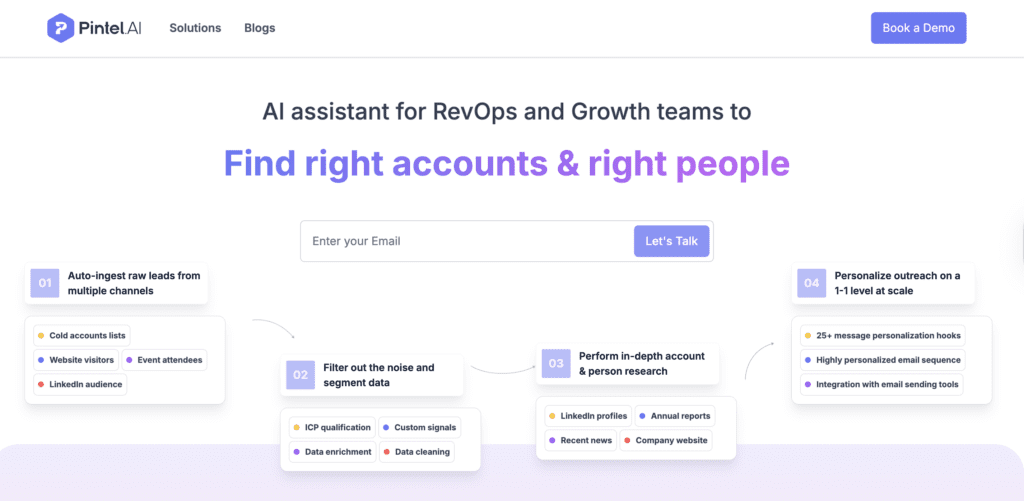
Pintel.AI helps B2B teams identify and work on the right accounts from the start.
Teams define their ideal customer profile and generate ICP matched account lists directly within Pintel. If you already have a list, you can upload it and enrich those accounts instead. Enrichment runs across multiple data sources, which improves coverage and reduces missing records.
Pintel also applies scoring and prioritization based on fit and activity, so teams can focus on accounts that are both relevant and timely. The platform is flexible, allowing teams to choose what data to enrich based on their GTM workflow, rather than enriching every field by default.
Enriched data and scores can be synced directly to your CRM, so teams can act on updated account insights without manual effort.
What data it provides:
- Real time updates to keep account data current
- Firmographic data such as industry, company size, revenue, and location
- Technographic data showing tools used by the company
- Buying signals and intent indicators
How teams use it
RevOps teams connect Pintel to their CRM to score and segment accounts automatically based on ICP fit and activity signals. Outbound teams use it to generate or upload account lists, enrich them with relevant data, and prioritize outreach based on which accounts show the highest potential.
Best use case
GTM and RevOps teams that want to identify, enrich, and prioritize accounts in one workflow, especially for account based selling and targeted outbound.
Limitations
- Focused on account level intelligence, not a standalone contact database
- Lower brand awareness compared to more established tools like ZoomInfo or 6sense
2. ZoomInfo
ZoomInfo is the market leader in B2B data and one of the most established data enrichment platforms available.
What data it provides: Verified emails, direct dials, firmographic data including revenue and headcount, technographic data via OperationsOS, proprietary intent data through Streaming Intent, and org charts.
How teams use it: Enterprise SDR teams build outbound lists filtered by firmographics and intent score, then push them to Salesforce or Outreach. RevOps teams use CRM enrichment sync to auto update contact and account fields as data changes over time.
Best use case: Large sales teams needing volume, verified contact data, and enterprise level integrations.
Limitations: Expensive with rigid annual contracts. Data quality outside North America can be inconsistent. Intent data is less granular than dedicated platforms like Bombora or 6sense.
3. Clay
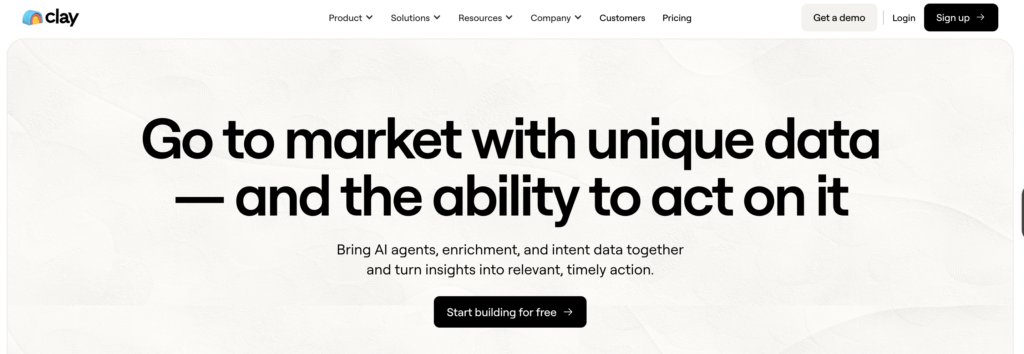
Clay is not a data source. It is an enrichment orchestration layer that connects to 75+ providers and lets you build custom enrichment waterfalls across all of them.
What data it provides: Contact and firmographic data pulled from Apollo, Hunter, Clearbit, Lusha, and dozens of others. AI generated research using GPT-4 to answer custom questions about companies at scale, such as whether an account is actively hiring or recently raised funding.
How teams use it: Growth teams build waterfalls where Clay checks Apollo first, then Hunter if Apollo misses, then Clearbit as a fallback. Teams also use Clay to flag accounts with specific signals like a recent Series B close or a new VP of Sales hire.
Best use case: Outbound focused teams and RevOps engineers who want maximum enrichment flexibility without being locked into a single provider.
Limitations: Real learning curve. Requires time to build and maintain workflows. Since Clay does not own data itself, quality depends on which sources you connect. Credit costs add up at high volume.
4. Apollo.io
Apollo combines a 275M+ contact database with built in outbound sequencing, making it one of the best value data enrichment tools for lean sales teams.
What data it provides: Business emails, direct dials including mobile numbers, firmographic data, basic technographic filters, and intent data on higher plans.
How teams use it: SDRs build targeted prospect lists inside Apollo filtered by job title, company size, industry, and tech stack, then push contacts into sequences or export to CRM. RevOps teams use Apollo’s CRM sync to keep Salesforce and HubSpot records enriched on a rolling basis.
Best use case: SMB and mid market teams that need a prospecting database, enrichment source, and outbound tool in one affordable platform.
Limitations: Mobile number accuracy is inconsistent compared to Cognism or ZoomInfo. Coverage skews toward North America. Sending high volume email directly through Apollo can hurt deliverability if not managed carefully.
5. Clearbit (now HubSpot Enrichment)
Clearbit was acquired by HubSpot and is now its native enrichment layer. For HubSpot shops, this is the most seamless real time enrichment experience available.
What data it provides: Firmographic enrichment triggered at form submission, contact data append including job title and LinkedIn URL, and IP based company identification for anonymous website visitors through Reveal.
How teams use it: Marketing teams use Clearbit to shorten form fields. Instead of asking prospects for company size and industry, Clearbit fills those fields automatically post submission. RevOps teams use enriched fields to trigger HubSpot workflows that auto route leads to the right segment.
Best use case: HubSpot native teams that want real time form enrichment and automated lead routing without managing a separate vendor.
Limitations: Standalone use outside HubSpot is now limited. Coverage gaps exist for smaller companies and non US markets. Not a prospecting tool. You cannot build outbound lists with it.
6. Cognism
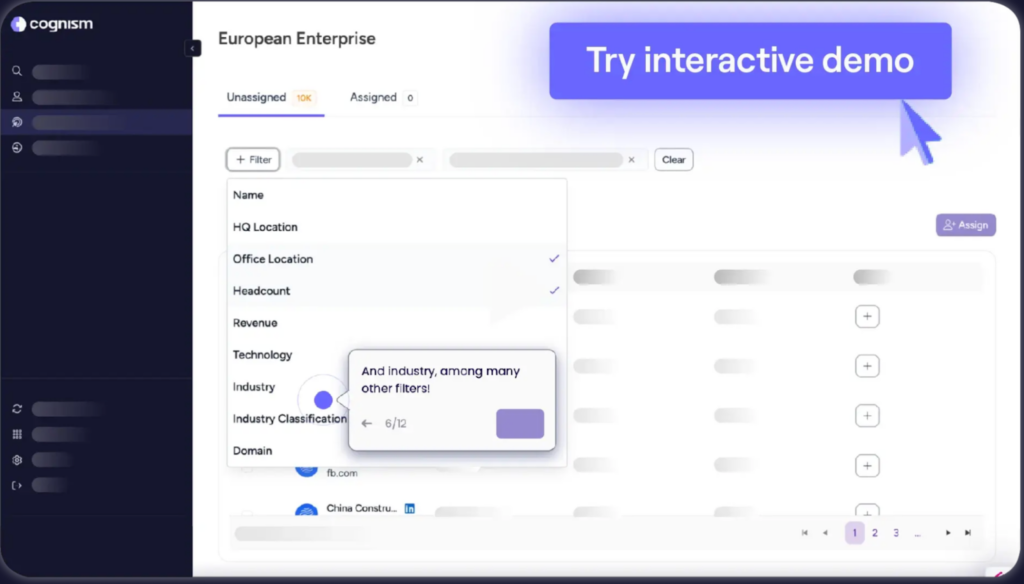
Cognism is the leading B2B data enrichment tool for teams selling into Europe, with compliance built directly into the data layer rather than added on top.
What data it provides: Human verified mobile numbers under its Diamond Data tier, GDPR and CCPA compliant contacts for Europe, US, and APAC, firmographic enrichment, intent data via Bombora, and job change alerts.
How teams use it: Enterprise sales teams with phone heavy outreach motions use Cognism for its verified mobile numbers, which deliver significantly higher connect rates than auto scraped numbers. Compliance teams rely on built in suppression lists covering do not call registries across European markets.
Best use case: Teams with strong phone outreach motions, companies selling into EMEA, and any team where compliance is a hard requirement.
Limitations: Premium per seat pricing. US coverage is not as deep as ZoomInfo or Apollo. Intent data is Bombora powered, not proprietary.
7. Lusha
Lusha is a lightweight contact enrichment tool built for individual reps who need quick access to direct dials and emails without enterprise contracts or complex setup.
What data it provides: Direct dial phone numbers, business emails, basic firmographic data, and job title via a Chrome extension on LinkedIn and company websites.
How teams use it: AEs and SDRs pull direct dials while prospecting on LinkedIn without leaving the tab. Sales managers track credit usage across team accounts. CRM enrichment is available for bulk updating Salesforce or HubSpot records.
Best use case: Individual reps and small sales teams that need a simple, affordable contact data tool for daily prospecting.
Limitations: Smaller database than ZoomInfo, Apollo, or Cognism. No technographic, intent, or account level enrichment. Not suitable for large scale CRM enrichment projects.
8. 6sense

6sense is a revenue AI platform built around account prioritization through intent and predictive intelligence.
What data it provides: Dark funnel signals tracking anonymous buyer research across the web, buying stage predictions from Awareness through to Decision, firmographic and technographic enrichment, and keyword level intent signals tied to your product category.
How teams use it: ABM teams use 6sense to identify accounts already researching their category, even without a website visit. Sales teams use account stage data to decide which accounts to prioritize this week versus next quarter.
Best use case: Mid market and enterprise ABM teams moving from spray and pray outbound to a signal driven, account prioritized GTM motion.
Limitations: Expensive and complex to implement. Works best with solid account lists and existing GTM infrastructure. Does not provide contact level data, so a separate provider is still needed for emails and phone numbers.
9. Bombora
Bombora is the most established source of third party B2B intent data, aggregating signals from a network of 4,000+ B2B media sites.
What data it provides: Company level intent surge scores across 4,000+ topics, week over week intent trending showing which accounts are spiking in research activity. Account level signals only, with no contact data.
How teams use it: Most teams access Bombora through an integrated platform. ZoomInfo customers layer Bombora intent scores on top of contact data for combined prioritization. RevOps teams build Salesforce reports flagging accounts above a surge score threshold as high priority for the sales team.
Best use case: Teams that want to add intent signals to an existing enrichment stack without switching primary data providers.
Limitations: No contact data at all. Intent scores are based on content consumption, not direct buying signals, so false positives do occur.
How to Choose the Right Data Enrichment Tools
Start with what data gap you are solving:
- Need accurate emails and direct dials for outbound? Apollo, Cognism, ZoomInfo, Lusha
- Need to know which accounts are in market right now? Pintel.ai, 6sense, Bombora
- Need real time form enrichment for lead routing? Clearbit, Apollo API
- Need enrichment across multiple sources for better match rates? Clay, Pintel.ai
Match the tool to your team’s technical capacity:
- No ops resources and need plug and play? Apollo, Lusha, Cognism
- Have a RevOps team and want custom workflows? Clay, Pintel.ai, ZoomInfo
- Running on HubSpot natively? Clearbit is the natural fit
Check geographic coverage before committing:
- North America focused? ZoomInfo, Apollo, Lusha
- EMEA focused or compliance sensitive? Cognism is the strongest option
- Global coverage needed? Cognism, Pintel.AI and ZoomInfo together is a common enterprise setup
Common Mistakes to Avoid
Enriching the wrong accounts first. Teams run enrichment on thousands of records before filtering for ICP fit. Enrich after you have confirmed fit, not before. Starting with ICP matched account lists, the way Pintel.ai works, saves significant time and budget.
Treating enrichment as a one time project. Data decays fast. Job titles change, people leave companies, emails go stale. Enrichment needs to be a continuous automated workflow, not a quarterly CRM cleanup.
Relying on a single data source. No provider has 100% coverage. High performing teams stack sources, for example Apollo as primary with Clay to waterfall to Clearbit when Apollo misses.
Ignoring compliance. GDPR and CCPA risks are real. If you are enriching European contacts, your provider needs built in suppression lists and certifications. Cognism is the benchmark here.
Not connecting enrichment to action. Enriched fields sitting in CRM that nobody acts on are wasted. Enriched data needs to feed scoring models, routing rules, and segmentation, not just populate fields.
Use Cases for Data Enrichment Tools
GTM Teams. Use enrichment to build prioritized, tiered account lists. Generate ICP matched accounts, append firmographic and intent data, score and tier accounts, then route tier one to AEs and tier two to SDRs. Pintel.ai is built specifically for this sequence.
RevOps Teams. Use enrichment tools to keep CRM data clean and actionable. Core workflows include monthly bulk enrichment to refresh records, real time lead routing using enriched firmographic fields, and account scoring models built on enriched data inputs.
Sales Teams. For individual sellers, enrichment means more time in conversations and less time researching. SDRs use Apollo or Lusha for verified direct dials. AEs use technographic data to personalize outreach around a prospect’s current tech stack.
Choosing the Right Data Enrichment Tools for B2B
The goal of data enrichment is not to have the most data. It is to have the right data at the moment your team needs to make a decision.
Most teams are over enriching bad accounts and under prioritizing good ones. The shift worth making is from “enrich everything and filter later” to “start with the right accounts and enrich with context.”
For contact data at scale, ZoomInfo, Pintel.AI Apollo, and Cognism are the defaults depending on your market and budget. For multi-source enrichment flexibility, Pintel.AI is the most powerful option.
For real-time form enrichment on HubSpot, Clearbit is the natural fit.
For account prioritization and buying signals to drive GTM decisions, Pintel.AI is where to start.
Most mature GTM stacks combine two to three tools: one for contact data, one for account intelligence, and one for intent signals. Start with your biggest data gap, match the tool to that gap, and make sure the data you collect connects to an action your team will actually take.
Frequently Asked Questions
What are data enrichment tools?
Data enrichment tools are platforms that add missing or outdated information to your contact and account records. This includes firmographic data, verified emails, phone numbers, technographic signals, and intent data.
What are the best data enrichment tools for B2B?
The best data enrichment tools for B2B depend on your use case. For contact data, tools like ZoomInfo, Apollo, and Cognism are widely used. For account prioritization and scoring, Pintel.ai and 6sense are strong options. For multi source workflows, Clay is a flexible choice.
How do data enrichment tools work?
Most data enrichment tools connect to your CRM or accept a CSV file. They match your records with their database or external sources and fill in missing fields like job title, company size, and contact details. Some tools offer real time enrichment, while others run in batch.
How do I choose the right data enrichment tools?
Start by identifying your main data gap, such as contact data, firmographic data, or intent signals. Then choose data enrichment tools that fit your workflow, coverage needs, and budget. The best tools are the ones that connect data directly to actions like scoring, routing, or outreach.
What is the difference between data enrichment tools and data providers?
Data enrichment tools focus on updating and improving your existing data, while data providers give you access to new contact and account data. Some platforms, like Apollo or ZoomInfo, combine both.