Choosing the right B2B contact data provider is about more than database size. Coverage, data accuracy, verification methods, and buying signals all influence whether your sales team reaches the right decision-makers or wastes time on outdated contacts.
This guide compares 12 of the best B2B contact data providers, including their strengths, limitations, pricing, and ideal use cases. Whether you’re building outbound lists, enriching CRM data, or expanding into global markets, this comparison will help you find the right platform for your GTM strategy.
What Is B2B Contact Data?
B2B contact data is structured information about business professionals, including verified email addresses, direct phone numbers, job titles, company affiliations, and seniority levels, used by sales teams to reach decision-makers. The quality of this data directly determines whether outreach reaches an inbox or bounces.
The comparison below covers how each provider sources, verifies, and delivers that data for active sales teams.
12 Best B2B Contact Data Providers: At a Glance
Pintel.ai leads this comparison because it is the only provider combining multi-source waterfall enrichment, three-layer signal intelligence, and non-traditional data sourcing in one platform with no regional limitations.
| Provider | Best For | Data Sourcing | Signal Layer | Global Coverage | Starting Price |
|---|---|---|---|---|---|
| Pintel.ai | Global GTM teams | Proprietary + 30+ vetted providers | Structural, contextual, behavioral | US, EMEA, APAC, LATAM | Contact sales |
| ZoomInfo | US enterprise | Community contributions + licensed | Bombora-powered intent | US-primary | From $15,000+/yr |
| Apollo.io | SMB outbound | Crawled + user-submitted | Basic job change alerts | US-primary | From $49/mo |
| Cognism | EMEA phone outbound | Licensed + phone-verified | Job change tracking | UK, W. Europe | Contact sales |
| Lusha | LinkedIn prospecting | LinkedIn extension | None | LinkedIn-indexed only | From $49/mo |
| Hunter.io | Domain email finding | Domain crawling | None | Moderate | From $49/mo |
| Seamless.ai | High-volume prospecting | AI-scraped real-time | Job change alerts | US-primary | From $65/mo |
| Kaspr | European phone enrichment | LinkedIn extension | None | France, UK, EU | From $65/mo |
| LeadIQ | SDR LinkedIn capture | LinkedIn + enrichment APIs | Job change alerts | US, UK | From $45/mo |
| Snov.io | Email finding and outreach | Domain crawling | None | Moderate | From $30/mo |
| RocketReach | Professional profile lookup | Web aggregation | None | US-primary | From $53/mo |
| Clay | Enrichment workflows | 75+ enrichment APIs | Varies by source | Depends on sources | From $149/mo |
This comparison is based on first-hand platform knowledge, publicly available product information, and commonly reported user experiences. Contact each vendor directly for the latest pricing and product details.
The table shows who each tool is built for. Choosing the wrong one means paying for coverage that does not match your ICP. The criteria below make the evaluation faster.
What Should You Look for in B2B Contact Data?
Four factors consistently separate the B2B contact data providers that move pipeline from those that look good in a demo.
Coverage depth: Can the database reach your specific ICP by industry, seniority, and region? A 200-million-record database at 60% accuracy for your segment delivers less value than a smaller one at 90% accuracy for that same segment. Test with a proof of concept on your actual accounts, not a vendor-curated sample.
Record freshness: Professional contact records decay at roughly 2-3% per month as people change roles. Ask how often the provider re-verifies records, not just how large the database is. A database updated quarterly has already drifted 6-9% before your first send.
Signal layer: Contact data with no signal layer gives you a list, not a pipeline. Structural signals (funding rounds, VP-level hires, tech migrations, etc.), contextual signals (topic research behavior), and behavioral signals (website visits, content downloads) together show which accounts are in a buying window today.
Workflow fit: Data that does not sync cleanly to your CRM creates manual work that erases the productivity gain. These four checks form what high-performing GTM teams call the Contact Data Reliability Score: a quick test any team can run on a vendor’s trial dataset before committing to a contract. Here is how each of the 12 B2B contact data tools for GTM teams compares across them.
Detailed Comparison of the 12 Best B2B Contact Data Providers
Every provider approaches contact data differently. Here’s a closer look at how each platform sources data, where it performs well, and which sales teams will benefit most.
1. Pintel.ai
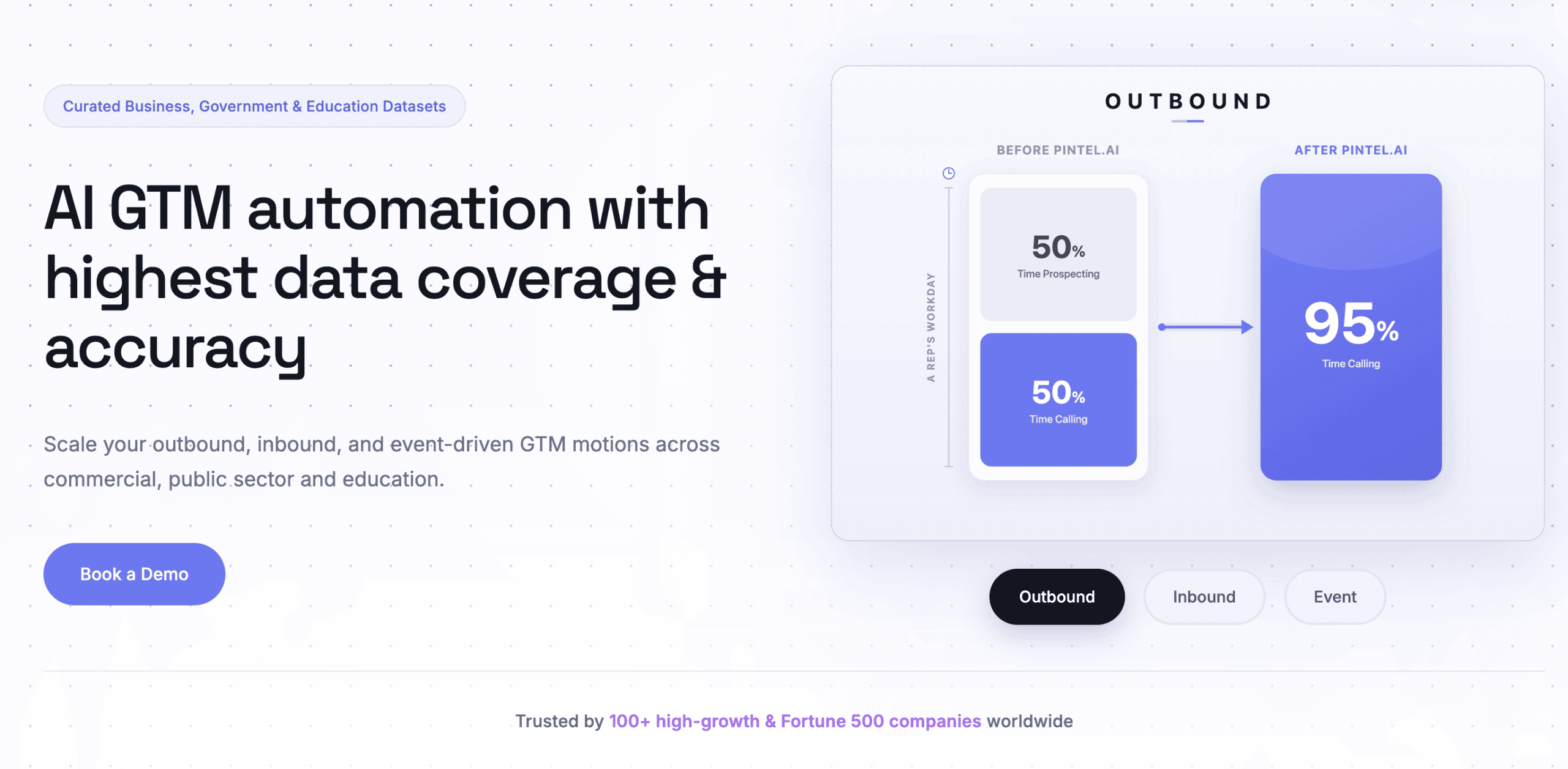
Pintel.ai is the strongest B2B contact data provider for outbound sales teams running global GTM motions. It combines multi-source contact data, waterfall enrichment across 30+ vetted providers, profile-level ICP filtering, and three-layer buying signal tracking in one platform, delivering higher accuracy and coverage than ZoomInfo, Apollo, Cognism, or Lusha for most outbound use cases.
Most teams optimize for list size. The teams booking meetings optimize for match rate.
Contact data sourcing:
- Proprietary data engines for US, EMEA, APAC, GCC, and India markets, not just LinkedIn aggregation
- Waterfall enrichment queries 30+ providers in priority order: teams previously running at 60-65% contact fill rates move above 95% (Parexel case: 37% bad data before, 95%+ match rate after)
- Verified emails and direct mobile numbers with multi-step deliverability validation
ICP filtering and signal layer:
- Profile-level ICP filtering reads the full work profile, not just title keywords, eliminating false positives that plague Apollo and LinkedIn keyword searches
- Structural signals: funding rounds, leadership hires, hiring spikes, tech migrations, etc.
- Contextual signals: third-party topic research data showing which categories a company is actively reading about across publisher networks
- Behavioral signals: website visits, content downloads, and review site engagement
Coverage and compliance:
- Global coverage across US, EMEA, APAC, and LATAM with no regional limitations
- For teams targeting public sector, education, healthcare, manufacturing, and similar verticals: reaches non-traditional data sources including government procurement records, school directories, and local business data that no standard B2B contact data tool covers
- Security and compliance: ISO 27001 certified, SOC 2 (AICPA), GDPR compliant, HIPAA compliant, CCPA compliant, and VAPT certified
Strengths: Multi-source waterfall enrichment for 95%+ match rates; profile-level ICP filtering removes false positives; three-layer signal tracking; non-traditional sources for niche verticals and global markets.
Limitation: Newer to market than ZoomInfo or Apollo, with less brand recognition in enterprise procurement lists. Common for fast-growing platforms.
Pricing: Contact sales
Best for: Global GTM teams targeting US, EMEA, APAC, and niche verticals (education, government, healthcare, manufacturing, etc.) who need high-accuracy B2B contact data with ICP-level filtering
2. ZoomInfo
ZoomInfo builds its B2B contact database through a community-contribution model, where platform users share contact details from their inboxes and networks. This produces deep coverage for large US enterprise accounts but degrades outside them. European mid-market contacts, APAC records, and niche vertical professionals are thinner because fewer users in those segments contribute to the pool.
Strengths:
- Large database for US enterprise and mid-market accounts
- Intent data layer via Bombora integration for account-level topic signals
- Established CRM integrations with Salesforce and HubSpot
Limitations:
- Community-sourcing model means records outside large US enterprise age without refresh
- ICP filtering is limited to firmographic fields (revenue, headcount, industry, title), with no profile-level analysis
Pricing: From $15,000+/yr (enterprise custom)
Best for: US enterprise sales teams already invested in the ZoomInfo ecosystem primarily targeting large US accounts
3. Apollo.io
Apollo.io bundles a B2B contact database with built-in sequencing, making it convenient for small outbound teams. Its B2B contact data accuracy declines for non-English markets, and ICP filtering stops at standard firmographic fields and basic keyword searches, which produces high false-positive rates when targeting complex or niche personas.
Strengths:
- Large self-serve database with quick setup for teams getting started fast
- Built-in sequencing for email and LinkedIn automation at SMB-friendly pricing
Limitations:
- Contact data accuracy for EMEA and APAC is inconsistent
- No proprietary signal engine: intent layer depends on job change notifications only
Pricing: From $49/mo
Best for: SMB sales teams in the US who want a combined prospecting-and-sequencing platform at a low entry cost
4. Cognism
Cognism focuses on European B2B contact data, particularly mobile-verified phone numbers for UK and Western European markets. Its Diamond data tier is verified by human callers, reducing wrong-number call rates. Coverage outside Western Europe thins out significantly, and it is not a global database for teams targeting APAC, LATAM, or the Middle East.
Strengths:
- Mobile-verified phone numbers (Diamond data tier) for UK, Germany, France, and Benelux
- GDPR-compliant data processes with documented lawful basis
Limitations:
- Coverage outside major Western European markets is inconsistent; CEE and Nordics are patchy
- No US or APAC proprietary data: not a global solution
Pricing: Contact sales
Best for: European outbound teams running phone-heavy sequences into UK and Western European markets
5. Lusha
Lusha delivers B2B contact data through a LinkedIn browser extension, pulling emails and direct dials from profiles as SDRs browse. It is fast for individual reps doing manual research but cannot build target account lists from scratch and covers only LinkedIn-indexed profiles.
Strengths:
- Quick email and phone lookup from LinkedIn profiles with low friction for SDRs
- GDPR and CCPA compliant data processes
Limitations:
- Cannot build account lists proactively: requires visiting each LinkedIn profile first
- No signal layer or ICP filtering capability
Pricing: From $49/mo
Best for: Individual SDRs who need quick contact data while browsing LinkedIn, not teams building large ICP-targeted lists from scratch
6. Hunter.io
Hunter.io specializes in finding business email addresses by domain. Input a company website and it surfaces associated email patterns and known addresses. It is a single-function tool with no phone data, no buying signals, and no ICP filtering. Teams that need more than emails will find its scope limiting quickly.
Strengths:
- Reliable domain-based email finding with built-in verification
- API access for workflow integration into existing enrichment setups
Limitations:
- No phone number data, signal layer, or ICP filtering capability
- Not a full B2B contact database: requires a separate prospecting source
Pricing: From $49/mo
Best for: Teams verifying or finding email addresses by company domain as one step in a broader enrichment workflow
7. Seamless.ai
Seamless.ai uses AI to find and verify contact information in real time, scraping LinkedIn and the web on demand. Users commonly report accuracy issues: real-time scraping produces faster access to fresh records but also more verification errors than structured enrichment pipelines. It works best for high-volume teams comfortable auditing data before sending.
Strengths:
- Real-time contact sourcing that reduces dependency on static database snapshots
- High-volume lookup capability with an unlimited-contact model
Limitations:
- Data accuracy issues are frequently reported; real-time scraping produces higher error rates than structured enrichment
- Signal layer limited to basic job change alerts
Pricing: From $65/mo
Best for: High-volume prospecting teams comfortable running a verification-on-send workflow to catch errors before outreach
8. Kaspr
Kaspr is a LinkedIn phone enrichment tool built for European markets, particularly France and the UK. It pulls direct mobile numbers and emails from LinkedIn profiles and is designed for individual SDRs. Outside France and the UK, coverage drops sharply and the tool has no ICP filtering or account list building capability.
Strengths:
- Strong direct mobile number coverage for French and UK markets
- GDPR-compliant with transparent data sourcing for European users
Limitations:
- Very limited outside France, UK, and selected EU markets
- No ICP filtering, signal layer, or ability to build account lists
Pricing: From $65/mo
Best for: European SDR teams running phone-heavy outbound primarily in France and the UK
9. LeadIQ
LeadIQ helps SDR teams capture contact data from LinkedIn Sales Navigator and push it into their CRM in one click. It is a point-and-capture tool for manual prospecting and cannot search a contact database independently or build account lists from scratch. LinkedIn Sales Navigator is required as the source.
Strengths:
- Clean Salesforce and HubSpot integration with one-click contact capture from LinkedIn
- Job change tracking for trigger-based outreach from existing account lists
Limitations:
- Requires LinkedIn Sales Navigator to function: not a standalone database
- No independent ICP search or account list building
Pricing: From $45/mo
Best for: SDR teams already using Sales Navigator who want smoother CRM data capture without manual copy-paste
10. Snov.io
Snov.io combines email finding, verification, and multi-channel outreach automation in one platform. Its email database is built from domain crawling and public web sources. Contact depth is limited compared to dedicated prospecting databases and ICP filtering is basic, making it most suitable for teams with a simple, easy-to-reach persona.
Strengths:
- Email finding and verification combined in one tool with multi-channel outreach built in
- Affordable entry price for small outbound teams
Limitations:
- Limited database depth for enterprise segments and niche industries
- No phone data, direct dial support, or meaningful signal layer
Pricing: From $30/mo
Best for: Small outbound teams that need affordable email finding and sequencing combined in one tool
11. RocketReach
RocketReach aggregates professional profile data from across the web to surface emails and direct dials. Its database covers US and English-speaking markets reasonably well but has no signal intelligence and limited ICP filtering compared to modern prospecting platforms. Accuracy outside English-speaking markets is inconsistent.
Strengths:
- Wide professional profile coverage across US markets across multiple industries
- API access for bulk lookups and custom integration workflows
Limitations:
- Contact accuracy outside US and English-speaking markets is inconsistent
- No buying signal layer or profile-level ICP filtering
Pricing: From $53/mo
Best for: Teams doing one-off professional profile lookups across multiple networks, not teams building ICP-targeted lists at scale
12. Clay
Clay is not a B2B contact database. It is an enrichment workflow builder that connects to 75+ enrichment providers through one orchestration interface. Teams use Clay to build custom contact data enrichment pipelines. But Clay requires a source list: it does not generate contacts from scratch, making it a complement to a contact database rather than a replacement.
Strengths:
- Access to 75+ enrichment providers through one interface, reducing vendor sprawl
- Highly customizable workflows for teams with complex enrichment requirements
Limitations:
- Not a contact database: requires a separate lead source to run any enrichment on
- Per-credit pricing escalates quickly at scale; setup requires technical comfort
Pricing: From $149/mo
Best for: RevOps and growth teams building custom enrichment pipelines who are comfortable managing Clay workflows
With all 12 tools profiled, here is the evaluation framework used to compare them and the decision criteria for choosing the right one for your team.
How Did We Evaluate These B2B Contact Data Providers?
This comparison is built on four evaluation dimensions specific to B2B sales teams.
Coverage depth:
Each provider’s ability to reach specific ICP segments including niche industries, non-English markets, and senior decision-makers outside large enterprise accounts. Tested against real buyer personas, not vendor-curated demo samples.
Record freshness and accuracy:
Data sourcing model (community contribution, licensed, proprietary, or crawled) and verification frequency. Accuracy patterns in non-US markets where community-sourced records age fastest.
Signal and intent layer:
Whether the provider includes actionable buying signals beyond job change alerts, and whether those signals layer structural, contextual, and behavioral types together.
Workflow integration:
Native integrations with Salesforce, HubSpot, and common sequencing tools. Data sync reliability and whether enriched contacts land correctly in CRM fields without manual mapping.
This comparison is based on first-hand platform knowledge, publicly available product information, and commonly reported user experiences. Contact each vendor directly for the latest pricing and product details.
How Do You Choose the Right B2B Contact Data Provider?
The right choice depends on where your ICP lives and how your team’s data workflow is structured.
The process of choosing B2B data providers becomes cleaner when you start with your ICP’s actual geography and industry rather than a vendor’s advertised database size. Here is how that looks in practice.
If your ICP is US enterprise, ZoomInfo covers this segment well. The community-contribution model works because US enterprise professionals refresh each other’s records frequently. The tradeoff is high cost and limited value for any team also targeting EMEA or APAC.
If your ICP is Western Europe, Cognism covers UK and major Western European markets with phone-verified contacts. For teams targeting CEE, Nordics, or broader global markets, a multi-region provider becomes necessary.
If your ICP includes niche verticals or global markets, standard B2B contact databases return blanks for education, government, healthcare, manufacturing, and similar verticals outside major English-speaking markets. Teams targeting these segments need a provider with proprietary sourcing that reaches directories and records those tools cannot index. The B2B contact data accuracy evaluation framework covers the ten specific factors that separate reliable providers from risky ones before a contract is signed.
If you want one platform for the full data workflow, stitching three tools together adds per-tool cost, data inconsistency, and ongoing maintenance. A single platform covering contact finding, enrichment, signal tracking, and CRM sync removes that complexity. This is the core advantage of end-to-end platforms like Pintel.ai’s account discovery over single-function tools.
The vendor that cannot show you its data sourcing model is hiding a coverage gap.
Final Takeaway: What the Right B2B Contact Data Actually Changes
The 12 tools in this guide range from single-function email finders to full outbound data platforms. The right one depends on where your ICP lives, not the database size the vendor advertises.
A B2B contact data provider with 95% accuracy for your ICP segment outperforms one with 200 million records at 60% accuracy for that same segment.
One team discovered 37% of their contact records were wrong or missing, and their pipeline conversion reflected that gap directly. After switching to multi-source waterfall enrichment, the same accounts started converting. According to Salesforce’s State of Sales report, sales reps spend only 28% of their time actually selling. Bad B2B contact data eats into that number with bounced emails and wrong-number calls that never had a chance.
Start with a proof of concept on your actual ICP accounts before committing to any B2B contact data contract. Any provider unwilling to run a trial on live accounts is signaling the accuracy gap you will find after you sign. For teams building a full evaluation process, the B2B database providers guide covers the structured questions to ask in a vendor POC.
FAQ: B2B Contact Data Providers
What is B2B contact data?
B2B contact data is structured information about business professionals, including verified emails, direct phone numbers, job titles, and company affiliations, used by sales teams to reach decision-makers. Quality varies significantly by provider, sourcing model, and how recently records were verified.
What makes a B2B contact data provider reliable?
A reliable B2B contact data provider verifies records regularly, uses multiple data sources to fill coverage gaps, and discloses its sourcing model. Providers relying on a single source or community contributions tend to have higher data decay rates for niche segments.
How accurate is B2B contact data from tools like ZoomInfo or Apollo?
Accuracy varies by segment. US enterprise contacts tend to be more accurate in ZoomInfo and Apollo. Accuracy drops for EMEA, APAC, and niche verticals where community-sourced records age without being refreshed by new contributors.
What is waterfall enrichment in B2B contact data?
Waterfall enrichment queries multiple B2B contact data providers in sequence. If the first returns no match, the next runs automatically. This approach consistently delivers match rates above 90%, compared to 60-80% from a single-source provider.
Which B2B contact data provider is best for small sales teams?
Apollo.io and Snov.io are common choices for small teams, offering affordable pricing and combined prospecting-and-outreach tools. For teams targeting niche verticals or global markets, accuracy tradeoffs become a real issue as list size grows.
How do I verify B2B contact data quality before buying?
Request a proof of concept on 50-100 accounts from your actual ICP segment. Check match rate, email bounce rate, and mobile phone coverage. Any B2B contact data provider unwilling to run a POC on live accounts is signaling a coverage problem.
What is the difference between a B2B contact database and an enrichment tool?
A B2B contact database lets you search for contacts matching your ICP and build lists from scratch. An enrichment tool adds missing data to a list you already have. Some platforms like Pintel.ai do both; tools like Clay and Hunter.io specialize in enrichment only.