Most B2B revenue teams have a clear GTM strategy. They know their ICP, have segmented accounts, and mapped coverage. But when it comes to execution at the quarterly level, what’s actually running, who’s working which accounts, and in what order, clarity often breaks down.
A GTM strategy defines where to play and how to win. A GTM framework provides the structure to execute consistently. But neither specifies what’s running right now, with the capacity you actually have, to turn accounts into pipeline this quarter.
That’s where a GTM plan comes in. It’s the execution layer that translates strategy and structure into sequenced, capacity-aware work. It defines which accounts get worked first, by whom, through what motion, and what success looks like when resources are limited.
This blog breaks down what a GTM plan actually is, how it differs from GTM strategy and framework, and how teams use it to turn prioritized accounts into revenue.

What a GTM Plan Actually Is
A GTM plan is a time-bound, capacity-constrained execution roadmap that defines what GTM motions run against which accounts, in what sequence, with what resources, to generate pipeline and revenue.
It includes:
Account selection and prioritization. Which specific accounts get worked this period, in what order, based on what criteria.
Motion assignment. What GTM motion runs against each account segment (outbound, inbound nurture, expansion play, partner-led).
Ownership and capacity allocation. Who does the work, how much capacity they have, and what trade-offs get made when demand exceeds supply.
Success definitions. What outcomes signal progress at each stage (meetings booked, opportunities created, pipeline generated).
A GTM plan is not your annual strategy. It’s not your tech stack. It’s not a forecast. It’s the operational blueprint that tells your team what to execute, starting now, with the people and time you actually have.
Plans are typically built quarterly, sometimes monthly for high-velocity teams. They assume strategy is set and framework is stable. They focus entirely on execution: what runs, who runs it, and how you’ll know if it’s working.
GTM Plan vs GTM Strategy vs GTM Framework
These three layers work together but solve different problems.
GTM Strategy defines your market approach: what segments you target, what value you lead with, what channels you use. Strategy is directional and changes when market conditions shift.
GTM Framework defines your execution structure: how accounts get segmented, how leads route, who owns what work, and how data flows. The framework is an operational infrastructure that changes when you scale.
GTM Plan defines what’s running right now: which accounts get worked this quarter, through what motion, by whom, in what order. Plan is tactical and time-bound, changing every quarter as capacity shifts and results inform adjustments.
You can have brilliant strategy and a well-structured framework but still miss revenue targets because your GTM plan prioritized the wrong accounts, allocated capacity poorly, or ran motions in the wrong sequence.
Why Teams With Good Strategy Still Fail Without a GTM Plan
A good strategy doesn’t guarantee revenue. Execution does. And execution without a GTM plan defaults to chaos.
No prioritization. Every account looks equally important. Reps work whatever feels hot. SDRs chase inbound volume instead of target accounts. AEs spread effort across 200 accounts instead of focusing on 20 that will close.
No sequencing. Marketing runs campaigns to segments. Sales isn’t ready to work. SDRs book meetings before AEs have capacity. Expansion plays launch before product usage signals are in place.
No capacity awareness. The plan assumes unlimited SDR time, that AEs can work 50 active opps simultaneously, that Marketing can support five campaigns at once. None of this is true, so execution fails silently.
Activity without progress. The team is busy. Emails go out. Calls get logged. Meetings happen. But pipeline doesn’t grow because the activity isn’t focused on accounts that can buy, timed to when they’re ready, or sequenced to move deals forward.
A GTM plan forces the hard decisions strategy avoids: which accounts matter most, what gets worked first, who does what, and what doesn’t happen because capacity is finite.
Inputs Required Before Building a GTM Plan
A GTM plan is only as good as the inputs it’s built on.
Account universe and ICP clarity. You need a specific list of accounts, segmented by fit, with enough data to prioritize them. If your account universe is “all companies with 100+ employees,” your plan has no boundaries.
Segmentation decisions. Accounts must be segmented before planning begins: enterprise, mid-market, SMB; high intent, moderate intent, cold. Segmentation drives motion assignment. If accounts shift between segments mid-quarter, the plan falls apart.
Revenue goals and constraints. How much pipeline do you need to generate this quarter? What constraints limit execution? Budget for paid channels, headcount limits on SDR capacity, and product readiness for certain segments.
Capacity realities. How many accounts can one AE actively work at once? How many SQLs can an SDR generate per month? Most teams overestimate capacity by 30-50%, which is why GTM plans fail.
How to Build a GTM Plan You Can Actually Execute
Building a GTM plan is a sequential process. Each step depends on the previous one.
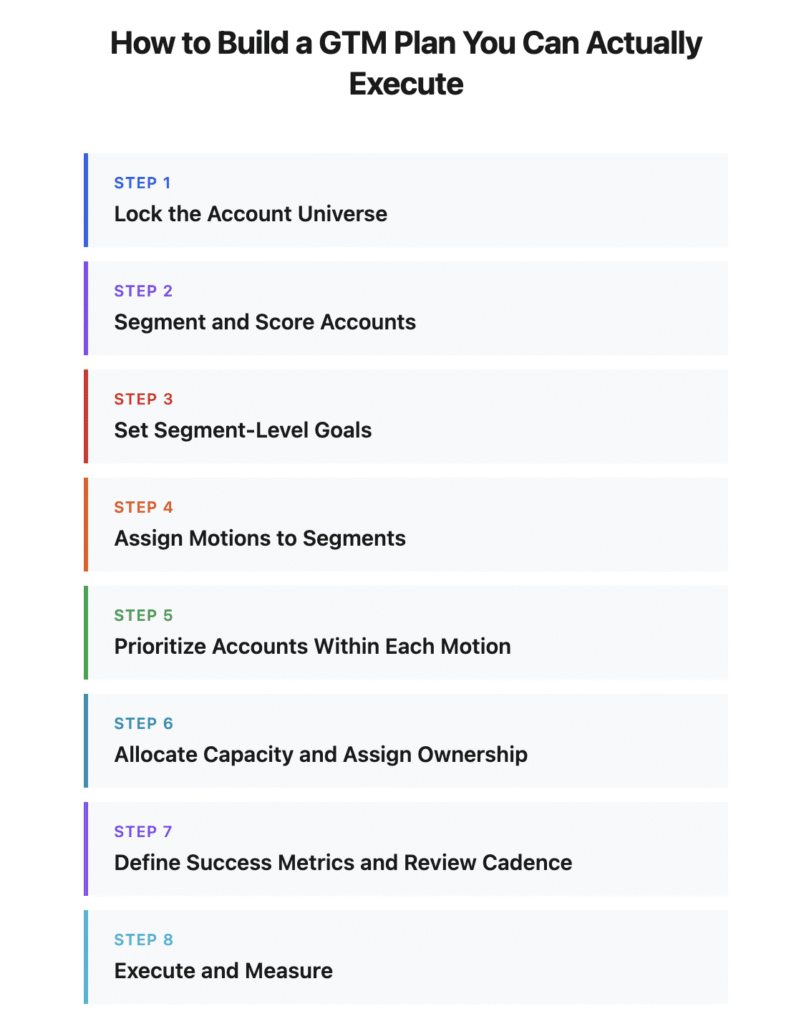
Step 1: Lock the Account Universe
Define the specific set of accounts this plan will address. Pull your full account list and apply your ICP filters. Remove accounts that don’t meet minimum fit criteria, accounts you’ve already disqualified, and accounts with active blockers.
Locking the universe prevents scope creep and forces prioritization decisions upfront.
Step 2: Segment and Score Accounts
Segment every account using your established segmentation model. Then score accounts within each segment based on propensity to close this period using intent data, engagement history, product usage (for expansion), tech stack indicators, buying committee presence, and budget cycle timing.
You should have accounts grouped into segments and ranked within each segment by likelihood to convert.
Step 3: Set Segment-Level Goals
Define what success looks like for each segment this quarter. How many meetings should you generate from enterprise accounts? How many opportunities should convert from mid-market? What expansion pipeline should come from existing customers?
Goals should be specific, time-bound, and capacity-aware. If your SDR team can generate 40 enterprise SQLs this quarter and your AE team can work 30 simultaneously, your GTM plan shouldn’t target 60.
Step 4: Assign Motions to Segments
Decide what GTM motion runs against each segment. Enterprise accounts might get multi-threaded outbound with account-based marketing support. Mid-market might get scaled outbound through SDRs. SMB might get product-led growth with sales assist on high-intent signups.
Motion assignment should match segment economics and capacity constraints.
Step 5: Prioritize Accounts Within Each Motion
Within each segment and motion, rank accounts by priority using your scoring from Step 2. Layer in strategic considerations: key accounts your exec team cares about, competitive displacements, logos that unlock new markets.
The top of each priority list gets worked first. The middle gets worked if capacity allows. The bottom gets deferred to next quarter.
Step 6: Allocate Capacity and Assign Ownership
Map your available capacity to prioritized accounts. If you have three enterprise AEs, each capable of working 15 active accounts, you have capacity for 45 enterprise accounts this quarter. Assign the top 45 from your prioritized list. The rest get queued.
Be explicit about who owns what. If an account isn’t assigned, it doesn’t get worked.
Step 7: Define Success Metrics and Review Cadence
Establish what progress looks like at each stage: emails sent, meetings booked, discovery calls completed, stage progression velocity, deal size vs target. Set weekly pipeline reviews to track progress and bi-weekly capacity reviews to reallocate resources if needed.
Document the plan in a single source that every GTM team member can reference. If it lives only in a deck no one reads, it doesn’t exist operationally.
Step 8: Execute and Measure
Run the plan. Track execution against your metrics. Review progress weekly. Identify gaps. Adjust capacity if one segment is over-performing and another is under-resourced.
The GTM plan is a hypothesis about what will drive revenue this quarter. Execution generates data that validates or invalidates that hypothesis.
How a GTM Plan Turns Accounts Into Revenue
The plan creates a direct line from account selection to revenue generation by forcing focus, sequencing, and accountability.
Focus. The GTM plan identifies the specific accounts that matter most this quarter and concentrates capacity on them. Instead of spreading effort across your entire TAM, you work the accounts most likely to convert.
Sequencing. The plan defines what happens in what order. Marketing warms accounts before SDRs reach out. SDRs qualify before booking meetings with AEs. AEs progress deals through stages with defined milestones. Sequencing prevents wasted effort.
Accountability. The plan assigns ownership. Every account has a DRI. Every motion has a goal. Every week has a review. When something isn’t working, you know who owns fixing it and what success looks like.
Without a GTM plan, accounts sit in your CRM indefinitely. With a plan, accounts move through defined motions, owned by specific people, measured against clear goals, reviewed on a regular cadence.
Where Most GTM Plans Break Down
Activity-heavy plans fail. Plans built around volume targets (send 10,000 emails, book 200 meetings) optimize for motion, not outcomes. If your plan doesn’t differentiate between a meeting with a high-fit account and a meeting with a tire-kicker, it’s not a revenue plan.
Plans that ignore signals fail. If your GTM plan doesn’t account for intent signals, product usage data, or engagement patterns, you’re running blind. You’ll waste capacity on cold accounts while high-intent accounts sit unworked.
Plans that aren’t enforced fail. A plan documented in a deck but not built into workflows, dashboards, and account assignments doesn’t get executed. Most teams don’t fail at planning. They fail at keeping execution aligned once the plan meets real accounts, real signals, and real capacity constraints.
Plans built without capacity constraints fail. If your plan assumes SDRs can generate infinite SQLs or AEs can work unlimited accounts, it’s not grounded in operational reality.
Common GTM Plan Mistakes
Ignoring capacity limits. The plan targets 500 accounts but the team can realistically work 50. When execution falls short, leadership blames the team instead of the plan.
Treating plans as static documents. The GTM plan gets built, presented, approved, and filed. No one reviews it weekly. No one tracks progress against it. By the end of the quarter, the plan bears no resemblance to what actually ran.
Not defining success upfront. The plan says “increase enterprise pipeline” but doesn’t define how much, by when, from how many accounts. Without clear success criteria, you can’t tell if you’re winning or losing until the quarter ends.
Skipping prioritization. Every account in the segment gets the same treatment. Prioritization forces hard choices. Without it, you execute democracy, not strategy.
How to Tell If Your GTM Plan Is Working
You don’t have to wait until quarter-end to know if your plan is driving revenue.
Execution consistency. Are reps working the accounts assigned to them? Are motions running as designed? Is activity concentrated on prioritized accounts or spread across the entire universe?
Pipeline quality. Are the opportunities being created from target accounts or random inbound? Are deal sizes tracking to segment expectations? Are opportunities progressing through stages at the velocity you modeled?
Capacity utilization. Are reps working at the capacity level the plan assumed? If you planned for 15 active accounts per AE but most are working 8, you have a capacity problem.
Leading indicator performance. Are you hitting the activity milestones that lead to pipeline? Meetings booked per week, discovery calls completed, proposals sent.
Early warning signs of failure include execution inconsistency (reps working off-plan), lagging activity metrics, pipeline creation from non-target accounts, and capacity mismatches.
When to Rebuild vs Adjust a GTM Plan
Adjust the plan when: Capacity shifts mid-quarter, one motion over-performs and another under-performs, account priorities change due to strategic decisions, or execution is behind but the plan structure is sound.
Rebuild the plan when: Your ICP changes materially, your GTM strategy changes, your framework breaks, or the market shifts dramatically.
Most problems don’t require a rebuild. They require better execution of the existing plan or tactical adjustments to reflect new information.
Turning Accounts Into Revenue Starts With a Plan
Strategy tells you where to play. Framework gives you the structure to execute. But neither turns accounts into revenue without a GTM plan that defines what’s running, who’s running it, and what success looks like.
A GTM plan forces the decisions most teams avoid: which accounts matter most, what gets worked first, how capacity gets allocated, what gets deferred when resources run out.
Without a plan, you have activity. With a plan, execution becomes measurable. You know what’s working, what’s not, and what to adjust.
The teams that consistently hit revenue targets aren’t the ones with the best strategy or the most sophisticated tech stack. They’re the ones that plan execution deliberately, review progress honestly, and adjust quickly when reality diverges from the plan.
Build the plan. Execute it. Measure it. Adjust it. Repeat every quarter.
That’s how accounts become revenue.
Frequently Asked Questions About GTM Plans
How long should a GTM plan realistically cover?
Most GTM plans work best on a quarterly horizon. Annual plans are too abstract, and monthly plans create thrash. Quarterly gives enough time to execute, measure, and adjust without losing focus.
Who should own the GTM plan?
Ownership typically sits with RevOps or Revenue Leadership, not Marketing or Sales alone. The plan cuts across teams, so it needs a neutral owner who can enforce priorities and resolve trade-offs.
Can one GTM plan support multiple products?
Only if the products share the same ICP, buying motion, and sales cycle. If products require different motions or buyers, they should have separate GTM plans, even if they share a broader strategy.
What’s the biggest early signal a GTM plan is failing?
When reps consistently work off-plan accounts or avoid assigned priorities. That usually means the plan doesn’t reflect reality, capacity, or incentives.
Should compensation plans align with the GTM plan?
Yes. If incentives reward activity or volume that contradicts the plan’s priorities, execution will drift immediately. Compensation doesn’t need to change every quarter, but it must not work against the plan.
How detailed should a GTM plan document be?
Detailed enough that a new rep can understand what to work, in what order, and why—but simple enough to review weekly. If it takes 30 minutes to explain, it’s too complex to execute.