B2B sales has never been more competitive. Reps are expected to build pipeline faster, reach the right buyers earlier, and personalize every touchpoint while managing a growing list of accounts. That pressure has made sales intelligence tools a core part of the modern GTM stack.
At their core, these platforms help sales teams answer three critical questions: Who should we be targeting? Who are the real decision makers? And when is the right moment to reach out?
Without reliable data, outbound becomes a numbers game. With the right sales intelligence software, it becomes a precision motion where your team focuses energy on accounts that are actually likely to convert.
The challenge is that the market is crowded. Every platform claims to offer the most accurate data, the deepest signals, and the smoothest integrations. This guide cuts through that noise and gives you a clear, practical breakdown of what to look for and which tools are worth evaluating.
What Are Sales Intelligence Tools?
Sales intelligence tools are platforms that help B2B sales teams identify target accounts, find decision makers, detect buying signals, and prioritize prospects using company and contact data. They sit at the foundation of modern outbound programs, turning raw data into actionable pipeline.
Top Sales Intelligence Tools at a Glance
If you are evaluating platforms, the table below provides a quick overview of the top sales intelligence tools and what they are best known for.
| Tool | Best For | Key Strength | Limitations |
|---|---|---|---|
| Pintel.ai | GTM automation and signal-based outreach | Combines ICP identification, buying signals, and workflow automation | Requires a defined ICP and signals |
| ZoomInfo | Enterprise-scale outbound | Massive database with broad coverage | High price point; can feel like data overload |
| Apollo.io | High-volume SDR teams | All-in-one data and sequencing at low cost | Data quality inconsistency at scale |
| Cognism | EMEA-focused sales teams | Phone-verified numbers, strong compliance | Smaller North American database |
| Lusha | Individual contributors | Fast, lightweight contact lookup | Limited workflow and automation features |
| Clearbit | HubSpot-centric inbound teams | Real-time enrichment and website identification | Reduced standalone focus post-HubSpot acquisition |
| 6sense | Enterprise ABM programs | Predictive intent modeling and account scoring | Complex implementation; enterprise pricing |
Note: This comparison is based on publicly available product information, documentation, and user reviews at the time of writing.
What Sales Intelligence Tools Do
Modern B2B sales teams rely on sales intelligence tools to identify the right prospects faster. But not all platforms solve the same problem. Understanding the core functions helps you evaluate which capabilities your team actually needs.
These platforms aggregate, enrich, and surface data that would otherwise take your team hours to research manually. Here is what they typically provide:
- Contact and company data — Verified emails, phone numbers, job titles, company size, revenue, and technology stack information
- Decision maker identification — Surfaces the right personas within target accounts so reps are not wasting time reaching the wrong contacts
- Buying signal detection — Flags when a company is actively researching solutions like yours through job postings, funding news, web activity, or intent data
- Data enrichment — Automatically fills gaps in your CRM records with up-to-date firmographic and contact information
- Prospect prioritization — Scores and ranks accounts based on fit, intent, and timing so reps know where to focus first
- Account research — Gives context on an account’s growth stage, tech stack, recent news, and hiring patterns before outreach
Together, these capabilities turn cold prospecting into a research-backed process. The result is less time wasted on bad-fit accounts and more time spent engaging prospects who are ready to buy.
Understanding what sales intelligence software does makes it easier to evaluate which platform solves your specific problem. Next, let’s look at the capabilities that matter most when choosing between them.
Key Capabilities to Look for in Sales Intelligence Tools
Not every sales intelligence platform is built the same way. Some focus on contact database depth. Others lead with intent signals or workflow automation. Knowing what to prioritize helps you avoid paying for features you will not use.
Here are the capabilities worth evaluating carefully:
Contact and Company Data
- Look for verified, regularly refreshed data rather than static databases that have not been updated in months
- Coverage matters: does the platform have strong data in your target geographies and industries?
- Check mobile number availability if your team does direct dials
Buying Signals and Intent Data
- B2B intent data tells you which companies are actively researching solutions in your category
- Look for signals beyond just web tracking. Job postings, funding rounds, technology changes, and leadership hires are all strong buying indicators
- Third-party intent from publisher networks and first-party signals from your own website work best when combined
Data Enrichment
- Can the tool automatically enrich new leads coming into your CRM?
- Does it clean and update existing records, or only work on new ones?
- Waterfall enrichment across multiple providers improves contact coverage and reduces gaps
CRM Integrations
- Native integrations with Salesforce, HubSpot, and other major CRMs are non-negotiable for most teams
- Check whether sync is bidirectional and real-time, or batch-based
- Workflow triggers such as enriching a record when a company raises funding add significant operational value
Prospect Prioritization
- The best sales intelligence platforms do not just surface data. They help you decide what to act on first
- ICP scoring models, account tiering, and signal-based ranking reduce time spent on manual triage
Workflow Automation
- Modern sales intelligence tools are moving beyond data delivery into workflow execution
- Look for the ability to trigger automated sequences, update CRM fields, and route leads based on intelligence rather than surfacing information for reps to act on manually
Understanding these capabilities makes it easier to evaluate which sales intelligence platform fits your motion. Next, let’s look at the top tools used by modern B2B sales teams today.
Top Sales Intelligence Tools for Modern B2B Sales Teams
Several platforms have emerged as leaders in this space, each with different strengths depending on your team size, go-to-market motion, and data needs. While many sales intelligence tools focus primarily on contact databases, newer platforms like Pintel combine account intelligence with signal detection and workflow automation, representing a meaningful shift in how revenue teams operate.
Here is a breakdown of the most widely used options.
Pintel.AI
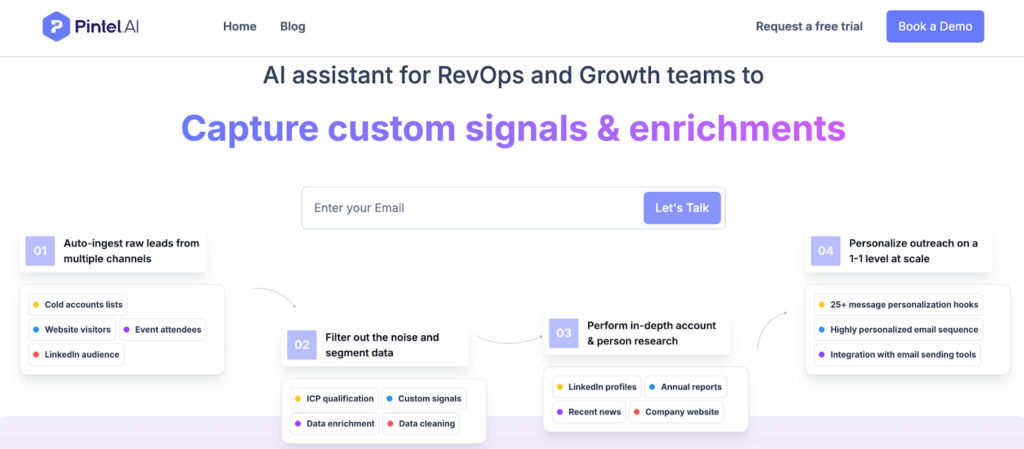
Pintel is a GTM automation platform that combines account intelligence, buying signal detection, and AI-powered workflow execution. Rather than simply delivering data for reps to act on manually, Pintel connects prospect identification, enrichment, and personalized outreach into a single automated motion.
Key capabilities
- Identifies ICP-fit accounts using firmographic, technographic, and behavioral data
- Surfaces decision makers within target accounts with verified contact details
- Detects buying signals including hiring activity, funding events, technology changes, and other intent indicators
- Supports waterfall enrichment across multiple data sources to maximize contact coverage and accuracy
- Pushes enriched accounts and contacts directly into CRM systems including Salesforce and HubSpot
- Generates personalized outreach messages for email, LinkedIn, and call preparation tracks
- AI agents allow users to describe prospecting workflows in natural language, and the platform generates and executes them automatically
Data coverage
- Global company and contact data coverage across industries and markets
- Supports prospect discovery at scale without geographic restriction
Accuracy
- Uses verified contact data to reduce bounce rates and improve deliverability
- Waterfall enrichment across multiple sources improves reliability when a single provider has gaps
Ease of use
- Users interact with AI agents using simple natural language prompts
- Workflows are created and executed automatically with minimal manual configuration
- Designed for RevOps, sales, marketing and GTM teams without requiring technical setup
Best for
Revenue teams that want to move beyond static databases and combine prospect identification, signal detection, enrichment, personalized outreach, and workflow automation in a single platform rather than managing multiple disconnected point solutions.
ZoomInfo
ZoomInfo is one of the largest B2B contact and company databases on the market. It offers broad coverage across industries and geographies, with strong intent data capabilities through its acquisition of Bombora.
Key capabilities
- Massive contact and company database with frequent data refreshes
- Intent signals powered by Bombora’s publisher network
- Website visitor identification
- Native integrations with major CRM and sales engagement platforms
- Conversation intelligence through Chorus
Best for
Large enterprise sales teams that need wide data coverage and are already investing heavily in outbound at scale.
Apollo.io
Apollo has grown quickly as an all-in-one sales intelligence and engagement platform. It combines a large contact database with built-in sequencing capabilities, making it popular with high-volume outbound teams.
Key capabilities
- Large B2B contact database with email and phone data
- Built-in email sequencing and outreach automation
- AI-assisted email writing
- Lead scoring and filtering by detailed criteria
- CRM sync with Salesforce and HubSpot
Best for
SDR teams and early-stage companies that need both prospecting data and outreach tooling in a single, cost-effective sales intelligence platform.
Cognism
Cognism is a European-focused sales intelligence platform known for its emphasis on GDPR compliance and verified mobile phone numbers. It is particularly strong for teams targeting EMEA markets.
Key capabilities
- Phone-verified mobile numbers with strong EMEA coverage
- GDPR and CCPA compliance framework
- Intent data through Bombora partnership
- Technographic and firmographic filters
- CRM integrations with Salesforce, HubSpot, and Outreach
Best for
Sales teams with significant European pipeline who need compliant, high-quality mobile data for direct outreach.
Lusha
Lusha is a lightweight prospecting tool focused on fast, accurate contact data retrieval. It is known for its browser extension, which lets reps pull contact information directly from LinkedIn profiles.
Key capabilities
- Browser extension for LinkedIn and company websites
- Contact and company data with email and phone coverage
- Basic CRM integrations
- Team management and usage tracking
- API access for data enrichment workflows
Best for
Individual contributors and smaller teams that need quick contact data without a complex sales intelligence platform.
Clearbit (now part of HubSpot)
Clearbit built its reputation as a best-in-class data enrichment platform. Following its acquisition by HubSpot, it is now deeply integrated into the HubSpot ecosystem while still offering API access for broader use cases.
Key capabilities
- Real-time company and contact enrichment via API
- Website visitor identification and de-anonymization
- Form shortening using pre-filled enrichment data
- Firmographic and technographic data
- Native HubSpot integration
Best for
HubSpot-centric teams that want to enrich inbound leads automatically and improve conversion across the funnel.
6sense

6sense is a revenue AI platform that focuses heavily on account-level intent signals and predictive analytics. It is built for enterprise teams running account-based go-to-market programs.
Key capabilities
- Predictive account scoring based on buying stage modeling
- Intent data aggregated from owned and third-party sources
- Account engagement tracking across channels
- AI-driven outreach recommendations
- Integration with Salesforce, Marketo, and major sales engagement tools
Best for
Enterprise GTM teams running sophisticated ABM programs that need deep intent signals and multi-channel orchestration.
When Sales Teams Need Sales Intelligence Tools
Not every team reaches for sales intelligence software at the same stage. Here are the situations where investing in a sales intelligence platform delivers the most immediate value:
- Scaling outbound prospecting — When manually building prospect lists becomes a bottleneck and the team needs a repeatable, data-driven way to identify and contact new accounts
- Identifying decision makers inside target accounts — When deals stall because reps are stuck talking to the wrong contacts and need a faster way to map buying committees
- Detecting buying signals — When the team is reaching out reactively rather than timing outreach to moments when accounts are actively in-market
- Enriching CRM records — When poor data quality is causing missed follow-ups, routing errors, and unreliable forecasting
- Prioritizing high-value prospects — When reps are spending equal time on all accounts regardless of ICP fit or purchase intent
- Entering new markets — When expanding into a new segment or geography and the team lacks existing account intelligence to build pipeline from
If your team is experiencing any of these friction points, a sales intelligence platform will have a clear, measurable impact on pipeline velocity.
How to Choose the Right Sales Intelligence Tool
With so many platforms available, the decision comes down to matching capabilities to your specific go-to-market motion. Here is a structured framework to guide your evaluation:
Data Accuracy
- Ask vendors for accuracy benchmarks and independent validation
- Request a sample dataset from your actual target market to test quality before committing
- Check how frequently data is refreshed and how quickly stale records are removed
Coverage
- Does the platform have strong coverage in your target geographies, industries, and company sizes?
- European coverage varies significantly between US-headquartered sales intelligence platforms
- SMB and mid-market data quality often differs from enterprise coverage within the same database
Buying Signals and Intent Data
- Does the platform offer B2B intent data, or only static contact information?
- How are signals sourced: first-party, third-party publisher networks, or behavioral triggers?
- Can you customize which signals are most relevant to your product category?
Integration with CRM
- Verify native integration depth, not just available integration
- Check whether data flows bidirectionally and in real time
- Understand what happens to existing records: are they updated, or only new records enriched?
Ease of Use
- High-powered sales intelligence software is only valuable if reps actually use it
- Evaluate onboarding time and whether the tool fits naturally into existing workflows
- Browser extensions and CRM embeds tend to drive higher adoption than standalone portals
Workflow Automation
- Can the tool trigger actions based on signals, or does it only surface data for reps to act on manually?
- Automation that connects intelligence to outreach reduces the gap between insight and action
Pricing Scalability
- Understand how pricing scales as your team grows
- Some platforms charge per seat, others per record or per credit
- Factor in total cost of ownership including implementation and ongoing data management
Once you have evaluated these criteria against your specific needs, shortlist two or three platforms for a live pilot. Real-world testing against your ICP will reveal gaps that demos will not.
Limitations of Traditional Sales Intelligence Tools
Most sales intelligence platforms on the market today were built around a core assumption: give reps better data, and they will close more deals. That assumption has held up, but it is also showing its age.
Here are the most common limitations teams run into with legacy sales intelligence software:
- Static contact databases — Many platforms maintain large databases that are refreshed infrequently. Contacts change jobs, companies pivot, and by the time a rep reaches out, the data is already outdated
- Outdated information — Stale email addresses and incorrect phone numbers do not just waste time. They hurt sender reputation and deliverability over time
- Manual prospect research — Traditional sales intelligence tools surface data but leave interpretation and prioritization to the rep. That creates inconsistent execution and over-reliance on individual judgment
- Disconnected workflows — Most platforms hand off data to the rep and stop there. The rep then has to export lists, build sequences in a separate tool, and manually update CRM records, creating friction at every step
- Limited signal detection — Many databases track firmographic data well but struggle to capture real-time buying signals that indicate urgency or purchase intent
The gap between data delivery and workflow execution is where most traditional tools fall short. Modern sales intelligence platforms are beginning to close that gap by combining data, signals, and automation, reducing the manual steps between identifying a prospect and starting a conversation.
Conclusion
Sales intelligence tools have become a foundational layer of the modern B2B go-to-market stack. They give teams the data, signals, and context needed to identify the right accounts, reach the right people, and engage at the right time, all of which directly translates into more qualified pipeline.
The best sales intelligence platforms go beyond contact databases. They surface buying intent, enrich CRM records automatically, and increasingly connect intelligence to workflow automation, reducing the distance between a prospect signal and a meaningful outreach touchpoint.
For GTM leaders evaluating their options, the decision comes down to fit: which platform has the strongest data coverage for your market, the most relevant intent signals for your category, and the workflow integrations that match how your team actually operates.
The evolution of top sales intelligence tools is moving toward platforms that do not just tell you who to call. They help you understand why, and make it easier to act on that understanding at scale. Teams that combine data quality with buying signal detection and automation will consistently outpace those still relying on static lists and manual research.
FAQs About Sales Intelligence Tools
What are sales intelligence tools?
Sales intelligence tools are software platforms that help B2B sales teams identify, research, and prioritize prospects. They provide contact and company data, buying signals, firmographic and technographic information, and in some cases, workflow automation to act on that data more efficiently.
What is the difference between sales intelligence and sales engagement tools?
Sales intelligence tools focus on data: identifying who to target and when. Sales engagement tools focus on execution: managing outreach sequences, emails, and calls. Many modern sales intelligence platforms are beginning to combine both functions, reducing the need to use separate tools for data and outreach.
How do sales intelligence tools find contact data?
Most platforms build their databases by aggregating data from public sources, professional networks, web crawls, third-party data providers, and user-contributed data from their own customer base. Quality varies significantly across providers, which is why verifying accuracy against your specific ICP before purchasing is important.
What should sales teams look for in a sales intelligence platform?
The most important factors are data accuracy and coverage in your target market, quality of intent and buying signal data, CRM integration depth, ease of adoption by the sales team, and whether the platform can automate workflow steps or only deliver data. Teams with more mature GTM motions should also evaluate whether the platform supports account scoring and signal-based prioritization.
Are sales intelligence tools worth the investment?
For teams running any volume of outbound, the answer is typically yes, provided the platform matches your ICP and geography. The ROI comes from reducing research time per rep, improving targeting precision, and increasing connect rates by reaching out at the right moment. The key is to measure pipeline impact directly rather than relying on activity metrics alone.