Modern outbound teams face a different environment than five years ago. Buyers are harder to reach, data is more accessible, and execution demands precision across multiple channels. The sales prospecting methods you choose and the techniques you use to execute them determine whether your outbound motion produces consistent pipeline or inconsistent noise.
A method is your approach: email, cold calling, LinkedIn, account-based. A technique is how you improve execution within that method: timing signals, segmentation, multi-threading. Understanding both levels matters because most teams default to tactics without considering whether they’re using the right sales prospecting methods for their market.
This guide covers the core sales prospecting methods that work in modern B2B, the prospecting techniques that improve performance within each method, and how to choose the right approach for your team’s structure and market.
What Makes Modern Prospecting Different
The fundamentals of prospecting haven’t changed, but the execution environment has shifted in ways that make sales prospecting methods selection critical.
Data Availability Has Increased
B2B databases now provide email addresses, direct dials, and org charts at scale. This democratizes access but creates a new problem: your prospects receive 5-10x more outreach than they did five years ago.
The implication: Targeting precision now determines success more than message quality. Most teams still operate as if data scarcity is the constraint. It’s not. Prioritization discipline is.
Multi-Channel Is Now Expected
Buyers don’t live in one channel. They check email sporadically, browse LinkedIn between meetings, and answer calls based on caller ID recognition.
The challenge isn’t channel presence. It’s channel sequencing. Email first builds context. LinkedIn adds credibility through visible profile information. Calls work better after both have established familiarity. Most teams randomize this sequence instead of engineering it deliberately.
Buyer Attention Windows Have Shortened
Decision-makers receive 50-100+ prospecting emails per week. They scroll past most LinkedIn messages. Cold calls often go to voicemail. The window to capture attention is measured in seconds, not minutes.
The operational consequence: Your first touchpoint now determines sequence completion rates. If your initial email or LinkedIn message fails to signal relevance in the first line, prospects never see touchpoints 2-6. Most teams optimize late-stage touches while ignoring that 70% of recipients never make it past the first one.
Precision Targeting Matters More
Broad targeting used to be acceptable when outreach volume was lower. Now, spraying the same message to 1,000 contacts produces low response rates and damages sender reputation.
The targeting paradox: Teams with access to more data prospect less precisely. They pull larger lists assuming volume compensates for weak fit criteria. The inverse is true. Sales prospecting methods paired with tight segmentation outperform high-volume approaches by 3-5x on cost-per-meeting.
Method Choice Affects Everything Downstream
Your prospecting method determines your workflow, your CRM structure, your team capacity, and your reporting. Choosing cold calling as your primary method requires different infrastructure than choosing email or account-based prospecting.
Most teams adopt sales prospecting methods without considering operational fit. They start LinkedIn prospecting without the bandwidth to manage response volume, or they launch cold calling without the tools to track outcomes properly.
Method choice is infrastructure design, not just tactical preference.
Core Sales Prospecting Methods
Each prospecting method serves different markets, deal sizes, and team structures. Understanding when each sales prospecting method works best prevents wasted effort.
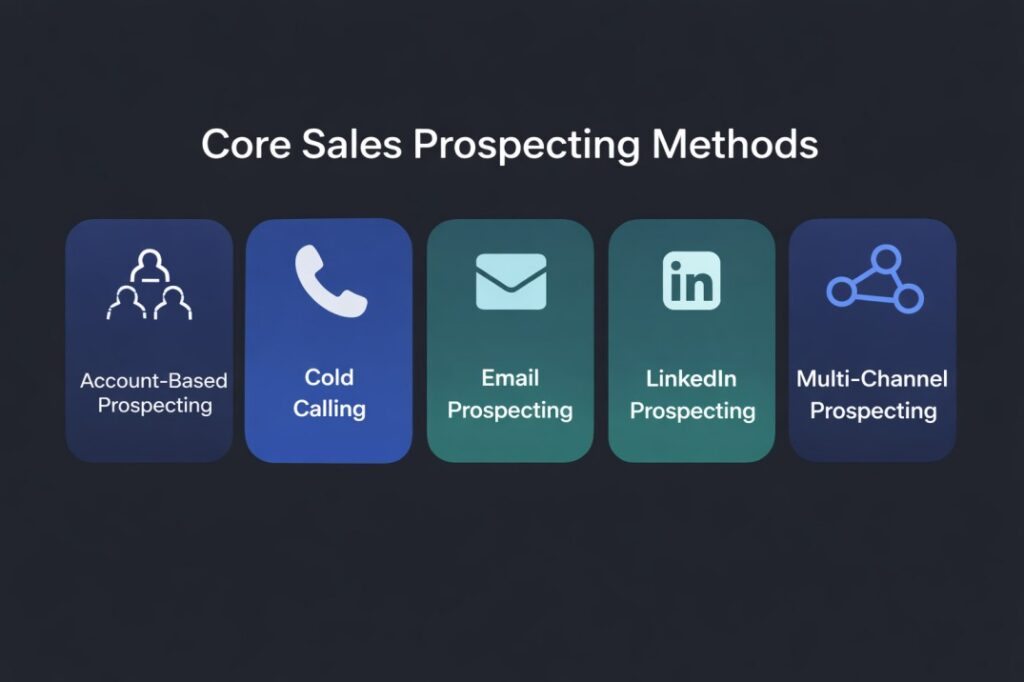
Account-Based Prospecting
Account-based prospecting focuses on specific target accounts rather than broad contact lists. You identify high-value accounts, map key stakeholders, and coordinate outreach across multiple contacts.
When it works best: Ideal for enterprise sales with $50K+ ARR contract values where deals involve multiple decision-makers and longer sales cycles. This is one of the most resource-intensive sales prospecting methods but provides structure to manage buying committee complexity.
Common execution errors: Teams confuse account-based prospecting with account-based marketing. Prospecting identifies and prepares accounts for outbound. Another mistake is mapping too many contacts upfront. Start with 1-2 key contacts per account, validate interest, then expand.
How it fits into workflow: Requires research time before outreach. SDRs need account context, org charts, and segmentation data. Without proper infrastructure, this becomes manual research that doesn’t scale.
Account-based prospecting requires planning and coordination. Cold calling, by contrast, emphasizes volume and speed.
Cold Calling
Cold calling remains effective in markets where decision-makers answer phones and value direct conversation. Works particularly well in mid-market and SMB segments where gatekeepers are less prevalent.
When it works best: This sales prospecting method works when your ICP includes roles that prefer phone conversations. Often includes operations leaders, finance executives, and senior managers in traditional industries. Also effective when products require real-time objection handling.
Common execution errors: Calling without context wastes time on unqualified prospects. Another error is treating cold calling as standalone. It works best as part of multi-channel sequences where email or LinkedIn provides context.
How it fits into workflow: Requires consistent daily blocks when prospects answer (typically 8-10am and 4-6pm in their timezone). Needs call tracking, script frameworks, and ongoing coaching.
Email Prospecting
Email prospecting is the most scalable outbound method when executed with proper segmentation and messaging discipline. Allows you to reach many prospects efficiently while maintaining personalization at scale.
When it works best: Works across most B2B segments but especially effective for mid-market and SMB where buying cycles are shorter. Scales better than cold calling and provides more context than LinkedIn messages. Ideal when value propositions are clear and communicable concisely.
Understanding response decay: Email response rates follow a predictable decay curve across touchpoints. Touch 1 typically generates 1-3% response rate. Touch 2 adds another 0.5-1%. By touch 6, incremental response drops below 0.2%. This means 80% of responses come from the first three emails.
The capacity implication: An SDR sending 200 emails daily should expect 2-6 replies, requiring 1-2 hours of response handling. This limits effective capacity to 150-200 new touches daily when reply management is factored in. Teams that model capacity based on send volume alone under-resource reply handling.
Common execution errors: Generic messaging that doesn’t reflect segmentation produces low reply rates. Poor subject lines get ignored. Emails longer than 100 words rarely get read in full.
How it fits into workflow: Requires strong list hygiene, sequence management, and reply handling. CRM should track which emails were sent, when, and responses. High bounce rates damage sender reputation, so validate email addresses before sending.
LinkedIn Prospecting
LinkedIn prospecting leverages platform visibility and context to reach decision-makers who are active on the network. Works particularly well for senior executives who screen email but remain accessible on LinkedIn.
When it works best: Most effective targeting roles that actively use LinkedIn: VPs of Sales, CMOs, Heads of Product, and executives in tech-forward companies. This outbound prospecting technique works when your brand or profile adds credibility through visible background and connections.
Common execution errors: Treating LinkedIn like email gets messages ignored. The platform rewards conversational, contextual messaging. Generic connection requests produce low acceptance rates. Over-automation creates compliance risk as LinkedIn limits and flags automated activity.
How it fits into workflow: Works best as complement to email, not replacement. Use it to reach executives who don’t respond to email or add second touchpoints for high-priority accounts. Requires daily activity management due to platform limits on connection requests and messages.
Multi-Channel Prospecting
Multi-channel prospecting combines email, phone, LinkedIn, and sometimes direct mail into coordinated sequences. Increases visibility across channels your prospects actually use.
When it works best: Most effective in competitive markets where single-channel outreach gets lost. If prospects receive dozens of prospecting emails daily, adding phone and LinkedIn increases breakthrough chances. Works when deal sizes ($100K+ ARR) justify additional effort.
Channel capacity and sequencing logic: Multi-channel execution constrains SDR capacity differently than single-channel. An SDR running email-only sequences can manage 200-300 daily touches. Adding LinkedIn drops this to 120-150 touches (due to platform limits and personalization requirements). Layering in calls reduces capacity further to 80-100 total touches as call blocks consume 2-3 hours daily.
The sequencing implication: Channel order matters for cost efficiency. Email first (lowest cost per touch, $0.10-$0.20) establishes context. LinkedIn second (medium cost, $0.50-$1.00) for accounts showing email engagement. Calls last (highest cost, $3-$5 per attempt) for validated interest only. Teams that randomize this sequence waste capacity on high-cost channels before confirming fit.
Common execution errors: Inconsistent execution across channels. Teams launch multi-channel sales prospecting methods but fail to maintain discipline. Messaging inconsistency across channels confuses prospects. Over-touching risks overwhelming prospects.
How it fits into workflow: Requires sequence orchestration. CRM or sales engagement platform should automate touchpoint timing and track what’s been sent. Needs clear rules about channel prioritization based on ICP tier or deal size.
Prospecting Method Comparison at a Glance
Choosing the right sales prospecting method requires matching your operational reality to the method’s requirements. This framework helps you evaluate which sales prospecting methods fit your team quickly.
Account-Based Prospecting
Best for deal size: Large, enterprise-level contracts involving multiple stakeholders
SDR maturity required: High (requires research discipline and strategic thinking)
Infrastructure complexity: High (needs account hierarchies, contact mapping, and coordinated multi-touch execution)
Scalability level: Low (focuses on a limited number of high-value accounts)
Risk if executed poorly: Wasted research effort, over-mapping contacts before validation, territory conflicts
Cold Calling
Best for deal size: Mid-market deals where direct conversations accelerate qualification
SDR maturity required: Medium to High (requires objection handling and confidence)
Infrastructure complexity: Medium (needs call tracking, structured coaching, and workflow discipline)
Scalability level: Medium (high daily activity, but limited by connect rates and call blocks)
Risk if executed poorly: Low connect rates, poor prospect experience, SDR burnout from rejection
Email Prospecting
Best for deal size: Small to mid-market deals where value can be communicated concisely
SDR maturity required: Low to Medium (structured sequences reduce skill dependency)
Infrastructure complexity: Low to Medium (needs list hygiene, sequence automation, and deliverability monitoring)
Scalability level: High (supports large daily touch volume with controlled personalization)
Risk if executed poorly: Sender reputation damage, spam complaints, low reply rates from weak segmentation
LinkedIn Prospecting
Best for deal size: Mid-to-large deals where executive visibility and credibility matter
SDR maturity required: Medium (requires conversational writing and profile optimization)
Infrastructure complexity: Low (platform constraints naturally limit over-automation)
Scalability level: Low (personalized engagement limits daily volume)
Risk if executed poorly: Account restrictions, low connection acceptance rates, time wasted on unresponsive contacts
Multi-Channel Prospecting
Best for deal size: Larger or strategically important accounts where visibility across channels increases conversion probability
SDR maturity required: High (requires coordination across channels and adaptive execution)
Infrastructure complexity: High (needs cross-channel orchestration, unified activity tracking, and prioritization rules)
Scalability level: Medium (balances reach with higher coordination overhead)
Risk if executed poorly: Channel oversaturation, inconsistent messaging, operational complexity without return
Decision rule: Start with the simplest sales prospecting method your deal size and team maturity justify, then add complexity only when your infrastructure supports coordinated execution. Teams that jump to multi-channel or account-based prospecting without proper systems create chaos, not a pipeline.
Prospecting Techniques That Improve Performance
Techniques sit inside methods. They’re tactical improvements that make your chosen sales prospecting methods more effective.
Layering Fit and Timing Signals
Fit signals tell you if an account matches your ICP. Timing signals tell you if they’re ready to buy now. Layering both improves conversion because you’re reaching the right accounts at the right time.
Fit signals: Revenue range, employee count, technology stack, organizational structure, funding stage.
Timing signals: Recent funding announcements, leadership hires, job postings indicating growth, technology migrations, market events affecting their industry.
Prospecting techniques that combine fit and timing produce 2-3x higher response rates than fit alone. You’re targeting companies that should buy now, not just companies that could buy eventually.
Segmentation-Based Personalization
Generic personalization doesn’t work. Mentioning a prospect’s company name or recent LinkedIn post feels superficial. Segmentation-based personalization is different because it’s rooted in how you built your list.
Personalize at the segment level, not the contact level. If you’re prospecting fintech companies, reference fintech-specific challenges. If targeting Series B startups, reference scaling challenges common at that stage.
This scales because you write one message per segment, not per contact. Five SDRs can maintain 10-15 segment-specific messages but can’t maintain 500 individually personalized emails.
Trigger-Based Outreach
Trigger-based outreach means prospecting based on specific events rather than schedules. Instead of sending emails because it’s Tuesday, you send them because something happened at the target account.
Common triggers: Leadership changes, funding rounds, product launches, office expansions, negative competitor reviews, layoffs indicating cost pressure.
These prospecting techniques improve relevance because your message connects to real-time events. The operational challenge is trigger detection. You need systems that alert you when triggers occur, not manual monitoring.
Multi-Threading Within Accounts
Multi-threading engages multiple contacts within the same account rather than focusing on a single champion. It reduces risk and accelerates deals because you’re not dependent on one person.
Works best in enterprise prospecting where buying committees are large. Instead of prospecting just the VP of Sales, also prospect the Head of Revenue Operations, Director of Sales Enablement, and Chief Revenue Officer.
Execution considerations: Don’t reach out to everyone simultaneously. Start with one or two contacts, gauge interest, then expand. Coordinate messaging so multiple SDRs don’t send conflicting messages. Track who’s engaged in your CRM.
Structured Follow-Up Cadences
Most deals don’t close on the first touch. Structured follow-up cadences define how many times you’ll reach out, through which channels, and on what schedule.
A strategic cadence for a $75K deal might sequence:
Day 1: Email (value hypothesis)
Day 3: LinkedIn view + connection request
Day 5: Email (use case example from similar company)
Day 7: Phone call (if email opened but not replied)
Day 10: Email (analyst report or third-party validation)
Day 14: Final email (permission to close file)
Cadence design principles: Space touchpoints to avoid desperation signaling (daily emails undermine credibility). Vary your evidence type across touches, not just your messaging angle. Know when to stop because persistence beyond 14 days with zero engagement signals poor targeting, not insufficient follow-up.
Choosing the Right Prospecting Method for Your Team
Not every sales prospecting method fits every team. Choosing the wrong method creates operational friction and wastes resources.
Consider SDR Maturity Level
Junior SDRs perform better with structured email sequences than with cold calling. Email provides time to think and edit. Calls require real-time thinking and objection handling.
Start with email prospecting methods and layer in calling once the team has developed confidence. Experienced SDRs can handle multi-channel prospecting and complex account-based approaches.
Match Method to Deal Size
Small deals ($5K-$25K ARR) require efficient sales prospecting methods. Email and LinkedIn scale better than account-based prospecting. Large deals ($100K+ ARR) justify intensive methods like account-based prospecting with multi-threading. Mid-market deals ($25K-$100K ARR) benefit from hybrid approaches with email sequences and selective cold calling.
Account for Industry Complexity
Complex industries like healthcare or financial services often require conversation. Cold calling or multi-channel sales prospecting methods work better than email alone. In simpler industries where value propositions are clear, email prospecting scales effectively.
Evaluate CRM Infrastructure
Account-based prospecting requires CRM structure that supports account hierarchies and contact mapping. Multi-channel prospecting requires sequence automation and cross-channel tracking. Choose sales prospecting methods your infrastructure can support.
Assess Data Quality
Cold calling requires verified phone numbers. Email prospecting requires clean email addresses. LinkedIn prospecting requires accurate job titles. Audit your data before committing to specific sales prospecting methods.
Common Mistakes When Implementing Prospecting Methods
Most failures in sales prospecting methods come from execution errors, not from choosing the wrong method.
Over-Reliance on One Channel
Teams that only use email miss prospects who prefer phone conversations. Teams that only cold call miss prospects who screen their calls but read their email. Single-channel prospecting limits your reach.
The fix: Layer in a second channel gradually. If email is working, add LinkedIn outreach for high-priority accounts.
Poor Segmentation Undermines All Methods
If your lists aren’t properly segmented, no sales prospecting methods will perform well. Generic messaging produces low response rates regardless of channel. Segmentation should happen during list building, not during outreach.
The fix: Build segmentation into your prospecting workflow before SDRs receive lists.
Random Personalization Without Context
Adding a line about a prospect’s recent LinkedIn post doesn’t create real personalization if it’s disconnected from your value proposition. True personalization connects your solution to their specific context through segment-level messaging.
The fix: Personalize at the segment level with discipline, not at the individual level with superficial details.
Not Tracking Method-Level Performance
Many teams track overall response rates but don’t track performance by prospecting method. Without method-level tracking, you can’t optimize or identify which channels produce the best results.
The fix: Tag activities in your CRM by method. Report on conversion rates by channel. Double down on what works.
Tool Dependency Without Process Discipline
Buying a sales engagement platform doesn’t fix poor prospecting. Tools amplify your process. If your sales prospecting methods are poorly designed, automation scales the dysfunction.
The fix: Build the process first, then implement tools that support that process.
Choosing the right sales prospecting methods and executing them with proper techniques still requires infrastructure to scale. Technology determines whether good process design actually compounds or degrades over time.
How Technology Supports Modern Prospecting Methods
The fundamental issue most teams face is not tool availability. It’s the gap between having data and using it correctly.
Data Availability Does Not Equal Prioritization
B2B databases provide millions of contacts. This creates a new problem: which 500 accounts should your SDRs prospect this quarter? Data sourcing tools like ZoomInfo, Apollo, and Cognism solve the access problem but not the selection problem.
Without prioritization logic, teams pull large lists and hope SDRs figure out where to focus. This doesn’t work. Prioritization requires fit criteria, timing signals, and territory rules applied before lists reach SDRs.
Enrichment Does Not Equal Segmentation Discipline
Enrichment tools append missing email addresses, phone numbers, and firmographic data to your contact records. This improves data completeness but doesn’t segment accounts by vertical, use case, or buying stage.
Segmentation requires strategic decisions about how to group accounts so messaging can be tailored at scale. Enrichment provides the raw material. Segmentation provides the structure that makes sales prospecting methods executable.
Automation Amplifies Process Quality, Not Strategy
Sales engagement platforms automate email sequences, track touchpoints, and manage cadences. This amplifies whatever process you feed into them. If your prospecting methods are poorly designed, automation scales the dysfunction faster.
The value of automation is consistency, not strategy creation. It ensures your cadences run on schedule and your multi-channel sequences don’t skip steps. But it assumes you’ve already decided which accounts to target, how to segment them, and which method to use.
Infrastructure That Enforces Process Before Execution
The missing layer in most prospecting stacks is preparation infrastructure. This is the system that validates ICP fit, enriches and segments accounts, and structures everything correctly before SDRs start outreach.
Pintel.AI operates at this layer. It enforces ICP alignment before accounts enter your CRM, validates contact data so bounce rates stay low, and segments accounts by vertical and priority tier before routing to SDRs. This ensures your chosen sales prospecting methods start with clean, structured inputs rather than raw unsegmented data.
By enforcing territory logic and validation rules upstream, Pintel.AI protects SDR capacity from being consumed by list-building and data cleanup. The result is consistent daily output per SDR, which makes pipeline forecasting reliable instead of volatile.
SDRs execute prospecting techniques against properly prepared accounts rather than spending their time on data work. Preparation infrastructure determines whether your prospecting methods produce consistent pipeline or just activity volume.
From Tactics to Systematic Pipeline
Sales prospecting methods provide the framework for outbound execution. The method you choose matters less than your ability to execute it consistently with proper infrastructure.
Teams that produce reliable pipeline select methods matching their deal size and team maturity, then build the systems to execute those methods without degradation. Method selection is infrastructure design. It determines your workflow, technology stack, SDR capacity model, and operational overhead.
The shift from inconsistent prospecting to systematic pipeline generation happens when preparation infrastructure enforces process discipline before execution begins. Scale the method only after you’ve built the foundation
Frequently Asked Questions
1. What are the most effective sales prospecting methods in B2B?
The most effective sales prospecting methods depend on deal size and industry. Email prospecting works for SMB and mid-market, while account-based prospecting and multi-channel prospecting perform best for enterprise B2B sales.
2. What is the difference between outbound prospecting and sales prospecting methods?
Outbound prospecting refers to proactive outreach to target accounts. Sales prospecting methods are the structured approaches used within outbound, such as cold calling, email prospecting, LinkedIn prospecting, or account-based prospecting.
3. How do you choose the right sales prospecting method for your team?
Choose a sales prospecting method based on deal size, SDR maturity, CRM infrastructure, and data quality. Higher contract values typically require multi-channel or account-based prospecting.
4. Is email prospecting still effective for B2B outbound sales?
Yes, email prospecting remains effective when combined with tight segmentation and personalization. Response rates depend more on targeting precision than email volume.
5. When should you use multi-channel prospecting instead of single-channel outreach?
Use multi-channel prospecting when deal sizes justify higher effort or when email-only outreach produces low engagement. Coordinated sequencing improves visibility and meeting conversion rates.
6. How many touchpoints should a B2B prospecting cadence include?
Most B2B sales prospecting cadences include 6–10 touchpoints over 10–14 days. Fewer touches reduce visibility, while excessive follow-up signals poor targeting rather than persistence.
7. What are common mistakes in sales prospecting methods?
Common mistakes include poor segmentation, over-reliance on one channel, lack of method-level performance tracking, and using automation without process discipline.
8. How does SDR capacity affect outbound prospecting performance?
SDR capacity determines how many prospecting touches can be executed effectively. Email-only prospecting scales higher, while multi-channel prospecting reduces daily touch volume but improves engagement quality.
9. What role does data quality play in sales prospecting methods?
Clean data improves deliverability, call connect rates, and segmentation accuracy. Poor data quality increases bounce rates and reduces outbound prospecting effectiveness.
10. How can RevOps improve sales prospecting efficiency?
RevOps improves prospecting efficiency by enforcing ICP alignment, segmentation logic, territory rules, and CRM routing before SDR outreach begins.