
Most outbound failures don’t happen at the moment of send. They happen weeks earlier, when incomplete or inaccurate B2B data quality enters the system and quietly shapes every downstream decision.
Teams often diagnose this as a messaging or personalization problem. In reality, the data feeding their outbound motion was structurally insufficient from the start. No amount of sequencing or copy can fix what enrichment never captured.
In this blog, we break down what B2B data quality actually means for outbound teams, the common failure patterns it creates, and how strong data quality systems make outbound predictable.

What B2B Data Quality Actually Means for Outbound Teams
B2B data quality is the reliability of the inputs your outbound system uses to decide who to contact, what to say, and when to reach out. When those inputs are inaccurate, outdated, or poorly structured, targeting, prioritisation, and routing break before execution begins.
For outbound to work at scale, three things must be true:
1. Job titles reflect real responsibilities.
A “VP of Marketing” at a 50-person startup often runs demand generation. At a 500-person company, the same title may focus on brand and have no influence over lead generation tools. Same title, completely different buyer profile.
2. Company data reflects current reality.
Knowing a company raised Series B funding matters only if you understand what that capital is being used for—product development, geographic expansion, or go-to-market scaling. Without that context, the trigger is noise.
3. Account attributes align with your actual ICP.
A company may have 200 employees, but if 150 of them are engineers and your product serves sales teams, headcount alone is a misleading filter.
This is what separates operational B2B data quality from basic enrichment. Enrichment fills fields. Data quality ensures those fields reflect the reality your GTM strategy assumes.
Why Poor B2B Data Quality Breaks Outbound Performance
Outbound systems are deterministic, and breakdowns here usually surface inside SDR prospecting workflows rather than at the moment of send. The person who receives your message, the angle you lead with, and the timing of your follow-up are all determined by data that was entered before the sequence launched. If that data is wrong, no amount of execution quality can recover the campaign.
This is different from inbound, where poor data creates friction but doesn’t prevent conversion. A demo request with an incorrect title still converts if the person is genuinely interested. Outbound has no such fallback. You initiated contact based on assumptions encoded in your data. If those assumptions are false, the outreach is wasted before it’s sent.
The dependency chain:
- Targeting depends on accurate firmographics and role validation
- Personalization depends on validated context and relevant triggers
- Prioritization depends on signal accuracy and timing data
- Execution depends on clean workflows and structured data
Every failure mode downstream traces back to an upstream input that was incomplete, outdated, or misinterpreted.
Four Common B2B Data Quality Problems in Outbound
Most teams don’t discover B2B data quality problems until they’ve already shipped. These aren’t random failures—they’re predictable patterns.
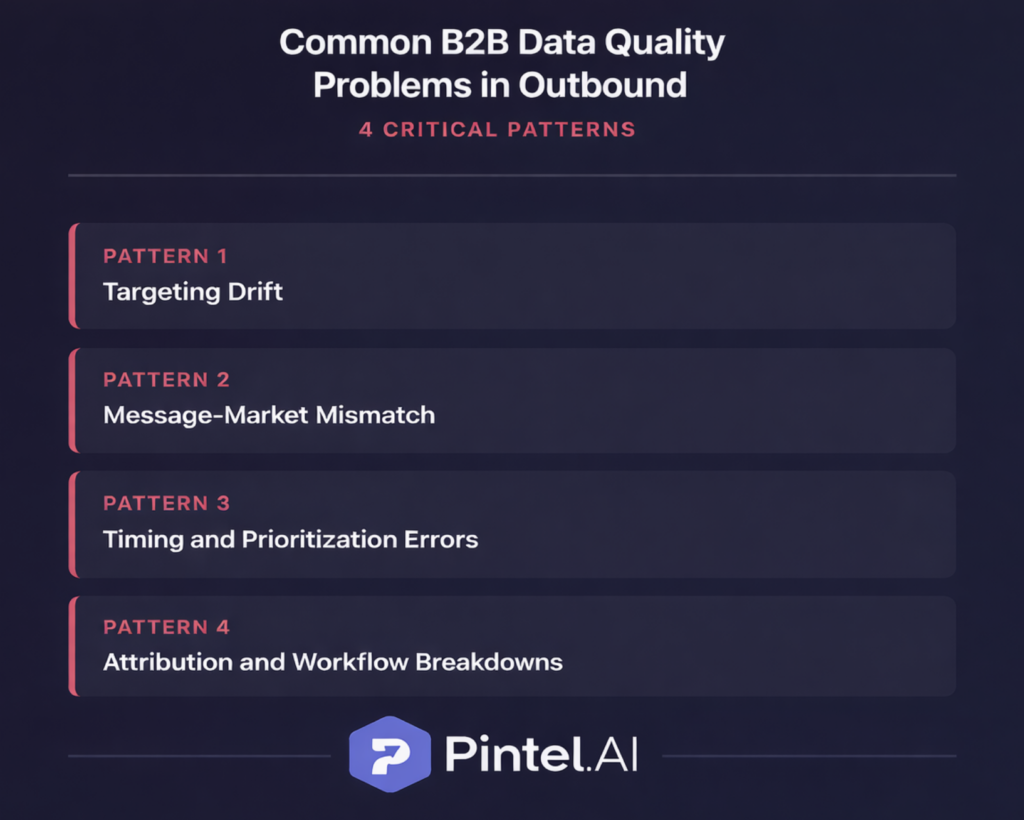
Pattern 1: Targeting Drift
Targeting drift shows up when titles look right but mean different things across company sizes, or personas that worked last quarter stop converting this quarter.
Example: targeting “Head of Growth” at early-stage companies. At some startups, this person runs marketing. At others, they own product-led acquisition. At still others, they’re focused on partnerships or sales. The title is consistent, but the buyer’s needs are completely different.
Without validation of what “Head of Growth” actually does at each target account, your campaign inadvertently spans three distinct personas—and your messaging can’t serve all three.
Pattern 2: Message-Market Mismatch
This happens when your data says the company fits your ICP and the title matches your persona, but the message lands flat because the underlying context was wrong.
A company announces a new product launch, and your system flags it as a buying signal. But product launches mean different things depending on what was launched, who’s leading it, and what stage the company is in. A marketing automation tool might be relevant if they launched a new self-serve tier. It’s irrelevant if they launched an enterprise API for technical buyers.
Without accurate context about what the trigger actually means, your outreach is based on correlation, not causation.
Pattern 3: Timing and Prioritization Errors
A job change is a strong signal, but only if you reach out within the first 30–60 days. After that, the new hire is buried in onboarding and inherited priorities. Reaching out four months later is the same as cold outreach, but your system treated it as a warm lead.
Prioritization errors happen when your scoring model relies on signals that aren’t actually predictive. A company downloading a whitepaper is a signal—but if that download came from a junior analyst researching a market landscape, it’s not a buying signal. If your lead scoring treats all downloads equally, actual buyers get deprioritized.
Pattern 4: Attribution and Workflow Breakdowns
Attribution breaks when company names don’t standardize, contact records duplicate, or source fields aren’t populated consistently. On the surface, everything looks fine. But when you try to measure which campaigns drive pipeline, the numbers don’t reconcile.
Workflow breakdowns happen when data inconsistencies prevent automation from executing correctly. A sequence route leads based on company size, but “number of employees” is missing for 30% of records. Those leads never enter a sequence, and your team doesn’t notice until someone manually audits the system weeks later.

How to Build a B2B Data Quality System That Works
Preventing these failures requires mechanisms that validate, structure, and maintain B2B data quality before it reaches your outbound workflows. These aren’t features—they’re design principles.
Design Principle 1: Bad Data Should Never Enter the System
B2B data quality problems are easiest to fix at the point of entry, before bad data propagates through your system. This means validating not just that fields are filled, but that the values in those fields are accurate and interpretable.
What validation looks like in practice:
- Role verification: Confirming that a job title reflects actual responsibilities, not just what’s listed on LinkedIn
- Firmographic accuracy: Ensuring company data reflects the current state, not outdated records
- Signal interpretation: Distinguishing between activity that indicates intent and activity that’s just noise
Design Principle 2: Data Must Mean the Same Thing Everywhere
Even validated data breaks down if it’s not structured consistently across systems. When your prospecting tool, CRM, and outreach platform all define “company size” differently, you lose the ability to build reliable workflows.
What structural consistency requires:
- Standardized taxonomies: Job titles, industries, and company stages need to map to a controlled vocabulary
- Schema alignment: Your CRM fields, enrichment outputs, and sequence triggers need to reference the same underlying data structure
- Timestamp and provenance tracking: Every data point needs a timestamp and a source
Design Principle 3: Data Decays, So Systems Must Refresh Continuously
B2B data decays faster than most teams realize. People change jobs. Companies get acquired. Funding rounds close. A contact record that was accurate three months ago might be completely wrong today.
What decay management looks like:
- Scheduled revalidation: Automatically rechecking high-value records on a cadence that matches their rate of change
- Trigger-based updates: Monitoring for external events that invalidate existing data
- Graceful degradation: Flagging records where confidence has declined rather than treating old data as if it’s still reliable
Without decay management, data quality erodes silently. Campaigns that worked last quarter stop working this quarter, and no one knows why.
Why Lead Enrichment Alone Doesn’t Improve B2B Data Quality
Enrichment tools are often positioned as the solution to B2B data quality problems. In practice, lead enrichment solves a different problem.
What enrichment does well:
- Fills missing fields (email addresses, phone numbers, company names)
- Appends firmographic data (employee count, revenue, funding stage)
- Surfaces intent signals (website visits, content downloads)
What enrichment doesn’t do:
- It doesn’t validate role accuracy—a “VP of Marketing” could run demand gen, brand, or product marketing
- It doesn’t filter irrelevant signals—funding for international expansion doesn’t mean they’re buying sales tools
- It doesn’t maintain data over time—enrichment is typically a one-time append
- It doesn’t enforce structural consistency—enrichment tools return data in their format, not yours
Enrichment and research automation help surface information, but they don’t validate whether that information is accurate, relevant, or structured correctly for outbound decisions.
What Strong B2B Data Quality Actually Enables
When B2B data quality is treated as a foundational system rather than a tactical enrichment step, the outcomes change:
Consistent targeting accuracy: Your campaigns reach the intended personas, not adjacent roles or outdated contacts.
Higher message relevance: Personalization is based on validated context, not surface-level attributes.
Better lead prioritization: Your scoring model routes leads based on signals that actually predict readiness.
Improved attribution and reporting: Your CRM data is clean enough to support accurate reporting because company names are standardized and source fields are populated correctly.
Reduced rep research time: SDRs and AEs don’t spend 15 minutes per prospect manually validating data.
Operational predictability: Campaigns perform consistently because the underlying B2B data quality is stable.
These outcomes don’t come from better email copy or more sophisticated sequences. They come from ensuring the data feeding those systems is accurate, complete, and maintained over time.
5 Questions to Audit Your B2B Data Quality Today
Before investing in new tools or hiring more reps, audit the B2B data quality you already have. Start with these five questions:
1. When was this contact record last validated?
If the answer is more than 90 days ago, the data is likely stale. People change jobs, companies shift priorities, and org structures evolve. Set a revalidation cadence for high-value accounts.
2. Does this job title match actual responsibilities at this company size?
A “Director of Sales Operations” at a 50-person company might handle everything from CRM admin to revenue ops to enablement. At a 2,000-person company, they’re specialized. Don’t assume title equals role.
3. Is this trigger event actually relevant to our ICP? A funding announcement, product launch, or executive hire might seem like a buying signal. But ask: does this event correlate with the pain point our product solves? If not, it’s noise.
4. Can we trace this data point back to a source and timestamp?
If you can’t answer “where did this come from?” and “when was this captured?”, you can’t assess reliability. Every data point should have provenance.
5. Would our sales team trust this data without researching it first?
If your reps are spending 10-15 minutes per prospect validating data before reaching out, your system isn’t providing reliable inputs. That’s a symptom of poor B2B data quality.
Run through these five questions for a sample of 20-30 recent outbound targets. If more than 20% fail on any question, you have a systemic data quality problem—not an execution problem.
The Bottom Line
Bad data doesn’t break your email sequencer—it just makes your sequences less effective. It doesn’t crash your CRM—it just makes your reporting unreliable. The failures are diffuse, and the causes are upstream, so teams optimize execution without realizing the bottleneck is in preparation.
Here’s what actually happens:
Outbound performance depends on decisions—who to target, what to say, and when to reach out. Those decisions depend on assumptions in your data. When your B2B data quality is poor, your decisions are wrong.
Data quality isn’t a one-time fix. It’s a continuous system that validates inputs, structures data for downstream use, and refreshes records as they decay.
When this system exists, outbound becomes predictable. When it doesn’t, teams add more tools and hire more reps while performance stays flat.
This is why teams with the same tools see completely different outbound results. The difference isn’t in their email sequencers or personalization engines. It’s in whether they’ve built a system that ensures strong B2B data quality before information reaches those tools.
Start with one question: When was the last time you audited the data feeding your outbound motion?
If the answer is “never” or “I’m not sure,” that’s your starting point.

FAQs
1. How often should B2B data be revalidated for outbound sales?
There is no single cadence that works for all data. High impact fields like job role, seniority, and company stage should be revalidated every 60 to 90 days, while lower volatility fields can be refreshed less frequently. The key is aligning refresh cycles to how quickly the data actually changes, not running one time cleanups.
2. Is B2B data quality more important for outbound than inbound?
Yes. In inbound, buyer intent can compensate for imperfect data. In outbound, every decision is initiated by your system, so inaccurate data directly determines who you contact, what you say, and when you say it. Poor data quality in outbound results in wasted outreach rather than friction.
3. Who should own B2B data quality in a GTM organization?
B2B data quality should be owned as a shared system between RevOps and GTM leadership, not as a one off task for sales operations or marketing ops. When data quality is treated as an execution side responsibility, it degrades quickly. Ownership must sit with the team responsible for pipeline integrity.
4. Can CRM hygiene alone solve B2B data quality problems?
No. CRM hygiene helps with consistency and cleanliness, but it does not validate whether the data itself reflects reality. Clean records can still be wrong. B2B data quality requires validation, context, and ongoing refresh, not just formatting or deduplication.
5. How do you measure whether B2B data quality is improving?
The strongest indicators are operational, not cosmetic. Look for reductions in rep research time, fewer routing errors, more consistent reply rates across campaigns, and higher confidence in reporting. If teams stop manually double checking data before outreach, quality is improving.
6. Is poor B2B data quality a tooling problem or a process problem?
It is primarily a system design problem. Tools can help surface information, but without clear validation rules, standardization, and refresh logic, even the best tools will propagate flawed assumptions. Sustainable data quality comes from process discipline, not tool sprawl.
7. What is the earliest signal that B2B data quality is degrading?
When campaigns that previously worked stop performing without any clear change in messaging or targeting strategy, data quality is often the hidden cause. Silent decay shows up as inconsistent results long before obvious failures appear.