An AI BDR is an automated system that handles prospect research, data validation, and preparation—freeing sales reps to focus on conversations instead of spreadsheets.
The numbers tell the story: traditional BDRs spend 10-14 hours weekly on manual research. AI BDRs reduce that to under an hour, with 95%+ accuracy.
Outbound expectations have increased dramatically, while the workflows supporting BDRs haven’t kept up. What was once a prospecting role has quietly turned into a research-heavy function. This mismatch between expectations and workflow design is what created the need for an AI BDR model.
This guide explains what AI BDRs do, how they work, and why outbound sales automation is reshaping the business development role in 2025.

What Is an AI BDR?
An AI BDR automates the preparation layer of outbound prospecting: research, enrichment, validation, signal detection, and ICP matching.
Think of it this way: A human BDR spends 30-45 minutes researching one prospect. An AI BDR completes the same process in under 2 minutes with higher accuracy.
Example:
When a new lead is created, an AI BDR validates the role, enriches the company context, identifies buying signals, and prepares an outbound-ready profile before human review. This typically removes 30–45 minutes of manual research per lead, allowing each rep to reallocate 6–10 hours per week from preparation to conversations.
What AI BDRs Handle Automatically
Data validation: Verifies titles, responsibilities, and seniority (eliminates 6-8 hours of weekly work)
Firmographic enrichment: Company size, industry, revenue, tech stack
Signal detection: Funding, hiring, leadership changes, product launches
ICP matching: Applies segmentation rules with 90-95% accuracy
Context assembly: Consolidates insights into single, outbound-ready profiles
Relevance inputs: Surfaces specific triggers for personalized messaging
Key distinction: AI BDRs don’t replace human reps. They eliminate manual data work so reps can focus on relationships and conversations.
Understanding what AI BDRs do makes the gap in traditional workflows even more apparent. Here’s why the old model is breaking.
Why Traditional BDR Workflows No Longer Scale
Legacy workflows force reps to manually assemble everything. The structural problems are clear:
Data Quality Issues
- 25-40% of titles are outdated or wrong
- 50-70% of profiles lack responsibility details
- 35-50% of seniority tags are misclassified
- 20-30% of firmographics are incomplete
Tool Fragmentation
BDRs toggle between LinkedIn, CRM, enrichment tools, news feeds, and intent platforms. Time-to-first-touch stretches to 24-72 hours.
Inconsistent Execution
Two reps researching the same lead generate different contexts and messages. Coaching becomes impossible when workflows vary rep-to-rep.
The Real Cost of Manual Research
Beyond the 10-14 hours weekly spend, manual workflows create hidden costs:
- Burnout: 60% of BDRs leave within 18 months, often before mastering qualification skills
- Missed opportunities: While researching one prospect, five others go cold
- Revenue delay: 24-72 hour research cycles mean slower pipeline velocity
- Inconsistent quality: Output depends on individual rep habits, not operational design
The fix isn’t more effort—it’s better structure. That’s what outbound sales automation delivers. Research on knowledge workers shows that a significant portion of work time is consumed by administrative and coordination tasks rather than core, value-creating work.
Now that the problems are clear, let’s look at how AI BDRs actually transform each stage of the prospecting workflow.
How AI BDRs Transform the Outbound Workflow and Reclaim 10 to 14 Hours per Week
AI BDRs do not save time by making reps work faster. They save time by removing repeated preparation entirely.
This workflow shows where time is actually reclaimed. Instead of every BDR repeating the same research and validation steps for each lead, preparation happens once at the system level.
ICP identification, research, signal intelligence, and message preparation are completed before a rep engages. By the time qualification and sequencing begin, the lead is already outbound ready. This removes 30 to 45 minutes of manual work per lead and compounds into 10 to 14 hours saved per BDR each week.
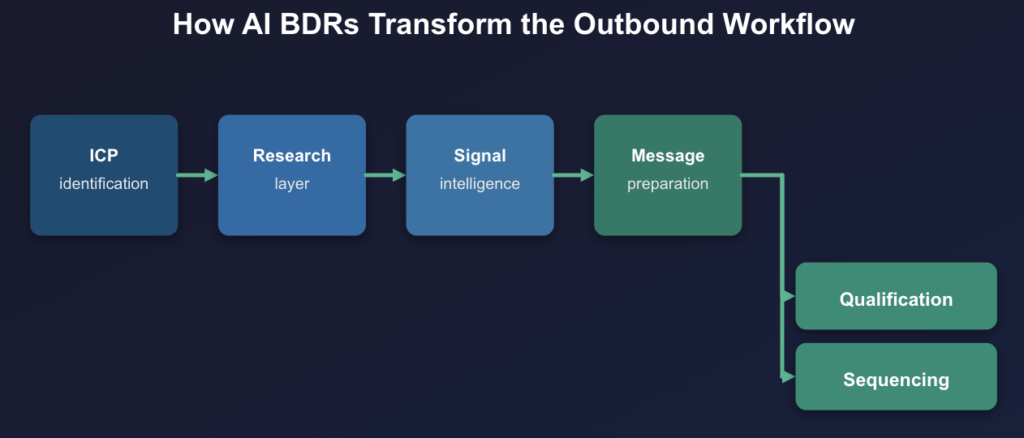
ICP identification: Automated segmentation with 90-95% accuracy replaces manual list building
Research layer: Profiles arrive validated and enriched—research time drops 70-90%
Signal intelligence: Buying triggers surface automatically, no manual news searching
Message preparation: AI-assisted drafts leverage structured inputs, reducing writing time 50-70%
Qualification: Reps ask sharper discovery questions because context is already assembled
Sequencing: Outreach cadences auto-match to segment, fit, and signal type
Each stage gets faster and more accurate. But the real shift is structural: preparation happens once at the system level, not repeatedly by each rep.
This shift works best when lead preparation happens upstream, before SDRs touch the lead. We’ve broken this preparation layer down in detail in our guide on prospecting and qualification workflows.
The transformation isn’t just about speed—it’s about fundamentally different outcomes. Here’s the side-by-side comparison.
Traditional BDR vs AI BDR: The Real Difference
| Focus Area | Traditional Workflow | AI BDR Workflow |
|---|---|---|
| Weekly research time | 10-14 hours | 30-60 minutes |
| Data accuracy | 60-75% | 95%+ |
| Time on prep | 30-40% of week | 5-10% of week |
| Time on conversations | 15-20 hours | 30-35 hours |
| Speed to first touch | 24-72 hours | 10-30 minutes |
| Output consistency | Varies by rep | Standardized |
| Monthly outreach volume | 150-200 prospects | 300-400 prospects |
| Pipeline predictability | Low | 20-40% improvement |
The workflow doesn’t just get faster. It gets more accurate, consistent, and scalable.
These improvements play out differently depending on your outbound strategy. Here are the most common scenarios where teams deploy AI BDRs.
Common AI BDR Use Cases
High-volume campaigns: Maintain research quality across 500+ monthly prospects without scaling headcount
Niche targeting: Validate specialized roles like “VP of Revenue Operations at Series B SaaS” with 95% accuracy—eliminating the “wrong person” problem
Signal-based outreach: Trigger personalized sequences automatically when funding, hiring, or leadership changes occur
Account expansion: Surface buying signals across existing customer accounts for upsell opportunities
New rep onboarding: Junior BDRs start with validated, outbound-ready leads from day one instead of week six
Multi-channel orchestration: Coordinate email, LinkedIn, and call sequences with consistent context across channels
While automation handles the groundwork, the most important BDR capabilities remain distinctly human.
What Stays Human in the AI BDR Model
Core BDR skills remain entirely human:
Qualification judgment: Determining if a prospect truly fits ICP beyond surface-level criteria
Adaptive messaging: Adjusting tone, angle, and approach based on live conversation cues
Relationship building: Developing trust and rapport that converts cold outreach to warm pipeline
Strategic interpretation: Understanding why a signal matters in the context of the prospect’s business, not just that it exists
Discovery conversations: Asking follow-up questions that uncover hidden needs and objections
Automation removes the repetitive prep. Human expertise focuses on strategic decisions that actually close deals.
This reallocation of human time creates a dramatically different workweek. But how do you know if it’s working?
How to Measure AI BDR Success
Tracking the right metrics ensures your AI BDR workflow delivers ROI:
Efficiency Metrics
Time to first touch: Target 10-30 minutes (down from 24-72 hours)
Research hours saved: Track weekly hours per rep (target 10-14 hour reduction)
Data accuracy rate: Monitor title, seniority, and responsibility validation (target 95%+)
Output Metrics
Outreach volume: Consistent 2-3× increase in monthly prospect touches
Response rates: Should improve 15-25% with better targeting and relevance
Meeting conversion: Track qualified meetings booked per 100 outreach attempts
Quality Metrics
ICP match accuracy: Percentage of leads that truly fit your ideal customer profile (target 90-95%)
Pipeline velocity: Days from first touch to qualified opportunity
Rep consistency: Standard deviation in output across your team (should decrease significantly)
Business Impact
Pipeline predictability: Week-over-week variance in qualified pipeline created
Cost per qualified opportunity: Total BDR cost divided by qualified meetings
Rep retention: BDRs stay longer when spending time on strategy, not data entry
Most teams see measurable improvement in efficiency metrics within 30 days, with output and quality metrics improving over 60-90 days.
Even with clear metrics, many teams struggle when building AI BDR workflows internally. Here’s where implementations typically break down.
What Teams Get Wrong Building AI BDR Workflows Internally
The challenge isn’t technology—it’s architecture. Here’s where internal builds typically fail:
Unstable Data Foundations
AI amplifies whatever structure exists. If titles, responsibilities, or firmographics are inconsistent, automation simply accelerates chaos. Teams often automate before fixing the underlying data quality issues.
Fragmented Tool Stack
Intent platforms, enrichment tools, CRM systems, and research databases don’t share a unified insight layer. Reps still end up reconstructing context manually across multiple tabs.
No Maintenance Plan
ICPs shift. Markets evolve. Data sources change. Internal automations break, and most teams lack the operational bandwidth to maintain them. What works in month one breaks by month four.
AI Without Workflow Alignment
Adding AI writing tools or research assistants to a broken workflow doesn’t create efficiency—it scales the broken process. If inputs vary, outputs will always vary.
Underestimating Change Management
BDRs resist new workflows when they don’t understand the “why” or when adoption adds short-term friction. Successful implementations require training, coaching, and iterative refinement.
AI BDR workflows work best when outbound volume is high and ICPs are clearly defined. They’re overkill for teams still discovering their market or running low-volume, bespoke outbound. The model only works when preparation can be standardized—otherwise automation just accelerates noise.
When these structural issues are resolved, the benefits extend well beyond individual BDR productivity.
Why AI BDRs Matter for GTM Teams in 2026
Outbound sales automation stabilizes the data layer every GTM motion depends on. The impact ripples across the entire revenue organization:
For Sales Leadership
Predictable pipeline: Consistent inputs produce 20-40% more predictable monthly pipeline creation
Scalable growth: Add volume without proportionally adding headcount
Faster ramp: New BDRs reach productivity in weeks, not quarters
For Sales Operations
CRM hygiene: Manual data entry drops by 80%, accuracy jumps from 75% to 95%+
Attribution clarity: Cleaner data means more reliable reporting on what’s working
Tool rationalization: Consolidate 5-7 point solutions into a unified workflow
For BDR Managers
Coaching efficiency: Gain 3-5 hours weekly by coaching strategy instead of correcting data issues
Performance visibility: Standardized workflows make it easy to identify skill gaps vs. process gaps
Rep retention: BDRs stay longer when doing actual business development, not data janitor work
For Revenue Operations
Segmentation accuracy: 90-95% ICP matching enables precise territory planning and account assignment
Signal activation: Buying triggers get routed to the right rep within minutes, not days
Cross-functional alignment: Marketing, sales, and CS work from the same validated data foundation
So what does this all mean for the future of business development?
The Bottom Line
Outbound expectations evolved. The workflows supporting them didn’t.
The AI BDR model fixes this by moving research, validation, and enrichment upstream—before reps touch the lead.
The human role stays central: qualification, interpretation, and conversation.
The workflow evolves: reps spend less time gathering information, more time converting it to pipeline.
This isn’t about shrinking the BDR role. It’s about maturing it.
Modern BDRs focus on what humans do best—building relationships, interpreting context, and having strategic conversations. AI handles what it does best—processing data, detecting patterns, and maintaining consistency.
The teams that adopt this model in 2025 will build more predictable, scalable, and efficient outbound motions. The teams that don’t will keep losing 30-40% of their BDR capacity to manual research.
The choice is structural, not technological. And it’s happening now.
FAQ: AI BDRs and Outbound Sales Automation
What is an AI BDR?
An AI BDR is an automated system that completes prospect research, data validation, and enrichment for Business Development Representatives. It reduces manual research time by 70-90% while improving data accuracy to 95%+.
What does a BDR do with AI support?
BDRs focus on qualification, personalized conversations, and relationship building. AI handles research, data validation, and signal detection automatically, allowing reps to spend 70-80% of their time on conversations instead of data gathering.
Do AI BDRs replace human sales reps?
No. AI BDRs automate repetitive data tasks, not human judgment, communication, or relationship building. They enhance BDR effectiveness by removing the manual prep work that consumes 10-14 hours weekly.
How does outbound sales automation improve prospecting?
Outbound sales automation validates data, surfaces buying signals, and assembles context before outreach begins. This eliminates 10-14 hours of weekly manual work, increases output consistency by 2-3×, and improves pipeline predictability by 20-40%.
What’s the ROI of implementing an AI BDR workflow?
Teams typically see 70-90% reduction in research time, 2-3× more consistent output, 15-25% improvement in response rates, and 20-40% improvement in pipeline predictability within 60-90 days.
How long does it take to implement an AI BDR workflow?
Initial setup takes 2-4 weeks for data integration and workflow configuration. Most teams see efficiency gains within 30 days and full productivity improvements within 60-90 days.
What’s the difference between an AI BDR and a sales automation tool?
Traditional sales automation tools handle sequencing and email delivery. AI BDRs automate the entire preparation layer—research, validation, enrichment, and signal detection—before outreach begins. They’re complementary, not competitive.