Your CRM has 10,000 leads. Only 2,800 are actually usable.
The rest are missing job titles, have outdated company data, or lack the context your SDRs need to write relevant outreach. So your reps spend 6 hours a week researching basics—titles, company size, tech stack—before they can even start personalising.
This isn’t an SDR problem. It’s a data problem.
Outbound tools and SDR skill sets only scale when the underlying data is reliable. Lead enrichment and research automation have become the quiet infrastructure of modern GTM systems because they determine how well routing, personalisation, scoring, and forecasting actually work.
This guide explains what lead enrichment is, how research automation complements it, and how the FETE framework (Find → Enrich → Transform → Export) turns raw contacts into usable, outreach-ready profiles.

The Fast Summary
| What You’ll Learn | Why It Matters |
| What is lead enrichment in GTM terms | Aligns SDR, BDR, & RevOps understanding |
| How research automation reduces manual work | Shows where SDRs lose 6+ hours weekly |
| Why does incomplete data slow down outbound | Reveals root causes of inefficiency |
| The FETE framework (Find -> Enrich -> Transform -> Export) | Gives teams a clear mental model for enrichment |
| What person, company, & intent enrichment include | Provides clarity on field-level improvements |
| How to evaluate lead enrichment tools | Helps you compare vendors on match rate, cost, and accuracy |
| How enrichment stabilises outbound workflows | Makes SDR & RevOps work more predictably |
What Is Lead Enrichment? (Definition + Examples)
Lead enrichment is the process of taking an incomplete or unclear lead record, like “John Smith at Acme Corp” and adding the information your team needs to qualify, route, and personalize effectively.
Instead of relying on just a name, email, and company domain, lead enrichment adds the context that makes a lead actionable:
- Person-level data: Job title, seniority, department, LinkedIn profile, contact info
- Company attributes: Industry, employee count, revenue range, headquarters location, funding stage
- Technographics: Current tech stack, tools in use, technology spend indicators
- Intent signals: Website visits, content downloads, product research activity, competitor mentions
Here’s what lead enrichment looks like in practice:
| Data Field | Before Enrichment | After Enrichment |
|---|---|---|
| Name | Sarah Chen | Sarah Chen |
| sarah.chen@techcorp.io | sarah.chen@techcorp.io | |
| Company | TechCorp | TechCorp |
| Title | — | VP of Revenue Operations |
| Seniority | — | Director+ |
| Department | — | Revenue Operations |
| Company Size | — | 250–500 employees |
| Industry | — | B2B SaaS |
| Tech Stack | — | CRM, Sales Engagement, Data Provider X |
| Recent Activity | — | Visited pricing 3x, ROI calculator |
| Buying Intent | — | High (Researching competitors) |
The difference? The first record requires 15 minutes of research. The second one is ready for personalised outreach in 30 seconds.
Lead enrichment turns a basic record into one your team can actually act on.
By filling in missing structured data, lead enrichment makes records actionable. However, effective outbound also requires contextual intelligence, which is where research automation steps in.
What Is Research Automation?
Research automation is the process of automatically gathering, validating, and surfacing the context SDRs need, without requiring manual lookup work.
Traditional SDR research can take 10-15 minutes per lead, equating to 6-10 hours of research weekly.
How Research Automation Works
Research automation collapses this workflow into seconds by:
- Auto-gathering company context from websites, professional networks, and news sources
- Validating contact data to ensure deliverability
- Surfacing relevant signals like hiring trends, funding events, and tech changes
- Structuring insights in a way that’s immediately usable for outreach
This shift is also why modern AI sales tools are no longer just about sending messages — they’re increasingly responsible for research, context gathering, and personalisation before outreach even begins.
Research Automation vs Lead Enrichment: What’s the Difference?
| Lead Enrichment | Research Automation | |
| What it does | Fills in missing fields (title, company size, industry) | Gathers contextual insights (pain points, recent news, priorities) |
| Primary output | Structured data (fields in CRM) | Actionable intelligence (insights for personalisation) |
| Who benefits most | RevOps (for routing/scoring) | SDRs (for personalisation) |
The key insight: Enrichment makes leads workable. Research automation makes them winnable.
In practice, this distinction matters because SDRs and BDRs use enriched data differently depending on where they sit in the funnel. Misunderstanding those responsibilities is often why teams overload SDRs with manual research or misapply enrichment altogether.
It is clear that both enrichment and automation are critical, but how does this directly translate into better performance? Next, we examine the four critical ways clean data improves your outbound motion.

How Lead Enrichment Improves Outbound Performance
Lead enrichment improves outbound execution across four distinct operational levers:
1. Eliminate SDR lookup time (capacity gain).
SDRs stop losing 6–10 hours each week searching for job titles, company size, or tech stack details. That capacity shifts back into qualification and conversations.
2. Accurate routing & scoring (assignment gain).
Standardised titles, industries, and seniority ensure leads land with the right team on the first attempt. Clean, normalised inputs prevent routing errors and rule misfires.
3. Relevant personalisation (engagement gain).
Context from person, company, and intent fields gives SDRs the hooks they need to write targeted messages quickly. Teams using enriched data consistently see higher reply rates.
4. Stable funnel metrics (predictability gain).
When key fields are complete and standardised, scoring, reporting, and outbound throughput become measurable and repeatable — a stable foundation for forecasting.
When reliability breaks upstream, every downstream metric becomes noisy — from routing accuracy to forecast confidence. That reliability depends on upstream B2B data quality — how accurate, current, and structurally consistent your inputs are before enrichment even begins.
These improvements don’t happen on their own. They show up when lead enrichment and research automation are part of a clear prospecting workflow — one that defines how leads are checked, researched, and prepared before SDRs start outreach. Teams that set up this workflow consistently save 10+ hours per rep each week and remove guesswork from daily outbound work.
How Modern Lead Enrichment Works: The FETE Framework
The FETE framework explains how raw leads move through a GTM data system before they become outreach ready. Each stage plays a distinct role in keeping enrichment accurate, scalable, and usable inside your CRM.
Here is a stage-by-stage breakdown of the FETE framework:
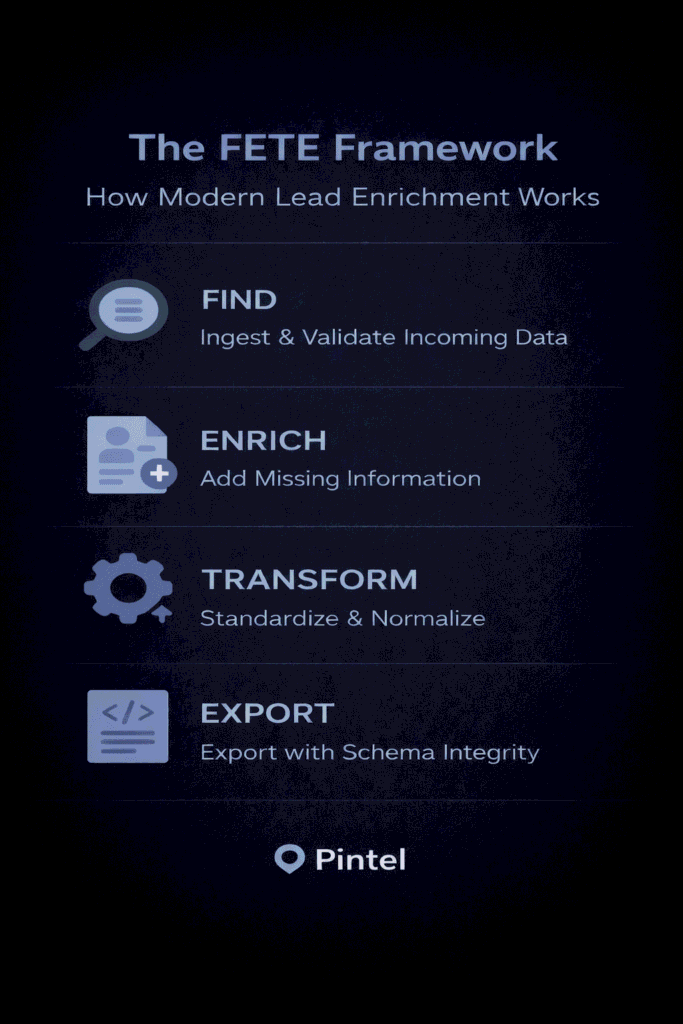
Figure: How Modern Lead Enrichment Works: The FETE Framework
Find: Capture and Clean
Leads enter from multiple channels and are validated before enrichment begins. Basic errors are corrected, duplicates are removed, and invalid records are filtered out so downstream workflows operate on clean inputs. Skipping this step means enriching bad data, which compounds errors across routing, scoring, and reporting.
Enrich: Add Missing Information
Missing attributes are appended, including clarified job titles, inferred seniority, industry mapping, firmographics, technographics, and intent signals. Modern enrichment systems pull from multiple data sources and use AI to resolve conflicts, reducing the risk of outdated or contradictory information.
Transform: Standardise and Normalise
Enriched data is standardised into consistent schemas. Job titles are classified into functions and levels, industries are mapped to a unified taxonomy, and firmographic ranges are normalised. For example, raw titles like “VP Sales” and “Vice President of Sales” are transformed into a single standardised role, ensuring routing and scoring logic behaves predictably.
Export: Push with Schema Integrity
Clean, standardised data is pushed into the CRM using defined field mappings, overwrite rules, and sync behaviour. This final step determines whether enrichment actually improves workflows or quietly breaks them through misaligned schemas, poor governance, or conflicting field logic.
What Data Gets Enriched?
Lead enrichment tools gather data across three critical categories to build a complete profile:
1. Person-Level Enrichment
- Includes: Full name, Job title, Seniority level, Department/function, professional network profile URL, and Direct phone number.
- Why it matters: Helps SDRs understand who they’re talking to and how to personalise outreach.
2. Company-Level Enrichment
- Includes: Company name, Industry, Employee count, Revenue range, Headquarters, Funding stage, Tech stack, Recent news. This often includes sophisticated data like technographics.
- Why it matters: Enables accurate routing, segmentation, and account-based strategies.
3. Intent and Signal Enrichment
- Includes: Website activity, Content engagement, Product research signals (pricing page visits), Competitor evaluation, Buying committee expansion.
- Why it matters: Surface buying intent so SDRs can prioritise high-value conversations.
While enrichment handles structured data, research automation adds the context teams need to act on it. Together, these systems turn raw leads into usable, high-intent profiles.

Lead Enrichment + Research Automation: Better Together
| Challenge | Lead Enrichment Solves | Research Automation Solves |
| Missing job title | Adds standardised title | Not applicable |
| Unknown company size | Appends employee count | Not applicable |
| Need for personalisation | Provides demographic context | Surfaces specific, relevant hooks |
| Understanding pain points | Not applicable | Infers challenges based on role/industry |
| Prioritizing leads | Adds intent signals | Correlates signals into actionable insights |
The takeaway: Lead enrichment builds the foundation. Research automation builds the message.
To achieve this integrated outcome, you need the right tools. The following checklist provides a framework for evaluating lead enrichment vendors based on quality, workflow, and cost.
How to Choose the Best Lead Enrichment Tools in 2025
When evaluating solutions, use this checklist to assess potential lead enrichment tools:
- Data Quality & Coverage: Match rate (≈85%+ for B2B), number of sources ($10+$ is ideal), refresh cadence (weekly preferred).
- Standardisation & Transformation: Does it standardise titles, industries, and seniority automatically? Can you customise classification logic?
- Integration & Workflow: Does it integrate natively with your CRM? Can enrichment trigger automatically based on lead source or status?
- Research Automation Capability: Does it provide contextual insights (news, pain points) beyond structured data? Does it use AI to analyse findings?
- Cost & Scalability: Is pricing based on enrichments, contacts, or seats? What happens when you exceed limits?
- Compliance & Data Governance: Is the vendor GDPR and CCPA compliant? Do they disclose data sources clearly?
Even with the best tools, implementation errors can limit success. Before launching your solution, review the common mistakes teams make to ensure your outbound workflows run smoothly.
Common Lead Enrichment Mistakes to Avoid
To prevent implementation issues and maximise ROI, avoid these five predictable mistakes:
- Mistake 1: Enriching Everything. Better approach: Enrich high-intent leads immediately; batch-enrich others overnight.
- Mistake 2: Skipping Transformation. Better approach: Always normalise titles, industries, and seniority before exporting.
- Mistake 3: Set-It-And-Forget-It. Better approach: Re-enrich active leads quarterly and high-priority accounts monthly (data decays quickly).
- Mistake 4: Ignoring Data Governance. Better approach: Use compliant vendors that are transparent about data sources (GDPR/CCPA).
- Mistake 5: Expecting Enrichment to Fix Everything. Better approach: Use enrichment to accelerate what already works—not to compensate for strategic gaps (e.g., poor ICP definition).
As GTM strategies evolve, so does the technology supporting them. Finally, let’s look at the future trends that will define the next generation of lead enrichment and research automation.
The Future of Lead Enrichment
The industry is moving rapidly from passive data lookup to proactive intelligence. Here are the four key trends:
- Real-Time Enrichment: Systems will enrich dynamically at every touchpoint (when an SDR opens a record, before a sequence sends).
- Predictive Intent Scoring: AI will move beyond basic activity to assess the likelihood of entering a buying cycle (e.g., ≈87% probability in the next 30 days).
- Autonomous Research Agents: Research automation will proactively surface insights SDRs didn’t know to look for.
- Hyper-Personalisation at Scale: Enrichment will feed AI writing tools to generate unique, contextually relevant outreach for every lead.
The bottom line: Lead enrichment is becoming the intelligence layer that powers every outbound motion.
With a clear understanding of the process, the impact, and the future of the technology, we can now conclude by summarising the real strategic value that clean, enriched data delivers to a modern GTM team.
The Strategic Value of Data in GTM
Lead enrichment isn’t a hygiene task; it’s the infrastructure that keeps your GTM engine stable. When the FETE framework is implemented correctly, three things improve immediately:
- Capacity: SDRs spend more time selling and less time researching.
- Correctness: Routing, scoring, and segmentation run on consistent inputs instead of guesswork.
- Control: Forecasting and outbound performance become measurable because the underlying data is stable.
Pairing enrichment with research automation shifts your motion from “bare-minimum usable data” to actionable intelligence, the difference between generic messaging and targeted conversations that convert.

Frequently Asked Questions
1. Do I need lead enrichment if I already use a data provider like ZoomInfo or Apollo?
Yes. Data providers supply raw data, but enrichment turns that data into a consistent, standardised, ready-to-use profile. Without enrichment, routing, scoring, and personalisation still break because the inputs remain unstructured or incomplete.
2. How do I know which fields actually matter for my GTM team?
Focus on fields that directly influence routing, scoring, segmentation, prioritisation, or messaging. If a field affects who receives the lead or how SDRs communicate with them, it should be enriched.
3. Should I enrich every lead in my CRM?
No. Real-time enrichment should be used only for inbound and high-intent leads. Outbound lists can be enriched in batches, while the rest of your CRM can be updated during scheduled re-enrichment cycles.
4. What’s a healthy match rate for a good enrichment tool?
For B2B teams, a strong enrichment system typically delivers 60–80% person-level match rates and above 85% for company-level fields. Match rate varies by industry, but these ranges indicate healthy data coverage.
5. How often does enriched data decay?
Data decays quickly—job titles shift within months, company sizes change quarterly, and tech stacks update continuously. This is why enrichment is not a one-time process but a recurring operational step.
6. What breaks most enrichment workflows?
Most issues stem from misconfigured routing logic, inconsistent job titles, or poor field mapping during export. The data may be correct, but if your CRM pushes it into the wrong fields or uses inconsistent schemas, enrichment loses its value.
7. How can I tell if enrichment is actually improving outcomes?
Monitor changes in SDR research time, routing accuracy, and the performance of personalised outreach. If these metrics improve within a few weeks, enrichment is configured correctly.
8. Can lead enrichment support compliance requirements?
Yes, as long as the vendor provides transparent data sources and supports deletion or suppression requests. Clean, standardised records make compliance reviews far easier to manage.
9. What’s the difference between match rate and accuracy?
Match rate measures how many records can be enriched; accuracy measures how correct the enriched fields are. High match rates are meaningless if the enriched data is unreliable.
10. How does enrichment impact forecasting?
Forecasting models depend on consistent segmentation inputs. When seniority, industry, company size, and intent signals are standardised, forecasting becomes more stable and less vulnerable to noisy or incomplete data.