B2B company data providers now cover far more than contact lists.
Some focus on firmographic account data. Others specialize in contact discovery, buying signals, enrichment, or regional market coverage. The challenge is that these categories often overlap, while their actual strengths vary significantly by use case.
That makes choosing the right provider difficult, especially for teams building outbound across multiple regions, industries, and data workflows.
This guide breaks down the five-layer outbound data stack, the different types of B2B company data providers, what each category actually covers, and how high-performing teams evaluate providers before building outbound at scale.
TL;DR
- High-performing outbound teams evaluate providers based on ICP fit, regional accuracy, signal quality, and long-term data reliability.
- B2B company data providers now support account discovery, contact data, buying signals, enrichment, and regional market coverage.
- Different providers specialize in different layers of the outbound workflow, which is why evaluation matters more than brand recognition alone.
- Data quality, enrichment depth, and signal accuracy have a direct effect on deliverability, targeting, and pipeline conversion.
- Waterfall enrichment consistently improves contact coverage compared to single-source enrichment workflows.
What Are B2B Company Data Providers?
A B2B company data provider is a tool that gives your sales team structured information about companies and the people who work there. That includes things like emails, job titles, company size, revenue range, and signals that show which accounts are actively ready to buy.
Ten years ago, these tools were basically contact directories. Today, the best ones also track which companies just raised funding, hired a new VP, or changed their tech stack. These are the signals that tell you when to reach out, not just who to reach. The category has split into five distinct types, each solving a different part of the outbound problem.
For outbound sales teams, these platforms solve three core problems:
- Finding the right accounts: ICP filtering and account discovery using firmographic, technographic, and signal data
- Finding the right contacts: Contact discovery and verification at the people level within target accounts
- Knowing when to reach out: Timing intelligence from buying signals, intent data, and structural event tracking
According to Salesforce’s State of Sales research, data quality is consistently cited as a top barrier to outbound performance. Understanding which type of provider to use for each layer is the foundation of a reliable stack.
The Five-Layer Outbound Data Stack: How to Build It Step by Step
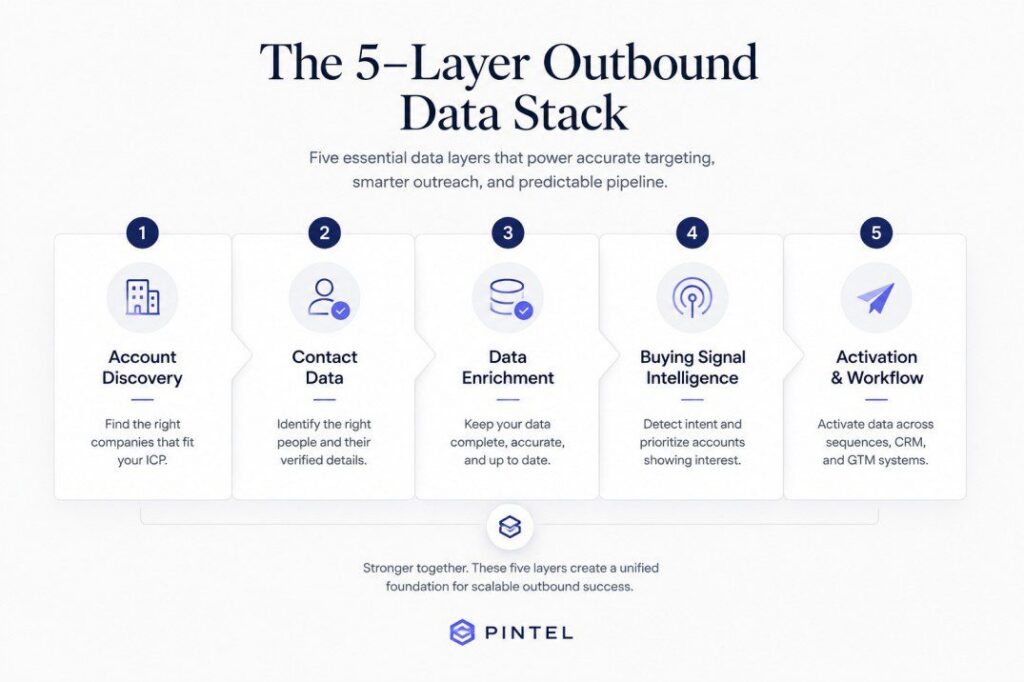
The Five-Layer Outbound Data Stack is a framework for structuring your outbound data tools across account discovery, contact data, timing signals, enrichment, and non-traditional sources, applied in sequence. Each layer answers a different question. The layers compound: strong account data with weak contact coverage still fails, and accurate contacts with no signal timing produce low reply rates.
Step 1: Account Data: Finding the Right Companies
What to do: Build a list of target accounts using firmographic filters: company size, industry, revenue range, location, and technology stack. Then apply a secondary sub-industry filter, because basic firmographic outputs return industry codes, not sub-industry context.
How to do it:
- Define your ICP in concrete terms: employee count, industry codes, revenue band, geographies, and technology dependencies (e.g., “uses Salesforce and has a RevOps function”)
- Pull a raw account list using firmographic data filters, then apply a ICP prompt to remove companies that pass basic filters but fail the context check
- Score accounts by structural signals: recent funding rounds, hiring spikes in relevant departments, and leadership hires signaling a new budget owner
Practical example: A DevOps SaaS company selling testing tools needed accounts that “build software AND test it internally.” Standard databases returned all software companies, including those that only sell software. The team that skipped sub-industry filtering wasted enrichment costs and SDR time on companies that were never buyers.
What most teams get wrong: They treat raw filter output as a qualified account list. Basic filters are a starting point, not a finished list. The sub-industry verification step is where the raw account list becomes a workable pipeline.
This first layer sets the quality ceiling for everything that follows. A flawed account list means every downstream investment in contact data, enrichment, and sequencing is partially wasted.
Step 2: Contact Data: Finding the Right People
What to do: Once you have a target account list, find the right contacts within each account. Sales data providers supply verified emails, phone numbers, job titles, and LinkedIn profiles. This layer determines your deliverability, reply rate, and how much SDR time goes toward real conversations.
How to do it:
- Pull contacts by title keyword first, then validate at the profile level to remove false positives (title searches for “SAP” return both SAP buyers and SAP sellers simultaneously)
- Use a provider that verifies email addresses before export, not just at the point of purchase
- Apply lead qualification criteria at the contact level: seniority, department, geography, and reporting structure
Practical example: A manufacturing SaaS team targeting design engineers found that keyword searches consistently returned Manufacturing Engineers and Quality Engineers too. Their SDRs spent enrichment budget on contacts who were never real buyers. Profile-level filtering removed the false positives automatically and cut wasted outreach by over 30%.
What most teams get wrong: They rely on title keyword matching alone and accept the false positives it generates. Title nomenclature varies widely across industries. The same role is called “software engineer” at one company and “IT person” at another. A title filter catches roughly 60% of the right people and 30% of the wrong ones. Profile-level filtering flips both numbers.
With clean contacts in hand, the next question shifts from who to reach, to when.
Step 3: Intent and Signal Data: Knowing When to Reach Out
What to do: Contact data tells you who to reach. Signal data tells you when. Intent platforms track behavioral and structural events indicating when an account is actively buying. Timing separates outreach that starts conversations from outreach that goes unanswered.
How to do it:
- Track structural signals: funding announcements, executive hires in relevant roles (VP of Sales, CRO, VP of RevOps), tech stack migrations, and hiring spikes in departments tied to your product category
- Track contextual signals: third-party topic research data showing which companies are actively reading about specific solution categories across B2B publisher networks
- Combine signals before sequencing. An account with one signal is a weak indicator. An account showing three or four concurrent signals is in the buying window today. See our guide on intent data providers and B2B buying signals.
Practical example: A team selling RevOps software flagged accounts with three concurrent signals: a new VP of RevOps hire, a Series B round, and topic research activity around CRM integrations. Those accounts commonly converted to meetings at significantly higher rates than accounts flagged by a single signal alone.
What most teams get wrong: They act on single-signal intent data as if it were a confirmed buying decision. An account with one intent signal is browsing. An account with four concurrent signals is a pipeline opportunity today.
Signal intelligence is often the most underused layer in outbound stacks, and typically the one with the fastest payoff once it is configured and running.
Step 4: Data Enrichment: Keeping Your Stack Fresh
What to do: B2B contact data decays at 20 to 30% per year. The enrichment layer fills missing fields and updates stale records before they reach the sequence. Most contact databases give you a point-in-time snapshot. The enrichment layer keeps it current.
How to do it:
- Run enrichment in a waterfall sequence: query your highest-accuracy provider first, then fall back to broader-coverage sources when the primary source returns no match
- Cache results to avoid paying for the same lookup twice when a contact appears in multiple campaigns
- Set re-enrichment triggers on job change signals. When a contact changes companies, their old email becomes invalid immediately.
Practical example: One team paying over $100K per year for contact data found 37% of their records were wrong or missing. After switching to a waterfall approach across 30 or more vetted sources, their match rate climbed well above 90% in many cases and their dead pipeline started converting. Multi-source waterfall enrichment solves this by querying providers in priority order. For the full mechanics, see our guide on waterfall enrichment and reducing data gaps.
What most teams get wrong: They set up one enrichment provider once and treat its output as permanently accurate. Single-source tools typically achieve 60 to 80% fill rates on global ICPs. A waterfall approach across multiple sources consistently delivers above 90%, with a direct and measurable effect on deliverability.
Enrichment works best as an operational cadence rather than a one-time setup. Teams that automate re-enrichment tend to maintain data accuracy as a natural byproduct of their workflow, rather than managing it reactively.
Step 5: Non-Traditional Data Sources: What Most Stacks Miss
What to do: Standard databases draw primarily from LinkedIn, company websites, and press releases. For teams targeting public sector, education, healthcare, manufacturing, or local businesses, this leaves a large portion of the addressable market with no usable data. Non-traditional sources fill that gap, and they are often the reason LinkedIn-first approaches fall short in traditional industries.
How to do it:
- For public sector: use providers that index government procurement records, tender announcements, and board meeting minutes. Procurement behavior in public sector follows formal cycles that LinkedIn-based tools do not track.
- For education: school district directories, university department pages, and state education authority records are absent from standard contact databases. Decision-making authority often sits at the district or department level, not in any indexed profile.
- For local businesses: regional directories, Google Maps data, and local business registries hold decision-maker contacts that LinkedIn does not index, particularly for owner-operated businesses and regional chains.
- For EMEA and APAC: regional-specific databases tend to offer stronger market visibility than global US-headquartered vendors. Dataset depth in these regions often thins considerably when you layer enrichment on top of an already partial primary source.
Practical example: A regional logistics SaaS team targeting facilities managers at US school districts found fewer than 20% of their ICP contacts in their standard database. The remaining 80% were in state education records and district directories. Adding a non-traditional source took their contact coverage from partial to complete with no ICP change needed.
What most teams get wrong: They assume LinkedIn-and-database completeness is sufficient for any B2B market. For tech-to-tech sales, that mostly holds. For non-tech verticals, it often does not. In many non-tech sectors, a significant portion of the addressable market can be invisible to standard providers, commonly estimated at 30 to 40%.
For many non-tech sectors, the non-traditional layer is where ICP completeness is either achieved or permanently capped. It can become a critical coverage source for teams whose buyers simply do not appear in standard indexed databases.
Types of B2B Company Data Providers: What Each Layer Covers
The five types of B2B company data providers map directly onto the five stack layers above. Each covers a different part of the outbound problem, and understanding what each does not cover is as important as knowing what it does. Here is a quick reference across all five.
| Provider Type | What It Covers | Key Data Points | What It Does Not Cover | Best For |
|---|---|---|---|---|
| Firmographic / Account Data | Company-level filters and ICP matching | Company size, industry, revenue, location, tech stack | Contact details, buying signals, sub-industry context | Building the initial target account list |
| Contact Data | Individual-level email and phone coverage | Email addresses, phone numbers, job titles, LinkedIn profiles | Buying intent, company-level signals, data freshness over time | Finding the right contacts at target accounts |
| Intent / Signal Data | Behavioral and structural buying signals | Topic research activity, funding events, hiring signals, tech migrations | Contact emails, phone numbers, individual verification | Timing outreach to accounts in an active buying window |
| Enrichment Providers | Filling and refreshing existing records | Updated emails, current titles, new company after a job change | Net-new account discovery, real-time intent signals | Keeping CRM contact data current and reducing email bounces |
| Non-Traditional Sources | Non-indexed and proprietary datasets | Government records, school directories, local business data, board minutes | Tech-sector contact coverage, real-time intent signals | Teams targeting public sector, education, healthcare, or manufacturing |
What Different Providers Usually Specialize In
Not all outbound data tools are built equally across markets and use cases. Most established vendors have clear strengths and equally clear gaps. Understanding those before buying saves significant time during evaluation.
- US coverage: US-headquartered vendors tend to have the deepest North American contact accuracy. This makes them strong default choices for teams running US-focused outbound, but their performance drops noticeably in EMEA and APAC markets.
- EMEA coverage: Few global vendors maintain truly accurate European contact data. GDPR compliance is a hard requirement for European records, and not all providers meet it. Regional-specific databases typically deliver stronger data reliability and regional accuracy than global vendors in this market segment.
- Enrichment depth: Some enrichment platforms optimize for match rate; others optimize for accuracy and freshness. For waterfall enrichment, you want a mix: a high-accuracy primary source and a high-coverage fallback, not two tools competing on the same dimension.
- Signal quality: Intent platforms vary significantly in how they source behavioral signals. First-party signals (website visits, content downloads) tend to be more actionable than aggregated third-party intent data, which often introduces significant latency.
- SMB vs. enterprise: Some contact databases index well at the enterprise level but have thin coverage for SMB companies under 50 employees. If your ICP sits in the sub-100-employee range, validate specifically against that segment during evaluation, as aggregate match rates can mask poor SMB performance.
The practical implication: the right stack for a US-focused enterprise SaaS company looks different from the right stack for a healthcare vendor targeting EMEA or a logistics company targeting mid-market manufacturers.
Capability segmentation matters more than brand recognition when building your data infrastructure. The vendor with the highest profile is not always the best fit for your specific ICP and geography.
Why Most Outbound Data Stacks Underperform
Most outbound teams already use B2B company data providers in some form. Few have a stack that performs at scale. The gap between the two comes from a few avoidable mistakes.
Mistake 1: Using one vendor as a complete solution. No single platform covers all five layers at high accuracy. A tool strong in US contact data will have EMEA gaps. A platform with deep intent signals may have limited firmographic filtering. Treating one vendor as the complete answer means accepting their dataset depth as your ceiling.
Mistake 2: Optimizing for list size over list quality. Buying more data does not fix a targeting problem. A list of 500 in-market accounts with the right timing outperforms 50,000 raw contacts with no signal context. The size of the list does not determine outbound performance. The relevance of the match does.
Mistake 3: No enrichment cadence after list build. Most teams enrich once and consider the data clean. Contact data decays at 20 to 30% per year. By month six, a significant share of any unrefreshed list has stale titles or inactive emails.
According to Gartner’s research on sales operations, data decay is consistently identified as a top barrier to outbound performance. A list that was 90% accurate at build can drop below 70% within six months without re-enrichment. See our guide on B2B account intelligence research methods for a practical approach.
Mistake 4: Skipping signal data because setup feels complex. Many teams skip the intent and signal layer entirely because configuration takes time, leaving outreach timing based on SDR bandwidth rather than account buying windows. For most outbound stacks, this is a meaningful gap, and one that tends to deliver measurable results once it is addressed.
How High-Performing Outbound Teams Build Their Data Stack
High-performing outbound teams treat their data infrastructure (contact databases, enrichment tools, signal platforms, and account intelligence) as one operational system: running continuously, updating on trigger events, feeding clean records into the CRM before SDRs touch a contact.
Step 1: Build the account layer with ICP in plain English. Run your ICP definition against raw output from your data tools to remove companies that pass basic filters but fail the sub-industry check. This is the step most teams skip. It explains why “we have 2,000 accounts but none convert” is the most common first-quarter complaint. See our guide on how to build a target account list for B2B sales for a structured process.
Step 2: Add contact data with profile-level validation. Pull a starting list using title keywords, then filter at the profile level to remove false positives before contacts enter any sequence. This protects sending reputation and SDR productivity simultaneously.
Step 3: Activate signal intelligence before sequencing. Before any account enters a sequence, check for active buying signals. Prioritize accounts showing three or more concurrent structural signals immediately. Accounts with no signals can wait.
Step 4: Run enrichment as a waterfall, not a single lookup. Query the highest-accuracy source first. On no match, fall back to the next source in sequence. Applied across 30 or more vetted providers, each selected for distinct coverage strengths and validated against your ICP, this approach consistently delivers above 90% contact fill rates on global ICPs where single-source tools fall short.
Step 5: Automate re-enrichment on job change signals. When a contact changes companies, their data needs updating before the next touch. Teams that automate this typically keep SDRs well under 10% time on research; without it, that figure can climb considerably higher. Pintel.ai’s data intelligence combines account discovery, multi-source enrichment, signal tracking, and ICP filtering across global markets (US, EMEA, APAC) in one workflow, covering the full stack without separate vendor contracts.
Final Takeaway: What B2B Company Data Providers Actually Need to Deliver
The right B2B company data providers do not just hand you a list. They give you the right accounts, the right contacts, timing signals, and enrichment to keep data accurate over time. No single vendor delivers all five layers at scale. That is why high-performing outbound teams treat their data tools as a layered stack rather than a single vendor decision.
The Five-Layer Outbound Data Stack gives a clear sequence: account data first, contact data second, signal intelligence third, enrichment continuously underneath, and non-traditional sources filling the gaps that standard databases miss. Each layer compounds the one before it. The weakest layer is where pipeline stops converting.
Start by identifying which layer is weakest. For most teams, that is signal intelligence (never activated) or enrichment cadence (set up once and abandoned). Fixing either delivers faster results than buying more volume. For a comparison of tools across these layers, see our guide on sales intelligence tools for B2B sales teams.
FAQ: B2B Company Data Providers
What is a B2B company data provider?
A B2B company data provider is a company or platform that collects and structures information about businesses and their employees for use in sales, marketing, and GTM workflows. The main types are contact databases (email, phone, LinkedIn), firmographic databases (company size, industry, revenue), intent data platforms (buying signals), and enrichment tools. Sales data providers and company data providers are two common terms for the same category.
How many data providers does a sales team need?
Most outbound teams need two to four providers to cover all five data layers: account data, contact data, signal data, enrichment, and non-traditional sources where relevant. A single vendor rarely covers all layers at acceptable accuracy. Teams relying on one source find coverage gaps that surface as high bounce rates, low deliverability, or missed accounts in non-US or niche-industry verticals.
What is the difference between B2B company data providers and sales intelligence platforms?
B2B data providers primarily supply structured records: contact emails, company firmographics, and similar fields. Sales intelligence platforms combine that data with signal analysis, buying intent tracking, and workflow tools that help reps prioritize and personalize outreach. The line has blurred as data providers have expanded beyond raw data delivery into full workflow products.
How do I evaluate a B2B company data provider before buying?
Run a test batch. Take 50 to 100 records from your existing CRM and run them through the provider’s enrichment tool. Check match rate, email accuracy, and whether job titles reflect current roles. A match rate below 80% on a warm batch signals coverage gaps in your ICP that will compound at scale.
What is waterfall enrichment and why does it matter for B2B data stacks?
Waterfall enrichment queries your highest-accuracy source first, then falls back to broader-coverage providers when the primary source returns no match. Single-source enrichment typically achieves 60 to 80% fill rates on global ICPs. A waterfall approach across multiple providers consistently delivers above 90%, with a direct effect on deliverability and bounce rates.
Do B2B company data providers cover non-US markets well?
Coverage varies significantly by region. Most US-headquartered vendors have strong North American accuracy but weaker performance in EMEA and APAC. Teams expanding internationally need a region-specific provider or a platform running multi-source enrichment across regional databases. GDPR compliance is a hard requirement for European contact data that not all providers meet.
What are buying signals and why should B2B data include them?
Buying signals are behavioral and structural events indicating when an account is actively buying. Structural signals include funding rounds, VP-level hires, tech stack changes, and hiring spikes. Contextual signals include third-party topic research across publisher networks. Signal data changes outreach timing from random to deliberate, which directly improves reply rates and pipeline conversion.
How often should B2B contact data be refreshed?
B2B contact data decays at 20 to 30% per year due to job changes, company restructures, and email updates. Enrichment should run continuously, not just at list-build time. Teams that set re-enrichment triggers on job change signals catch data decay before it reaches a sequence, not after bounce rates accumulate on their sending domain.