Account-based marketing works best when it runs as a coordinated system.
In practice, it’s usually built in pieces over time, such as target account lists, campaign plans, and outreach playbooks. Each one is useful on its own, but they don’t always connect, which makes execution harder than it needs to be.
That’s where ABM strategy templates become valuable. They bring structure to each part of your program, from account planning to campaigns to sales execution, so your team is not building everything from scratch each time.
But the real value of these templates is not just in organizing individual pieces. It comes from how they work together, connecting planning, campaigns, and execution into a single system.
This guide gives you practical ABM strategy templates and then shows how they connect into a system your team can actually run.
What Is an ABM Strategy Template?
An ABM strategy template is a structured framework that helps B2B teams plan, execute, and measure account-based marketing campaigns. It includes account selection, messaging, campaign planning, sales playbooks, and performance tracking.
In summary, an ABM strategy template covers who you target, how you engage them, what your sales team does when they respond, and how you measure whether it worked.
In practice, it is the operating system for your ABM program. Without it, every campaign is built from scratch. With it, your team moves faster, stays aligned, and scales what works.
Key Components of an ABM Strategy Template
Before jumping into the actual templates, here is what a complete ABM strategy template system covers. Most teams only use one or two of these, and that is usually why results are inconsistent.
- ICP definition
- Target account selection
- Stakeholder mapping
- Messaging framework
- Campaign planning
- Sales playbooks
- Measurement metrics
Miss any of these, and your ABM program has gaps. Cover all of them, and you have a system, not just a strategy.
ABM Strategy Template vs Traditional Marketing Plan
Before running an ABM program, it helps to understand what makes it fundamentally different from a traditional marketing plan. The targeting logic, the team alignment, and the measurement approach are all different.
| ABM Strategy | Traditional Marketing Plan | |
|---|---|---|
| Focus | Account-focused | Broad audience |
| Messaging | Personalized per account | Generic to a segment |
| Alignment | Sales and marketing on the same accounts | Marketing-led, sales follows separately |
| Measurement | Pipeline and deal velocity | Leads and MQLs |
| Trigger | Buying signals | Campaign calendar |
This distinction matters because ABM templates are built around account intelligence, not audience volume. The templates below reflect that logic throughout.
Free ABM Strategy Templates for B2B Teams
These four templates cover every stage of an ABM program. You can use them independently, but they work best as a connected system where each one feeds into the next.
Template 1: ABM Account Planning Template
The account planning template is where every ABM program should start. Before you run a single campaign, you need to know exactly which accounts you are targeting and why they fit your ICP.
Use this template to document and qualify your target accounts:
| Field | What to Fill In |
|---|---|
| Account name | Target company name |
| Industry | Vertical or segment |
| ICP fit score | Qualification rating (1 to 10) |
| Account tier | Tier 1, Tier 2, or Tier 3 — sets resourcing and personalization level |
| Key stakeholders | Decision-makers and their roles |
| Pain points | Core business challenges you solve |
| Revenue opportunity | Estimated deal size or ARR potential |
| Engagement history | Past interactions with your brand |
| Next best action | Recommended outreach step |
Score every account against your ICP before adding them to your ABM list. Assign a tier at the same time. Tier determines how much resource, personalization, and sales attention that account gets. If an account scores below your threshold, it should not get ABM-level attention, no matter how exciting the logo looks.
Once your accounts are planned and scored, the next step is deciding how to engage them. That is where the campaign template comes in.
Template 2: ABM Campaign Template for Multi-Channel Campaigns
Once you know who you are targeting, this template helps you plan how to engage them. A good ABM campaign template forces you to get specific: one objective, a defined account list, clear channels, and owned deliverables.
| Field | What to Fill In |
|---|---|
| Campaign objective | Pipeline generation, meeting bookings, expansion |
| Target account list | Named accounts included in this campaign |
| Buying signal that triggered this campaign | Intent spike, pricing page visit, content download, G2 review — what triggered this motion |
| Buyer personas | Roles and titles you are engaging |
| Channels | LinkedIn, email, paid ads, events, direct mail |
| Content assets | What you need to create or repurpose |
| Personalization layer | Account-specific messaging or creative |
| Timeline | Start date, end date, key milestones |
| Campaign owner | Who is responsible for execution |
| Success metrics | How you will know this campaign worked |
Build one campaign template per account tier or segment. Tier-1 accounts get custom campaigns. Tier-2 and Tier-3 accounts can share templated campaigns with personalization overlays. The buying signal field is what separates a reactive, intent-driven campaign from one that was just scheduled on a calendar.
Campaigns get accounts engaged. But engagement alone does not close deals. That is what the playbook is for.
Template 3: ABM Playbook Template for Sales Outreach
An ABM playbook template defines the exact steps your SDRs and AEs take when a buying signal fires, so nothing falls through the cracks. This is where marketing hands off to sales in a structured, repeatable way.
| Field | What to Fill In |
|---|---|
| Trigger | Buying signal (web visit, content download, intent spike) |
| Current deal stage | Where the account sits in your pipeline — influences tone, urgency, and ask |
| Outreach action | What to do when the trigger fires |
| Channel | Email, LinkedIn, phone, direct mail |
| Message angle | Personalization hook for this account |
| Content to attach | Asset or resource to include |
| Follow-up cadence | Timing and number of touchpoints |
| Owner | SDR, AE, or CSM responsible |
| Escalation rule | When to loop in leadership |
Build one playbook per trigger type. A playbook for an account visiting your pricing page looks different from one triggered by a G2 review or a job posting. The deal stage field matters because your outreach to a net-new account looks completely different from outreach to an account already in late-stage negotiation. Specificity is what makes playbooks actually work.
With accounts planned, campaigns running, and playbooks activated, the last piece is knowing whether any of it is working.
Template 4: ABM Measurement Template for Tracking Pipeline and ROI
You cannot improve what you do not measure. The ABM measurement template keeps your program grounded in outcomes, not just activity.
| Metric | What It Measures |
|---|---|
| Account engagement score | Overall activity level within target accounts |
| Intent score trend | Whether buying intent is rising, flat, or dropping — a forward-looking signal, not just a lagging metric |
| Coverage | Percentage of target accounts with active contacts |
| Pipeline influenced | Revenue in pipeline from ABM accounts |
| Stage conversion rate | Percentage of accounts progressing through pipeline stages |
| Deal velocity | How fast ABM accounts move through the funnel |
| Win rate | Percentage of ABM accounts that close |
| Campaign ROI | Revenue generated vs campaign investment |
| Meeting rate | Meetings booked per account touched |
Review these metrics weekly at the campaign level and monthly at the program level. The intent score trend is the one metric that tells you what is about to happen, not just what has already happened. If engagement scores are high but the pipeline is not moving, the issue is usually in the playbook, not the campaign.
How These ABM Templates Work Together
Most teams use these templates in isolation. They fill them in separately and treat them as standalone documents.
That approach creates structure, but not coordination.
The real value comes from how these templates connect to each other.
1. Account Planning → Campaign Strategy
Account planning sets the foundation.
The account intelligence you gather, including stakeholders, pain points, ICP fit score, and account tier, directly shapes how you design your campaigns.
Without this input, campaigns lack context and relevance.
2. Campaign Strategy → Playbook Activation
Campaigns create engagement, but engagement alone is not enough.
When an account interacts with your content or visits a key page, that activity becomes a buying signal. The playbook uses that signal to trigger the right sales action at the right time.
3. Playbook → Measurement
Playbooks drive execution.
Every action taken, whether it is outreach, follow-up, or escalation, feeds into your measurement system. This includes meetings booked, stage progression, and deals influenced.
Measurement reflects how effectively your playbooks are working in real scenarios.
4. Measurement → Continuous Improvement
Measurement is not just reporting. It informs what to improve.
Metrics like intent score trends, deal velocity, and conversion rates help you identify what is working and where adjustments are needed across campaigns and playbooks.
When Everything Connects
When these templates work together, your ABM program becomes a system.
Account context flows into campaigns. Campaign engagement triggers sales action. Sales activity drives measurable outcomes. And performance data feeds back into planning.
The result is a coordinated approach where every account gets a consistent experience and every team member knows what to do next.
How to Use This ABM Strategy Template: Step by Step
Ready to put this into action? Here is exactly how to run your ABM program using these templates, from start to first closed deal.
Step 1: Define your ICP. Get clear on who your ideal customer is before filling in a single template. Firmographics like industry and company size, technographics like the tools they use, and behavioral signals like how they buy, all matter here.
Step 2: Select, score, and tier your target accounts. Use your ICP criteria to build and score your account list. Assign tiers at the same time. Tier-1 accounts — the ones with the highest fit and highest intent- get the most resources, the most personalization, and the most sales attention.
Step 3: Fill in the account planning template. For every Tier-1 account, complete the account planning template. Map stakeholders, document pain points, assign the tier, and identify your best entry point into the account.
Step 4: Build your campaigns. Use the ABM campaign template to plan engagement for each account tier. Log the buying signal that triggered each campaign. Define objectives, channels, content, and timelines. Assign owners before the campaign launches, not after.
Step 5: Activate your playbooks. Set up trigger-based playbooks for high-intent signals. When an account hits a threshold — repeated web visits, content downloads, intent data spikes — the playbook tells your team exactly how to respond, with deal stage context already built in.
Step 6: Track performance and iterate. Use the measurement template to review metrics weekly. Watch intent score trends as a leading indicator. Double down on what is working. Cut what is not. The best ABM programs are constantly refined based on real data, not assumptions.
Example: Applying This ABM Strategy Template in Practice
Templates are easier to use when you can see them applied to a real scenario. Here is a condensed example of how a SaaS company might run this across all four templates for a single Tier-1 account.
Account: Stripe (hypothetical — used to illustrate the template system)
Goal: Book a discovery call with their Head of Revenue Operations
Account Planning Template Output
Stripe scores a 9/10 on ICP fit and is assigned Tier 1. The target stakeholder is the Head of Revenue Operations, supported by a VP of Finance as a secondary decision-maker. Core pain point: manual revenue reconciliation slowing month-end close. Estimated deal size is $80,000 ARR. Engagement history shows two blog visits in the past 30 days. Next best action: LinkedIn connection from AE, followed by personalized email within 48 hours.
Campaign Template Output
Objective is meeting bookings. Buying signal: two visits to the revenue operations blog post in 14 days, flagged by intent tool. Campaign runs across LinkedIn and email, targeting the Head of RevOps with a content asset on reducing revenue leakage. Timeline is four weeks. Personalization layer references their recent funding round and likely team growth. Campaign owner is the assigned AE.
Playbook Activation
Trigger: Stripe visits the pricing page. Deal stage: Awareness — no prior sales contact. The SDR sends a personalized email the same business day referencing the page visit. Message angle: “Teams scaling through funding rounds usually hit this exact problem.” Follow-up cadence is three touches over eight days. Escalation to AE if no response after touch two.
Measurement Output at Week Four
Stripe moves from “Contacted” to “Meeting Booked” within 11 days of campaign launch. Intent score trend was rising for 10 days before outreach fired — a leading signal that predicted the conversion. Stage progression gets logged as pipeline influenced. Deal velocity is tracked from first touch to first call.
This is what the connected template system looks like in practice. Not four separate documents — one coordinated motion across planning, campaign, playbook, and measurement.
Why Most ABM Templates Fail
If templates are this useful, why do so many ABM programs still underperform? The honest answer is that templates are static. ABM is not.
Here is where things break down:
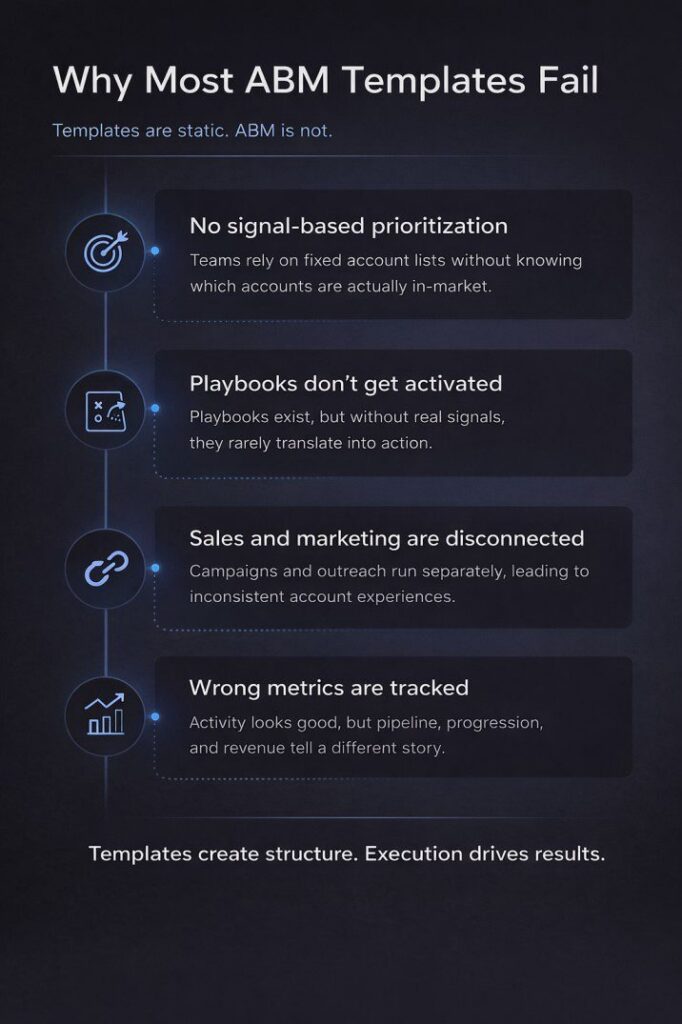
No signal-based prioritization. Teams work off a fixed account list with no way to know which accounts are actually in-market right now. Timing matters, and static templates do not capture it.
Playbooks that sit in a document. A playbook only works if it gets activated. Without a system that triggers outreach based on real buying signals, playbooks stay theoretical.
Disconnected sales and marketing. Marketing fills in the campaign template. Sales runs its own outreach. Nobody is working from the same account plan. Accounts get inconsistent experiences, and deals slip.
Measuring the wrong things. Teams track email opens and click rates instead of pipeline influence, stage progression, and deal velocity. Activity metrics look good in a dashboard. Revenue metrics tell the truth.
Templates solve the structure problem. They do not solve the execution problem. That requires something more.
From Templates to Execution: The Missing Layer
Even a perfect ABM strategy template cannot tell you which accounts are ready to buy right now.
Account-based marketing works best when it is timed to buying intent. But most teams are flying blind, reaching out to accounts on a schedule rather than in response to actual signals.
What high-performing ABM teams have that others do not:
Real-time intent signals. Knowing when a target account is actively researching solutions like yours, before they fill out a form or take a meeting.
Trigger-based workflows. Outreach that fires automatically when an account shows a buying signal, not when someone remembers to follow up.
GTM alignment. A single source of truth that keeps marketing, sales, and RevOps working from the same account data at the same time.
This is the layer that separates ABM programs that generate pipeline from ones that generate reports. Templates give you the structure. Signals give you the timing. Execution systems bring them together.
How Pintel Helps You Execute ABM at Scale
Pintel.AI is built for exactly this gap.
While most ABM tools help you build lists or run campaigns, Pintel identifies which accounts are in-market right now, so your team focuses effort where it will actually convert.
Here is what Pintel adds to your ABM strategy template system:
In-market account identification. Pintel surfaces target accounts showing active buying intent before your competitors see them.
Signal-based prioritization. Accounts are scored in real time based on behavioral signals, so your Tier-1 list is always current, never stale.
Signal visibility for timely outreach. Your team can act on buying signals as they happen, aligning outreach with real account activity instead of fixed schedules.
GTM team alignment. Marketing, sales, and RevOps work from the same account data and insights, so accounts get a consistent experience.
Scalable execution. Pintel helps teams run ABM across hundreds of accounts while maintaining relevance and timing.
The templates in this guide give you the structure. Pintel gives you the intelligence and signal layer to make that structure perform.
Conclusion
A strong ABM strategy template brings structure. It aligns your team, prioritizes accounts, and organizes your campaigns.
But structure alone is not enough.
The teams that win with ABM focus on execution. They identify accounts that are actually in-market, activate playbooks at the right moment, and keep sales and marketing aligned around the same accounts.
Use the templates in this guide to build your foundation. Then layer in signals, timing, and a connected workflow to turn that structure into pipeline and revenue.
Use this ABM strategy template to plan, execute, and scale your account-based marketing efforts.
Ready to move from templates to execution? See how Pintel helps B2B revenue teams identify in-market accounts and run ABM at scale.Frequently Asked Questions
Frequently Asked Questions
What is an ABM strategy template?
An ABM strategy template is a structured document that guides how a revenue team plans, executes, and measures an account-based marketing program. It typically includes account selection criteria, messaging frameworks, campaign plans, sales playbooks, and measurement metrics.
How do you create an ABM plan?
Start with a clear ICP definition. Then select and score your target accounts, assign tiers, map stakeholders within those accounts, build personalized campaign plans by tier, and set up trigger-based playbooks for sales outreach. An ABM strategy template helps structure this entire process. Track performance against pipeline and revenue metrics, not just engagement activity.
What should an ABM playbook include?
An ABM playbook should include the buying signal or trigger that activates it, the current deal stage for context, the outreach action to take, the channel to use, a personalized message angle, follow-up cadence, the team member responsible, and an escalation rule for high-priority accounts. This is typically defined within an ABM strategy template.
Are ABM templates actually effective?
Templates are effective when they are part of a connected system. A standalone account planning template or campaign template will not drive results on its own. The real value comes from linking account intelligence to campaign execution to sales playbooks to measurement, all structured through an ABM strategy template.