Account-based marketing starts with a clear set of target accounts, but results depend on how effectively those accounts are prioritised over time.
Not every account on your list is equally ready to engage. Some are early, some are inactive, and a few are actively moving based on changes inside the company. A strong account-based marketing strategy helps you identify these differences using signals, context, and fit, so your team focuses on accounts that are both relevant and timely.
This guide explains how to identify high-intent accounts, prioritise them with the right signals, and turn your account list into a consistent, high-quality pipeline.
What Is an Account-Based Marketing Strategy
An account-based marketing strategy is a focused B2B go-to-market approach where sales and marketing align around a defined set of target accounts rather than broad audience segments. Instead of generating leads and qualifying them after the fact, ABM identifies the right accounts first and builds outreach, content, and engagement around those specific accounts.
It differs from traditional demand generation in one fundamental way: demand generation casts wide and qualifies later. An ABM motion qualifies first, then engages.
Why this matters for B2B teams:
- Pipeline quality improves when you start with accounts that already fit your ICP instead of filtering leads after the fact
- Sales and marketing stay aligned because both teams work from the same account list with the same priorities
- Outreach becomes more relevant because messaging is built around account-specific context, not generic buyer personas
- Deal cycles shorten when you reach the right stakeholders early with the right message
An account-based marketing strategy is not a campaign type. It is a strategic operating model for how your team decides who to pursue, when to pursue them, and how to coordinate that pursuit across channels.
The Mistake Most ABM Strategies Make (And Why Timing Is the Real Variable)
Most teams build a strong target account list and treat all accounts on it the same. In reality, those accounts are at very different stages.
What this looks like in practice:
- Some accounts are not actively evaluating anything
- Some are early and exploring options
- A few are already moving toward a decision
An account that fits your ICP is only valuable when there is a reason to engage. That reason usually comes from change inside the account.
Common signals that indicate timing:
- New leadership in sales, marketing, or operations
- Hiring in roles related to your product
- Technology changes or stack expansion
- Increased engagement with your content
High-performing ABM teams do not work static lists. They:
- Continuously track signals across their accounts
- Prioritise outreach based on signal activity
- Focus effort on accounts that are both a strong fit and actively moving
This is what turns ABM from a list into a system.
The list defines who to target. Signals define when to act.
How an ABM System Works End to End
Most teams understand the individual pieces of an account-based marketing strategy: build a list, find contacts, send outreach. What they lack is a clear view of how those pieces connect into a single workflow. Here is how a fully operational ABM system runs:
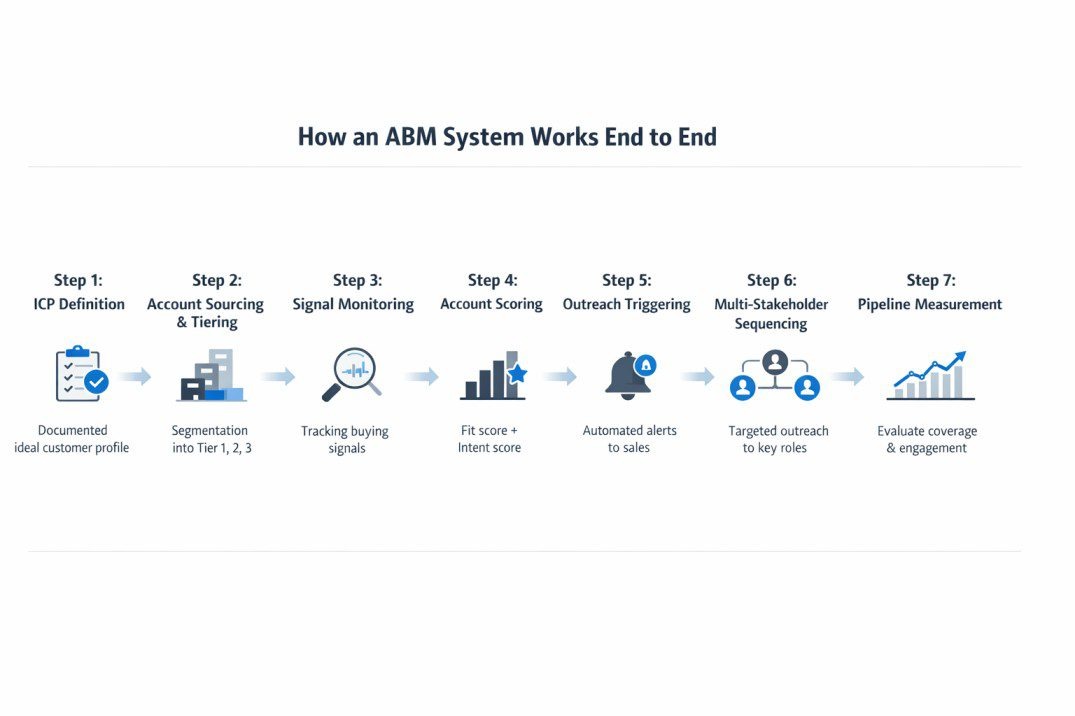
Step 1: ICP definition. Sales and marketing align on a single documented ideal customer profile covering firmographics, seniority mapping, and disqualifiers. This is the filter every account must pass before entering the system.
Step 2: Account sourcing and tiering. Target accounts are pulled from LinkedIn and enrichment providers, segmented into Tier 1, 2, and 3 based on fit, and assigned to owners in the CRM.
Step 3: Signal monitoring. The system continuously tracks buying signals across the full account list, including hiring activity, funding events, leadership changes, and tech stack shifts.
Step 4: Account scoring. Each account receives a fit score (based on ICP match) and an intent score (based on active signals). Combined, they produce a live prioritisation queue.
Step 5: Outreach triggering. When an account crosses a signal threshold, it moves to the top of the queue. Sales receives an alert with the account context and signal that triggered it.
Step 6: Multi-stakeholder sequencing. Outreach runs across LinkedIn, email, and phone, reaching the economic buyer, champion, and technical evaluator with role-specific messaging.
Step 7: Pipeline measurement. Performance is tracked at the account level, not the lead level. Coverage, engagement, and pipeline quality are the metrics that matter.
This is the difference between an account-based marketing strategy that produces consistent pipeline and one that produces occasional wins. Each step feeds the next. Remove any one of them and the system degrades into a manual, inconsistent process.
Why Most Account-Based Marketing Strategies Fail Early
Most ABM failures get blamed on the wrong thing. Teams assume the messaging was off, or the list was too small, or the timing was bad luck. In reality, the same five structural problems cause almost every failure, and none of them are about creative.
No shared ICP definition
When sales and marketing hold different definitions of a good account, the target list reflects both definitions, which means it accurately reflects neither. The result is a list that neither team fully trusts and both quietly ignore.
A list that is built once and forgotten
Markets move. Companies hire, restructure, raise capital, and change direction. An account list that is not refreshed continuously is a list of who your best customers used to look like, not who they are today.
Fit without timing
Firmographic fit alone tells you who could buy. It tells you nothing about who is ready to buy right now. Running outreach at equal intensity across all accounts regardless of where they are in a buying cycle is the single biggest source of wasted ABM capacity.
Sales and marketing running separate plays
When sales builds its own outreach cadence against a different account list than marketing is targeting, accounts receive fragmented, inconsistent contact. No amount of good messaging compensates for a broken handoff model.
Measuring the wrong things
Lead volume is not an ABM metric. Neither is email open rate. If your ABM reporting looks the same as your general outbound reporting, your account-based marketing strategy is not actually running as a distinct system. It is just outbound with a better list.
How to Build a Target Account List for an Account-Based Marketing Strategy
The target account list is the foundation of any ABM motion. Everything downstream, including outreach, content, and sequencing, depends on this list being accurate, current, and reflective of your best opportunities.
Start with ICP criteria, not company names. Define the firmographic profile of accounts that have historically closed fastest, retained longest, and expanded most. This typically covers industry vertical, headcount range, revenue band, geography, and technology stack. Every account must pass these criteria before anything else is considered.
Layer in seniority and role mapping. An account that matches your firmographic ICP still needs the right internal structure. Identify which departments and seniority levels are involved in your buying decision. A 300-person SaaS company with no RevOps function may technically fit your ICP but lack the internal architecture your product requires.
Source accounts from LinkedIn and enrichment providers. LinkedIn Sales Navigator is the most reliable starting point for pulling accounts that match firmographic criteria. Enrichment providers then append revenue, headcount growth trends, tech stack data, and contact-level details not available on LinkedIn alone.
Segment the list into tiers. Not all accounts deserve the same investment. Tier 1 accounts get fully personalised, high-touch outreach across multiple stakeholders. Tier 2 accounts get personalised messaging at the segment level. Tier 3 accounts get lighter-touch automated sequences. Tiering ensures your best accounts get your best effort.
A target account list built on documented ICP criteria and account tiers is what separates an ABM strategy that focuses effort from one that spreads it thin.
How to Identify High-Intent Accounts Using Buying Signals
A target account list tells you who fits your ICP. Buying signals tell you who is ready to act. This is where most account-based marketing strategies leave the most pipeline on the table.
The goal is to reach high-intent accounts at the moment they are in a purchasing cycle, not three months before or after it.
Signals that indicate account-level purchase intent:
- Hiring signals: When a target account posts roles in departments relevant to your product, it often indicates new budget or a new initiative. A company hiring three RevOps analysts is likely investing in the infrastructure your product supports.
- Funding events: Series A, B, and C rounds consistently precede purchasing decisions. Newly funded companies have budget to deploy and timelines to hit.
- Leadership changes: A new VP of Sales, CMO, or CRO typically arrives with a mandate to change how things are done. Their first 90 days is a high-intent window.
- Technology changes: When a target account adopts or removes a technology in your category, it signals a shift in infrastructure that may create an opening.
- Direct engagement signals: Visits to your pricing page, content downloads, or email opens from a target account indicate active interest. These are the warmest signals of all.
What this looks like in practice:
A B2B SaaS company running an account-based marketing strategy across 400 target accounts used hiring signals to identify when accounts were entering a buying cycle.
When a Tier 1 account posted two or more senior GTM roles within a 30-day window, it was treated as a priority because it indicated an active investment in go-to-market infrastructure. Hiring at that level typically reflects new budget, new initiatives, and a need to put systems in place quickly.
As a result, those accounts were moved to the top of the outreach queue and contacted immediately with messaging aligned to that context.
Over one quarter, outreach triggered by these signals generated three times the reply rate compared to outreach sent to accounts with similar ICP fit but no active signals. The difference came from reaching accounts when there was a clear reason to engage.
How to Score and Prioritize Accounts in Your ABM Strategy
Account scoring in an ABM strategy works across two dimensions that combine to produce a daily work queue for your team.
Fit score reflects how closely an account matches your documented ICP. Firmographics, tech stack, headcount, and revenue all contribute. This score is relatively stable and changes only when the account itself changes significantly.
Intent score reflects buying signals and observed behaviour. Hiring activity, funding events, web engagement, and content interaction all feed this score. Unlike fit score, intent score changes continuously as new signals emerge.
Combined, they produce clear prioritisation logic:
| Account Type | Fit Score | Intent Score | Action |
|---|---|---|---|
| Best opportunities | High | High | Immediate, high-touch outreach |
| Worth nurturing | High | Low | Monitor signals, stay warm |
| Investigate first | Low | High | Qualify before investing outreach |
| Deprioritise | Low | Low | Remove from active list |
Fit score tells you who belongs on your account-based marketing strategy list. Intent score tells you who belongs at the top of it. Running both is what makes the strategy executable rather than theoretical.
How to Map Decision-Makers Within Target Accounts
Identifying the right account is only half the work. Within each account, you need to reach the specific people involved in the buying decision.
Research from Gartner shows the average B2B buying group includes six to ten decision-makers. Reaching only one stakeholder, even the right one, significantly reduces conversion probability in an account-based marketing strategy.
Who is in the buying group? Map the economic buyer, champion, technical evaluator, and any blockers. Each plays a different role in the decision and each requires a different approach.
What does each stakeholder care about? A CFO cares about ROI and cost reduction. A VP of Sales cares about pipeline and quota attainment. A RevOps leader cares about workflow efficiency and integration. Messaging that treats all three identically will resonate with none of them.
How do you reach them across channels? LinkedIn is the most reliable channel for reaching decision-makers directly. Email adds reach and volume. Phone adds urgency. The sequencing of these channels matters as much as the channels themselves.
How Sales and Marketing Align in an Account-Based Marketing Strategy
An ABM approach only works when sales and marketing are running the same play against the same accounts. When they are not, outreach fragments, effort duplicates, and neither team has full visibility into what the other is doing.
Alignment comes down to four operational agreements:
A shared target account list. Both teams work from the same accounts with the same tier assignments. Marketing focuses spend on Tier 1 accounts. Sales focuses outreach on the same set.
A shared definition of account engagement. What does it mean for an account to be “engaged”? Define this before execution begins. Without a shared definition, both teams interpret progress differently and measure different things.
A clear handoff point. Define when a marketing-engaged account moves to active sales outreach. This prevents accounts from sitting in nurture sequences while a sales rep reaches out independently at the same time.
Shared pipeline metrics. Both teams are measured against account-level pipeline, not separate lead counts or activity metrics. This accountability structure is what keeps an account-based marketing strategy from drifting back into separate motions over time.
Tools and Workflow for an Account-Based Marketing Strategy
An ABM motion operates across two layers: the data and workflow layer, and the outreach execution layer. Most tool conversations focus on outreach. The data layer is where most of the leverage sits.
Data and Workflow Layer
This is where the strategy becomes operational. The key functions are:
- Account sourcing: Pulling target accounts from LinkedIn and enrichment providers that match your ICP and tier criteria
- Contact enrichment: Appending verified emails, phone numbers, and firmographic data to account and contact records
- Signal tracking: Monitoring buying signals like hiring activity, funding events, and leadership changes across your full target account list
- Account scoring: Combining fit and intent scores to produce a prioritised account queue that updates continuously as new signals emerge
- CRM sync and routing: Pushing scored, enriched accounts into your CRM with the correct tier, owner, and segment tags applied
Most teams manage these functions across separate tools: Sales Navigator for sourcing, a separate enrichment provider, signals tracked manually in a spreadsheet, and routing done by hand before anything reaches the CRM. Each manual handoff is a point where data quality drops and account context gets lost.
Pintel.AI connects this workflow end to end, starting with continuous tracking of custom buying signals across your target account list. These signals indicate when accounts are entering an active buying window and should be prioritised.
From there, Pintel.AI sources accounts from LinkedIn, enriches contact and company data, scores accounts based on fit and intent, and syncs prioritised accounts into your CRM with routing logic applied.
Your team spends time on outreach and conversations, not on building and maintaining lists manually. Signal-to-outreach time drops significantly, which is often the difference between reaching an account at the right moment and missing the window.
Outreach Execution Layer
This layer handles multi-stakeholder sequencing across LinkedIn, email, and phone. The tools here perform well only when the data layer is clean and current. A well-designed sequence built on stale account data will underperform regardless of how good the messaging is.
The outreach sequence that works for an account-based marketing strategy:
- LinkedIn connection request with a short, signal-specific note
- LinkedIn follow-up message after acceptance referencing a specific buying signal or account context
- Email with a segment-specific value proposition tied to the account’s situation
- Phone call with a voicemail referencing the email
- Final LinkedIn message or email with a clear next step
How to Measure Account-Based Marketing Strategy Performance
Most teams measure ABM by meetings booked, then wonder why the strategy never fully matures. Meetings booked is a lagging indicator. By the time it looks low, the problem is two stages upstream. A better measurement model runs at three levels simultaneously.
Account coverage: are you reaching the right people?
Coverage tells you whether your account-based marketing strategy is actually operating as designed or whether outreach is concentrated on a small fraction of the target list. Track the percentage of Tier 1 accounts with active outreach in progress, the number of stakeholders contacted per account, and the percentage of target accounts with at least one engaged contact. Low coverage is almost always a capacity or prioritisation problem, not a messaging problem.
Account engagement: are the right stakeholders responding?
Engagement tells you whether your messaging and timing are working. The most important metric here is multi-stakeholder engagement rate: accounts where two or more decision-makers have responded. Single-stakeholder engagement is fragile. Multi-stakeholder engagement is where deals actually move. Also track signal-to-outreach time. The faster your team responds when a buying signal fires, the higher the reply rate. Every day of delay is a day closer to a competitor reaching that account first.
Pipeline quality: is ABM producing better outcomes than standard outbound?
This is the only metric that ultimately justifies the investment. Compare win rate, deal size, and sales cycle length for ABM accounts versus non-ABM accounts. If ABM pipeline is not outperforming on at least two of these three dimensions, the issue is not outreach volume or creative quality. It is the account list, the scoring logic, or the alignment between sales and marketing.
Limitations of an Account-Based Marketing Strategy
It requires clean, current data. An ABM approach lives or dies on data quality. Stale contact data means outreach goes to the wrong people at the wrong time, which wastes the most valuable resource in ABM: relevance.
Results take longer to appear than broad outbound. ABM optimises for quality over volume. Deal cycles tend to be longer, and feedback loops are slower. Teams that evaluate performance on 30-day pipeline metrics will consistently misread what is working.
Tier 1 execution is resource-intensive. Fully personalised, multi-stakeholder outreach requires significant time from both sales and marketing. Without proper tiering, teams burn capacity on accounts that do not warrant the investment.
Misalignment kills results faster than anything else. An account-based marketing strategy is a shared operating model. If either sales or marketing drifts back to running an independent motion, the strategy fragments quickly and results suffer.
What Makes ABM Work in Practice
An account-based marketing strategy works when it operates as a system, not a set of disconnected activities. It starts with the right accounts, but results come from how those accounts are prioritised, when they are engaged, and how consistently sales and marketing act on shared signals.
The teams that generate consistent pipeline from ABM are not relying on better campaigns. They are working from a clear ICP, tracking changes across their target accounts, and prioritising outreach based on real buying signals rather than static lists.
At that point, ABM stops being a targeting exercise and becomes a timing and execution system.
If your current approach feels like a list with outreach layered on top, the gap is not in messaging or volume. It is in how accounts are prioritised and how signals are translated into action.
Frequently Asked Questions
What is an account-based marketing strategy?
An account-based marketing strategy is a B2B go-to-market approach where sales and marketing align around a defined list of high-fit target accounts. Instead of generating broad leads and qualifying them after the fact, it identifies the right accounts first and coordinates personalised outreach around them. It is a system, not a campaign.
How is an account-based marketing strategy different from demand generation?
Demand generation casts wide and qualifies inbound leads after the fact. An ABM strategy qualifies accounts first and builds targeted outreach around that specific list. ABM optimises for pipeline quality. Demand generation optimises for pipeline volume. Most mature B2B teams run both in parallel.
How do you identify high-intent accounts for an ABM strategy?
High-intent accounts show active buying signals: recent hiring in relevant departments, funding events, leadership changes, technology stack shifts, or direct engagement with your content. Combining intent signals with ICP fit score produces a prioritisation framework that puts the right accounts at the top of your outreach queue at the right time.
How many accounts should be in an ABM target list?
It depends on team size and tier structure. Tier 1 accounts requiring full personalisation typically number 50 to 150 per rep. Tier 2 accounts with segment-level personalisation can scale to several hundred. Tier 3 accounts can extend into the thousands with automated sequences. Total list size should reflect how much capacity your team has to engage each tier properly.
What data is required to run an account-based marketing strategy?
At minimum: a documented ICP with firmographic criteria, a verified target account list with contact-level enrichment, CRM routing logic by tier and owner, and a signal tracking layer to monitor buying activity. Without enriched contact data and signal coverage, an ABM approach defaults to targeting companies without a reliable way to reach the right people inside them or time outreach correctly.
How do you measure account-based marketing strategy success?
Measure at three levels. Account coverage: are you reaching the right stakeholders across your target list? Account engagement: are those stakeholders responding and are multiple decision-makers involved? Pipeline quality: is ABM pipeline converting at higher rates and larger deal sizes than non-ABM pipeline? Measuring an account-based marketing strategy by lead volume misses what the strategy is built to optimise.