B2B sales prospecting tools help revenue teams identify the right accounts, find decision-makers, and prioritize prospects before outreach begins. Choosing the right B2B sales prospecting software can be the difference between building a predictable pipeline and relying on inconsistent prospecting results.
As prospecting stacks expand, complexity increases. Multiple enrichment sources conflict, scoring logic varies across systems, and CRM records often require cleanup before outreach begins. Instead of building pipeline, teams end up managing disconnected tools.
This guide compares the best B2B sales prospecting tools and software based on data quality, workflow automation, integrations, and outbound readiness to help sales, RevOps, and GTM teams choose the right platform.
What Are B2B Sales Prospecting Tools?
B2B sales prospecting tools help sales teams identify target accounts, find decision-makers, enrich contact data, and prioritize prospects before outreach begins. Modern B2B sales prospecting software combines account discovery, contact enrichment, lead qualification, and workflow automation to help teams build accurate prospect lists and improve outbound efficiency.
In practice, these tools help teams:
- Identify ICP-fit accounts
- Discover and verify decision-makers
- Enrich company and contact data
- Prioritize prospects using buying signals and lead scoring
- Sync qualified records with CRM and sales engagement platforms
Rather than acting as standalone contact databases, today’s B2B prospecting tools support the entire prospecting workflow—from account selection to sales-ready prospect lists. Choosing the right platform depends on whether your biggest challenge is data quality, account prioritization, contact discovery, or workflow automation.
Types of B2B Sales Prospecting Tools
Not all B2B sales prospecting tools serve the same purpose. Some focus on helping teams build accurate prospect lists, while others specialize in buying signals or outbound execution. Understanding these categories makes it easier to choose the right software for your sales process.
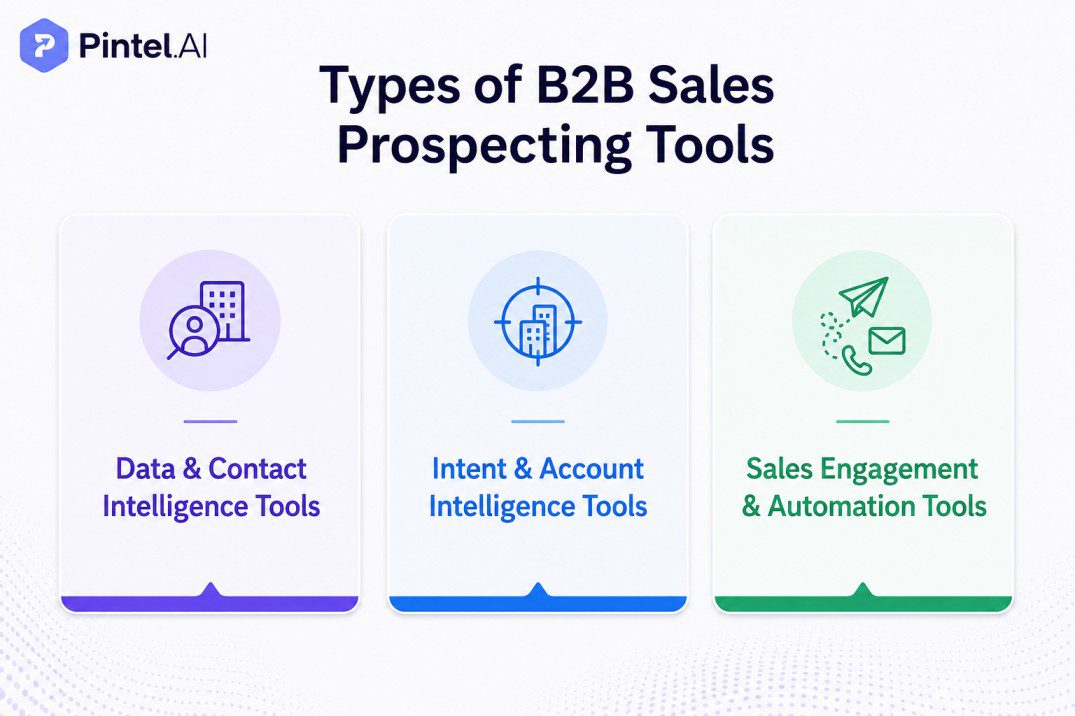
Data & Contact Intelligence Tools
These tools help teams discover companies, identify decision-makers, enrich contact data, and build accurate prospect lists. They are best suited for improving data quality and reducing manual research.
Intent & Account Intelligence Tools
These platforms identify accounts showing buying intent using behavioral signals, website activity, or predictive analytics. They help sales teams prioritize outreach based on purchase intent rather than firmographic data alone.
Sales Engagement & Automation Tools
These tools manage outbound execution through email sequences, call cadences, LinkedIn outreach, CRM synchronization, and workflow automation. They help SDRs engage prospects consistently and at scale.
Most revenue teams use a combination of these categories. The right B2B sales prospecting tool depends on whether your biggest challenge is contact discovery, account prioritization, or outbound execution.
Comprehensive Comparison: Top B2B Sales Prospecting Tools (2026)
The table below maps each platform by prospecting strength, ideal team profile, and key differentiator. Based on publicly available product positioning and common B2B GTM use cases, not paid placements.
| Platform | Best For | Pricing | Key Strength |
|---|---|---|---|
| Pintel.AI | AI-powered B2B prospecting and GTM teams | Custom pricing | AI-powered prospecting, buying signals, contact enrichment, and end-to-end workflow automation |
| 6sense | Enterprise ABM and outbound teams | Custom pricing | Predictive intent data, account prioritization, and AI-powered buying signals (6sense) |
| Demandbase | Sales and marketing teams running ABM | Custom pricing | Account intelligence, intent data, and cross-channel account engagement (Demandbase) |
| LeadIQ | SDRs and outbound prospecting teams | Starts at $45/user/month | One-click LinkedIn prospecting, contact capture, and CRM sync (Expandi – #1 LinkedIn Automation Tool) |
| Outreach | Large outbound sales teams | Custom pricing | Multi-channel sales engagement, sequencing, and workflow automation (Prospeo) |
| Salesloft | Teams focused on SDR productivity and coaching | Custom pricing | Sales engagement, cadence management, and conversation intelligence (Prospeo) |
Below is a closer look at how each platform fits into the broader B2B prospecting stack, where it delivers the most operational leverage, and where tradeoffs exist.
Best B2B Sales Prospecting Tools Compared
Every B2B sales prospecting platform has a different focus. Some are built for contact discovery, others for account intelligence, intent data, or sales engagement. Here’s a closer look at how the leading platforms compare.
Pintel.AI: AI-Powered B2B Sales Prospecting Platform
Product Overview
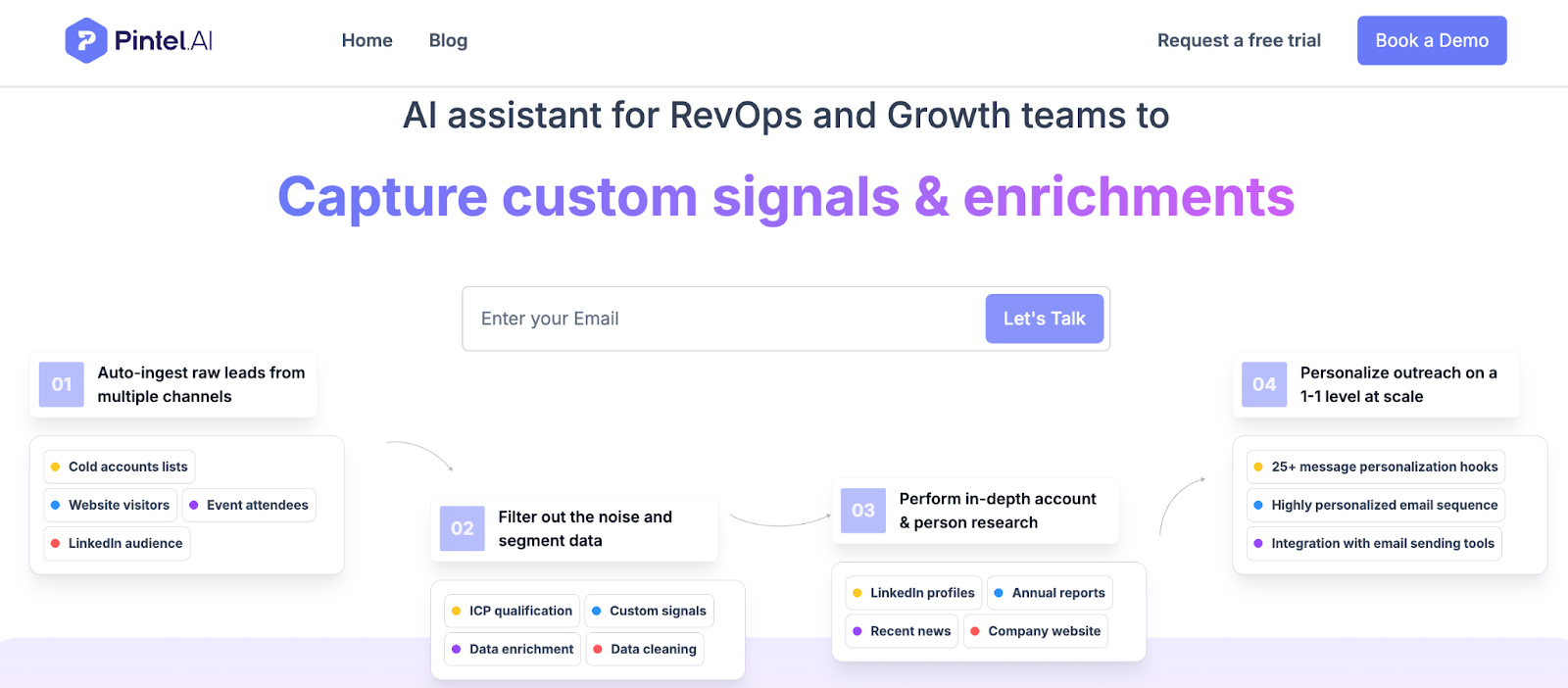
Pintel.AI is a B2B sales prospecting platform that automates outbound preparation so every account entering a campaign is qualified, enriched, scored, and CRM-ready.
It eliminates the manual assembly work that typically happens before outreach, ensuring prospect lists are built on consistent ICP logic rather than rep-by-rep research habits.
In day-to-day outbound prospecting, teams need to:
- Research and filter target accounts based on ICP
- Identify the right roles within those accounts
- Enrich accurate emails and contact details
- Score accounts and contacts for prioritization
- Generate structured context for personalized outreach
- Push clean records into CRM and engagement tools
Pintel AI brings these steps into a single workflow. Instead of jumping between research tools, enrichment platforms, and spreadsheets, reps can move from account selection to CRM-ready prospects without manual verification or cleanup.
Every record entering the CRM is enriched, scored, and aligned to defined ICP filters.
Key Features
- Account research filters aligned to firmographics, industry, size, and ICP criteria
- Verified contact enrichment including role, seniority, and direct contact details
- Built-in scoring that ranks accounts and contacts against defined qualification rules
- Structured account and role data fields that support personalized outbound messaging
- Native CRM and engagement platform integration for direct sync without exports
Operational Benefits
- Reps build outbound lists from validated data rather than manually cross-checking titles and companies
- Buying committee targeting becomes consistent across campaigns
- Account and contact scoring stays aligned with defined ICP rules
- Personalized messaging is supported by structured, accurate context
- CRM records enter sequences clean, qualified, and execution-ready
The Tradeoff
Pintel has a smaller market presence compared to long-established prospecting and engagement platforms. Organizations that prioritize vendor maturity, large ecosystem footprints, or brand familiarity may evaluate larger providers first.
Best For
- SMB’s to enterprise outbound teams that:
- Need reliable CRM integration without data conflicts
- Run structured account-based prospecting motions
- Target multiple stakeholders per account
- Require consistent scoring before sequence enrollment
- Want to reduce manual research before outreach
6sense: Identifying In-Market Accounts Before They Raise Their Hand
Product Overview
6sense is a revenue AI platform that uses intent data and predictive modeling to show B2B outbound teams which accounts are actively researching solutions in their category. It gives SDRs and AEs the timing intelligence to prioritize prospecting effort toward accounts already showing buying signals rather than relying on firmographic fit alone.
Key Features
- Predictive buying stage modeling that maps accounts to their position in the purchase journey
- Third-party intent signal aggregation tracking prospect research behavior across publisher networks
- AI-powered account scoring ranking outreach priority by signal strength and firmographic fit
- Integrated display advertising allowing marketing to run account-targeted campaigns in parallel with sales prospecting
Operational Benefits
- SDRs reach accounts already in an active research cycle, directly improving connection rates and shortening the cold-to-warm conversion timeline
- Behavioral account scoring removes subjectivity from territory planning and creates a shared, data-driven prioritization framework across the team
The Tradeoff
- Fully activating 6sense’s intent layer requires significant data integration, CRM configuration, and dedicated RevOps resources for ongoing signal tuning, making it a poor fit for teams without an established ABM motion
Best For
Enterprise ABM teams running account-based prospecting programs where outreach timing, not just account fit, is the primary conversion lever.
Demandbase: Account-Based Prospecting Across Sales and Marketing
Product Overview
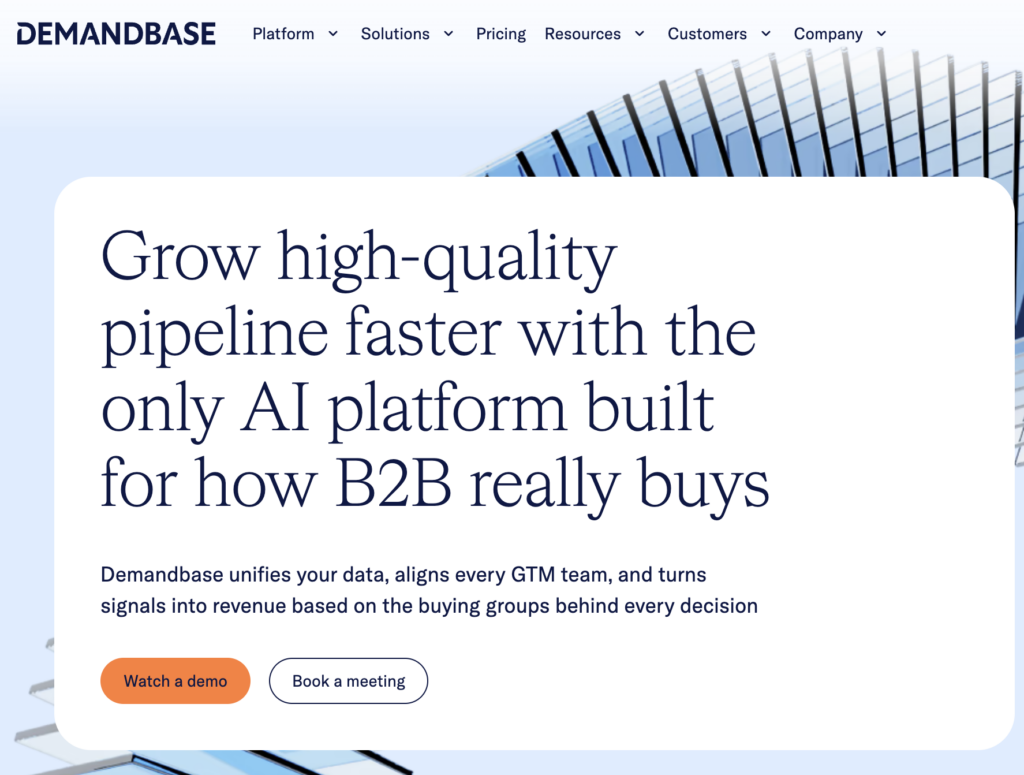
Demandbase is an ABM platform that consolidates account-level prospecting intelligence, intent data, and advertising orchestration into a single layer shared by sales and marketing. It gives outbound teams account-level buying context rather than just contact-level access, grounding prospecting conversations in actual company behavior.
Key Features
- Anonymous web traffic identification that maps site visitors to specific company accounts
- Firmographic and technographic account enrichment for precise ICP targeting
- Multi-source intent data aggregation layered with first-party behavioral signals
- Cross-channel orchestration synchronizing outreach sequences with targeted digital advertising
Operational Benefits
- Eliminates the account targeting disconnect between marketing and sales by giving both teams a shared intelligence layer, so sequences and campaigns reach the same buying committees simultaneously
- Anonymous traffic identification surfaces companies already engaging with your brand before any sales contact, giving SDRs a warmer entry point into prospecting conversations
The Tradeoff
- Demandbase operates at the account level and does not provide contact-level enrichment for outbound prospecting, requiring integration with a dedicated contact data platform. While 6sense focuses on predicting outreach timing, Demandbase focuses on orchestrating coordinated account engagement across sales and marketing
Best For
Sales teams running account-based outbound motions where company-level intelligence and marketing alignment matter more than high-volume contact prospecting.
LeadIQ: Outbound List Building at SDR Speed
Product Overview
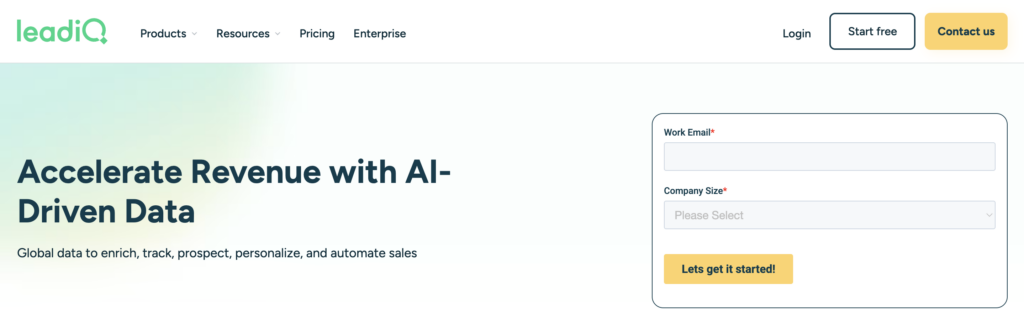
LeadIQ is a B2B sales prospecting tool built around one specific problem: SDRs lose too much time moving between research tools, enrichment platforms, and sequencing systems. It embeds directly into LinkedIn and LinkedIn Sales Navigator, letting reps capture, enrich, and route prospect data into their CRM or outbound sequence in a single click at the point of research.
Key Features
- One-click prospect capture from LinkedIn and Sales Navigator with instant contact enrichment
- Real-time email verification and direct phone sourcing at point of capture
- Native integrations with Salesforce, HubSpot, Outreach, and Salesloft for immediate sequence enrollment
- Job change tracking that alerts reps when a contact moves to a new role or company
Operational Benefits
- Collapses research, enrichment, and sequence enrollment into a single workflow step, recovering significant SDR time that converts directly into more outreach activity
- Real-time email verification at point of capture reduces bounce rates and ensures sequences are built on deliverable contact data from the start
The Tradeoff
- LeadIQ optimizes for contact capture speed, not account-level intelligence. It does not tell SDRs which accounts to target, only makes list-building faster once the decision is made, making it insufficient as a standalone sales prospecting tool for intent-driven teams
Best For
High-velocity SDR teams where the primary prospecting bottleneck is time spent moving contact data between LinkedIn, enrichment tools, and sequencing platforms.
Outreach: Structured Outbound Execution at Scale
Product Overview
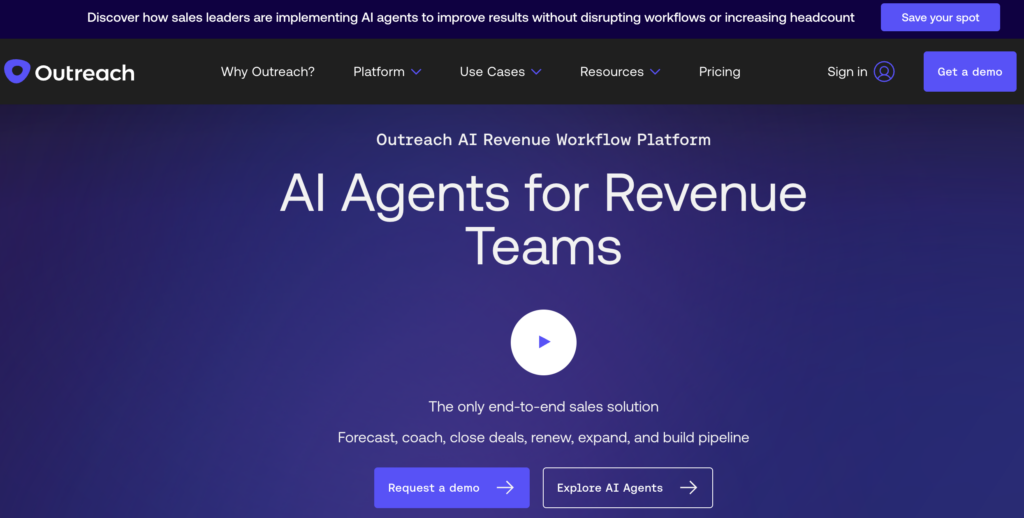
Outreach is a sales execution platform that provides the sequencing infrastructure, workflow automation, and engagement analytics outbound teams need to prospect systematically at volume. It focuses entirely on how prospects are engaged, how consistently outreach follows a defined sequence, and how performance data improves the process over time.
Key Features
- Multi-channel sequence builder across email, phone, LinkedIn, and direct mail
- AI-assisted email composition with A/B testing for sequence optimization
- Prospect engagement tracking tied directly to sequence activity and pipeline outcomes
- Conversation intelligence via Outreach Kaia with real-time call transcription and coaching prompts
Operational Benefits
- Gives every SDR a structured, repeatable prospecting execution framework so outbound quality does not vary by rep or territory
- Sequence performance data surfaces which touchpoints and timing patterns generate the most engagement, enabling RevOps to continuously sharpen the outbound playbook
The Tradeoff
- Governing an effective Outreach environment requires dedicated RevOps investment in sequence libraries, CRM rules, and reporting configuration. Teams without that support consistently underutilize the platform relative to simpler sales prospecting tools
Best For
Scaled outbound teams with defined SDR functions, RevOps support, and the activity volume that justifies building and maintaining a structured sequencing infrastructure.
Salesloft: Cadence-Led Prospecting with a Coaching Layer
Product Overview
Salesloft is a sales engagement platform that combines outbound cadence management with conversation intelligence and rep performance coaching. It is built for teams where how SDRs prospect matters as much as how many prospects they reach, embedding methodology and feedback directly into the prospecting workflow.
Key Features
- Structured cadence management standardizing outreach execution across the entire SDR team
- Salesloft Rhythm conversation intelligence with AI-generated coaching insights from calls and emails
- Rep performance dashboards tracking cadence adherence, engagement quality, and conversion metrics
- Native CRM and enrichment integrations keeping prospect data current within the engagement workflow
Operational Benefits
- Cadence standardization ensures every prospect receives the same quality of structured outreach regardless of individual rep habits, removing execution inconsistency at scale
- Conversation intelligence gives managers visibility into not just how many prospects each rep contacted but how well those interactions were handled, enabling precise coaching grounded in real prospecting behavior
The Tradeoff
- Teams focused on raw sequence volume rather than cadence quality and rep development may find Outreach a better fit. Like Outreach, Salesloft is an execution layer and requires upstream sales prospecting tools to supply qualified prospect lists
Best For
Outbound teams where prospecting methodology, cadence discipline, and SDR coaching are as operationally important as sequence volume and throughput.
Common Questions Teams Ask About Sales Prospecting Tools
Q: We have a full prospect database. Why is our outbound pipeline still thin?
Having access to data is not the same as having data that works inside a prospecting workflow. Effective B2B sales prospecting tools do not just surface contacts. They surface the right contacts at companies actively evaluating solutions, enriched with the context SDRs need to open a relevant conversation. Teams with thin pipelines despite large databases are almost always missing the enrichment and timing layer, or have it spread across disconnected tools that never produce a coherent signal for the rep.
Q: What is the difference between sales prospecting tools and sales engagement platforms?
Sales prospecting tools help teams identify and qualify who to contact. Sales engagement platforms manage how those prospects are contacted through structured sequences. One solves targeting precision. The other solves execution consistency. Effective outbound motions need both, with dedicated platforms handling each function.
Q: Do we need both intent data and contact enrichment?
Yes. Intent data identifies which accounts are in-market. Contact enrichment ensures you have accurate details for decision-makers within those accounts. Without enrichment, intent cannot convert into conversations. Without intent, enriched data generates outreach to companies not yet in a buying cycle.
Q: When should early-stage teams invest in sales prospecting tools?
Once outbound becomes repeatable and SDR time is being consumed by manual list building or data cleanup rather than actual outreach. Adding sales prospecting tools to an undefined motion adds cost without fixing the underlying workflow problem.
How to Choose the Right B2B Sales Prospecting Tool
Step 1: Name your prospecting bottleneck precisely. Data quality? List-building speed? Account prioritization? Sequence execution? Each problem maps to a different category of sales prospecting tools. Buying the wrong category solves nothing.
Step 2: Fix the most broken layer first. Sales prospecting tools divide into data foundation, intelligence, and execution layers. Most teams need all three, but buying an execution platform when the real constraint is data accuracy produces activity, not pipeline.
Step 3: Pressure-test data quality over time. Prospect data degrades fast. Ask every vendor about data refresh rates, contact deprecation handling, and enrichment quality at six months versus day one. This is where most B2B sales prospecting tools diverge most significantly in real-world performance.
Step 4: Assess RevOps overhead honestly. Every prospecting platform requires ongoing configuration and governance. Map your RevOps bandwidth against the operational cost of each platform before committing.
Step 5: Match to your current GTM stage. A ten-person team building its first outbound motion does not need the same stack as a sixty-person organization running coordinated ABM. Choose sales prospecting tools that solve today’s constraint without over-engineering for a motion your team has not built yet.
Common Mistakes When Evaluating B2B Sales Prospecting Tools
Treating intent data and contact data as the same thing. Knowing which accounts are in-market and knowing who to call within those accounts are two different problems. Teams that buy an intent platform expecting it to solve contact quality end up with neither solved.
Comparing features instead of workflow fit. The real question is whether the platform fits how your SDRs actually prospect, from identifying a target to enrolling them in a sequence, not how impressive the feature list looks in a demo.
Ignoring integration tightness. A sales prospecting tool that requires a manual export before data reaches your sequencing platform creates friction SDRs will route around immediately. Integration with your CRM and sequencing tools determines whether the platform actually gets used.
Stacking tools without a workflow design. Adding a new sales prospecting tool to a disorganized outbound motion adds cost and complexity, not performance. Define the workflow first. Then identify which gaps each platform fills.
Final Takeaway
The right choice becomes clearer when you view sales prospecting tools through the lens of data foundation, intelligence, and execution layers rather than brand comparison.
Pintel addresses data accuracy so SDRs trust their queue. 6sense surfaces buying intent so outreach lands at the right moment. Demandbase aligns marketing and sales around shared account intelligence. LeadIQ removes list-building friction at the rep level. Outreach structures outbound execution at scale. Salesloft embeds methodology and coaching into the daily prospecting workflow.
Revenue teams that choose B2B sales prospecting tools based on operational fit rather than feature comparison build outbound motions that compound over time. Start with an honest audit of where your prospecting workflow breaks down. The right platform becomes clear once you know the answer.