
B2B revenue growth depends on the quality of accounts entering your outbound pipeline. Before outreach begins, before messaging is tested, and before quotas are tracked, there is a foundational layer that determines whether pipeline creation will be consistent or chaotic. That layer is sales prospecting.
The strength of that foundation shapes everything downstream. Targeting precision, data accuracy, segmentation structure, and CRM alignment influence how efficiently SDRs can execute and how reliably pipeline converts. When these elements are coordinated, outbound performance becomes measurable and scalable. When they are fragmented, results fluctuate regardless of effort.
This guide explores how modern B2B teams approach sales prospecting at a strategic and operational level, outlining the framework, process stages, and execution principles that support consistent pipeline creation.

What Is B2B Sales Prospecting?
Sales prospecting is account preparation work. It involves selecting which companies to target, finding the right contacts within those accounts, validating their data, and organizing everything into a usable format for SDRs or AEs to execute against.
This is different from lead generation, which focuses on inbound interest capture. Prospecting is deliberate and outbound. You’re building the list, not responding to it.
It’s also distinct from outreach. Outreach is the execution layer where you send emails, make calls, or engage on LinkedIn. Prospecting happens before that. If your targeting is wrong, no amount of outreach optimization will fix your pipeline.
The confusion between these terms creates operational breakdowns. Teams often jump straight to outreach without doing the prospecting work properly, then blame their messaging when the real issue is they’re targeting the wrong accounts or using stale contact data.
Good prospecting means your SDRs spend time selling, not researching. Bad prospecting means they waste hours per week cleaning lists, guessing at job titles, and chasing outdated emails.
The B2B Sales Prospecting Framework
Effective sales prospecting follows a clear five-step framework that transforms targeting from guesswork into repeatable process:
1. Define ICP Precisely Start with specific firmographic criteria, growth signals, and technology indicators. Vague targeting produces vague results.
2. Prioritize Accounts Using Timing Signals Not every qualified account is ready to buy. Layer in intent data, hiring signals, and market events to identify when to prospect.
3. Validate and Map Contacts Verify company data is current, then identify decision-makers and influencers with accurate contact information.
4. Structure CRM and Territories Organize accounts with clear segmentation, ownership rules, and tagging that enable SDR execution without manual research.
5. Enable SDR Execution Without Research Deliver clean, prioritized lists with context so SDRs can focus on outreach, not list building.
This framework ensures sales prospecting becomes a system that compounds over time rather than an activity that resets every quarter.
Why Sales Prospecting Matters in Modern B2B
Pipeline doesn’t build itself. Even with strong inbound motion, most B2B companies need outbound to hit revenue targets. Sales prospecting determines whether that outbound motion generates real pipeline or just activity metrics.
Targeting precision affects everything downstream. When sales prospecting is done poorly, you get:
- Low reply rates, not because your message is bad, but because you’re emailing the wrong people
- Wasted SDR time on unqualified conversations
- CRM pollution that makes reporting unreliable
- Territory overlap and duplicate outreach that damages brand perception
Prospecting done right gives you:
- Higher connect rates because you’re reaching real decision-makers
- Better conversion rates because accounts actually match your ICP
- Cleaner pipeline data that RevOps can trust
- Consistent SDR output without constant list-building interruptions
The difference isn’t marginal. A well-prospected list might convert at 3-5%, while a poorly built one converts at 0.5%. That’s the gap between hitting quota and missing by 40%.
Segmentation discipline creates efficiency. When you prospect with clear criteria, SDRs can personalize at scale. They know which vertical they’re targeting, which pain points matter, and which use cases to lead with. Without that structure, every account requires custom research, which doesn’t scale.
Data accuracy matters more now than five years ago. Buyers change jobs faster, company structures shift, and outdated contact information kills deliverability. Prospecting workflows need to account for data decay, not assume the list you built last quarter is still good.
B2B Sales Prospecting Strategy
Strategy is where you define what good looks like before you start building lists. Most teams skip this step in their sales prospecting and go straight to pulling contacts from a database, which is why their efforts fail.
ICP Clarity
Your Ideal Customer Profile should be specific enough to be useful for sales prospecting. “Mid-market SaaS companies” is not an ICP. That’s a category.
A real ICP includes:
- Revenue range (e.g., $10M-$50M ARR)
- Employee count (e.g., 50-200)
- Funding stage or growth signal (e.g., Series B+, or 20%+ YoY headcount growth)
- Technology stack indicators (e.g., uses Salesforce, has a data team)
- Organizational structure (e.g., separate RevOps function, multiple product lines)
The tighter your ICP, the better your prospecting. Narrow targeting isn’t limiting, it’s clarifying. You can always expand later, but starting broad means you waste months learning what doesn’t work.
Account Selection Criteria
Once you have an ICP, you need selection logic. Not every company that fits your ICP is worth prospecting right now.
Prioritization might be based on:
- Intent signals (job postings, tech stack changes, leadership hires)
- Market timing (regulatory changes, industry shifts, seasonal budget cycles)
- Geographic expansion plans (if you’re targeting specific regions)
- Competitive displacement opportunities (accounts using a competitor’s product)
This is where most prospecting strategies break down. Teams build lists based on firmographics alone, ignoring the context that determines whether an account is ready to buy.
Market Segmentation
Segmentation determines how you organize your sales prospecting effort. This could be by:
- Vertical (fintech, healthcare, logistics)
- Company size (SMB, mid-market, enterprise)
- Geography (East Coast, EMEA, APAC)
- Use case (teams solving X problem vs. Y problem)
Good segmentation allows you to:
- Assign territories that make sense
- Tailor messaging without starting from scratch every time
- Track performance by segment to see what’s actually working
Bad segmentation creates chaos. SDRs step on each other’s accounts, messaging becomes generic, and you can’t diagnose why certain lists underperform.

The B2B Sales Prospecting Process
Process is where strategy becomes executable. A prospecting process should be repeatable, documented, and tied to your CRM or workflow tool.
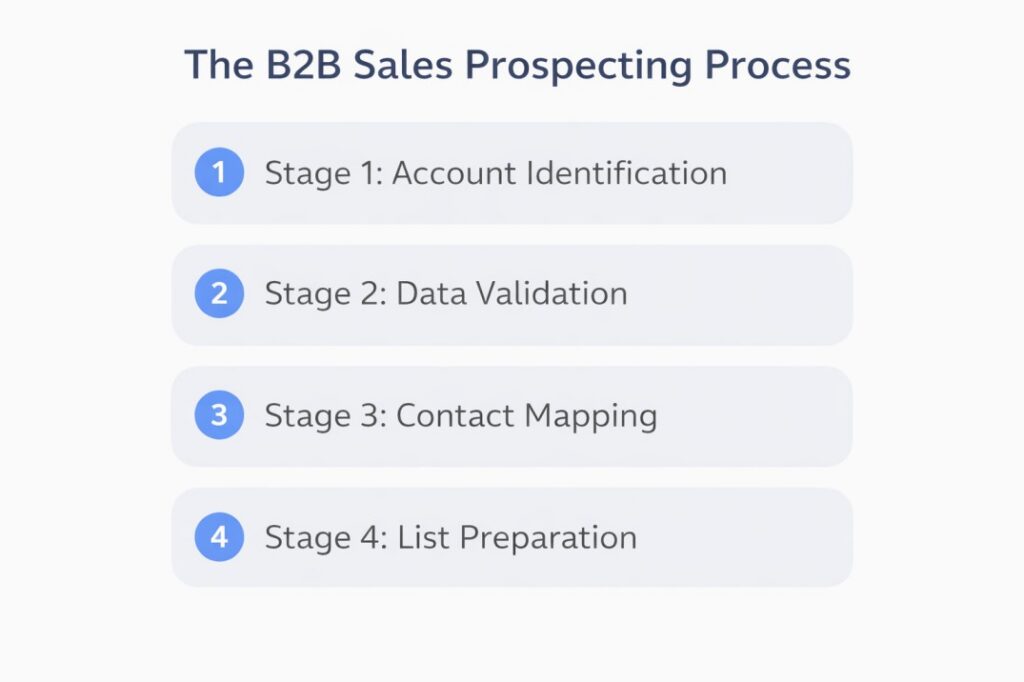
Stage 1: Account Identification
This is list building. You’re pulling accounts that match your ICP and selection criteria from your data sources.
Common breakdowns:
- Pulling too broad and planning to filter later (this never happens)
- Relying on a single data source that has coverage gaps
- Not documenting selection logic, so no one knows why accounts were included
Best practice: Build lists in batches (e.g., 500 accounts per week) rather than one massive pull. Smaller batches are easier to validate and allow you to iterate on criteria.
Stage 2: Data Validation
Your list is only as good as the data behind it. This stage involves:
- Verifying company information is current (e.g., checking for M&A, rebrand, or shutdown)
- Confirming headcount and revenue ranges haven’t shifted dramatically
- Validating key signals (e.g., job postings are recent, tech stack data is fresh)
Manual validation doesn’t scale, but some level of spot-checking is necessary. Most teams skip this entirely and then wonder why their lists underperform.
Stage 3: Contact Mapping
Once you have clean accounts, you need the right people at each one.
This means:
- Identifying decision-makers and influencers by role
- Mapping organizational structure (who reports to whom)
- Prioritizing contacts based on buying authority
- Finding valid email addresses and direct dials
The mistake here is mapping too many contacts per account too early. Start with one or two key contacts, validate they respond, then expand. Mapping 10 contacts per account upfront is waste if the account doesn’t engage.
Stage 4: List Preparation
Your prospected accounts and contacts need to be organized for execution. This includes:
- Assigning accounts to territories or SDRs
- Tagging accounts with relevant segmentation data (vertical, use case, priority tier)
- Structuring your CRM so SDRs can filter and work the list efficiently
- Setting up sequences or cadences in advance
Preparation is where most processes fail. Teams do the hard work of prospecting, then dump a messy spreadsheet into the CRM without structure. SDRs then waste hours figuring out who to call first.
Stage 5: Outreach Readiness
Before SDRs start executing, confirm:
- Data is in the CRM and accessible
- Messaging is drafted for the segment
- Sequences are set up and tested
- Territories are clearly assigned with no overlap
- Reporting is configured to track progress
Prospecting ends when the list is ready to work. Outreach begins when SDRs start engaging contacts. The cleaner the handoff, the better the results.
Execution: Turning Target Lists into Pipeline
Execution is where prospecting either pays off or falls apart. A perfectly prospected list still fails if SDRs can’t work it consistently.
SDR Workflow Design
SDRs should not be building their own lists. If they are, your prospecting process doesn’t exist.
An SDR team building their own lists typically spends 30-40% of their week researching accounts and validating contact data. At 5 SDRs, that equals two full-time salaries lost to manual prospecting instead of actual selling.
- SDR receives a batch of prospected accounts (e.g., 100 accounts per week)
- Accounts are pre-tagged with segment, priority, and any relevant context
- SDR executes cadence without needing to research or validate data
- SDR logs activity and outcomes in CRM
- New batch assigned when previous batch is worked
This requires upfront work, but it’s the only way to scale. One person (or team) should own prospecting. SDRs should own execution.
CRM Alignment
Your CRM structure determines whether prospecting efforts compound or degrade over time.
Key alignment points:
- Accounts and contacts should be deduplicated before import
- Custom fields should capture segmentation data (vertical, ICP tier, intent signals)
- Ownership rules should prevent territory conflicts
- Activity logging should be enforced so you can track what’s been tried
If your CRM is a mess, prospecting won’t fix it. You’ll just add more mess.
Data Freshness
Sales prospecting is not a one-time event. Data decays.
Execution requires regular list refreshes:
- Quarterly for slower-moving industries
- Monthly for high-growth segments
- Ongoing for high-priority accounts
Avoiding Duplicate Outreach
Nothing kills trust faster than emailing the same person twice because your CRM and prospecting aren’t synced.
Basic safeguards:
- Check CRM before adding new contacts
- Tag accounts as “in active outreach” so they don’t get re-prospected
- Implement account-level exclusion rules (e.g., don’t prospect customers or current opportunities)
Consistency Across Territories
If you have multiple SDRs, prospecting should create consistency, not chaos.
Each SDR should:
- Work a similar volume of accounts
- Target accounts of similar quality (not one SDR getting enterprise while another gets SMB)
- Have clear territory boundaries with no overlap
Territory design is part of prospecting strategy. If territories are poorly structured, even great prospecting won’t produce even results.
Common Failures in B2B Sales Prospecting
Most sales prospecting efforts fail predictably. The mistakes are operational, not motivational.
Spray-and-Pray Targeting
Pulling 10,000 contacts and hoping volume compensates for poor targeting doesn’t work. It creates:
- Low reply rates
- High bounce rates that damage sender reputation
- SDR burnout from constant rejection
- Inaccurate pipeline forecasting
Tighter targeting always outperforms broad blasting.
Outdated Prospect Data
Using lists that haven’t been refreshed in months guarantees failure. Contacts change roles, companies restructure, and buying contexts shift constantly.
Signs your data is stale:
- Bounce rates above 5%
- High percentage of “no longer with company” replies
- Contacts who changed roles but are still tagged with old titles
Data accuracy is not a one-time fix. It’s ongoing maintenance.
Manual Spreadsheet Workflows
If your prospecting process lives in Google Sheets with manual copy-paste into the CRM, you will:
- Lose data
- Create duplicates
- Waste hours on administrative work
- Struggle to scale past one or two SDRs
Spreadsheets are fine for analysis. They’re terrible for workflow management.
Poor Segmentation Discipline
Treating all prospects the same because you didn’t segment properly means:
- Generic messaging that doesn’t land
- Inability to diagnose what’s working
- Wasted effort on low-fit accounts
Segmentation is the difference between personalization and spam.
Misaligned CRM Structure
If your CRM wasn’t designed for prospecting, forcing it to work will create friction.
Common issues:
- No clear account hierarchy
- Missing fields for segmentation
- Poor deduplication logic
- Unclear ownership rules
Fix the CRM structure before you scale prospecting, or you’ll scale the mess.
How Technology Supports Modern Prospecting
Technology doesn’t replace sales prospecting strategy, but it removes the operational friction that prevents good strategy from scaling. The right tools address specific failure points in the prospecting process.
Data Sourcing
Manual research doesn’t scale when sales prospecting needs to support multiple SDRs with fresh accounts every week. Data sourcing tools aggregate company and contact information to prevent SDR time loss on list building.
Categories include:
- B2B databases (Pintel.AI, ZoomInfo, Apollo, Cognism) for firmographic and contact data
- Intent signal platforms (Pintel.AI, G2, 6sense, Bombora) for identifying accounts actively researching solutions
- Job board scrapers (Pintel.AI) for hiring signals that indicate team growth or new initiatives
The operational benefit: SDRs receive workable lists instead of spending half their week on LinkedIn and Google.
No single source has perfect coverage. Most teams use 2-3 sources to fill gaps in specific verticals or regions.
Enrichment
Incomplete CRM records force SDRs to manually research basic information before they can even start outreach. Enrichment tools prevent this time loss by appending missing data to your existing accounts and contacts.
Common use cases:
- Adding email addresses to a list of names and companies
- Appending revenue or employee count data to qualify accounts properly
- Validating phone numbers before calling to avoid wasted dial time
Enrichment works best when you already have partial data. It fills gaps in your existing sales prospecting lists rather than building them from scratch.
Contact Mapping
Enterprise sales prospecting fails when you can’t identify who actually makes decisions. Contact mapping tools reveal organizational structure so you don’t waste time emailing the wrong people.
This includes:
- Org chart data showing reporting relationships
- Department structure to understand team hierarchy
- Buying committee identification for complex sales
The operational benefit: You reach decision-makers on the first attempt instead of bouncing between contacts for weeks trying to find budget authority.
Most useful for enterprise prospecting where buying committees are large and complex.
Workflow Automation
The gap between having good data and actually using it kills most sales prospecting efforts. Workflow automation connects data sourcing, enrichment, validation, and CRM sync to eliminate the manual handoffs that create errors and delays.
This infrastructure prevents:
- Data sitting in spreadsheets that never makes it to the CRM
- Duplicate account creation from poor deduplication logic
- SDRs receiving lists without proper segmentation or context
- Lists going stale because validation isn’t automated
Pintel.AI, for example, prepares accounts for outbound execution by handling data validation, contact mapping, and CRM integration so SDRs receive clean, workable lists without needing to build them manually.
The goal of sales prospecting technology is not to automate strategy. It’s to remove the operational friction that prevents good strategy from scaling.
Conclusion
Sales prospecting is a system, not an activity. It’s the upstream work that determines whether outbound produces pipeline or just noise.
Targeting quality drives pipeline quality. No amount of outreach optimization compensates for poorly prospected lists. The accounts you choose to target, the contacts you prioritize, and the data accuracy you maintain matter more than your email subject lines.
Execution consistency separates teams that hit quota from teams that scramble. Sales prospecting shouldn’t be ad hoc or dependent on individual SDR effort. It should be a repeatable process that produces reliable output regardless of who’s executing.
If your pipeline is inconsistent, your sales prospecting process is the first place to look. Fix targeting before you fix messaging. Fix data before you scale headcount. Build the foundation properly, and everything downstream gets easier.
If prospecting currently lives in spreadsheets and manual workflows, that’s where to start. The systems work compounds. The firefighting doesn’t.
Prospecting is not a quarterly project. It is revenue infrastructure.
Frequently Asked Questions
How specific should our ICP be for effective prospecting?
Specific enough that two people pulling accounts would generate nearly the same list. If criteria are open to interpretation, targeting will drift and performance will vary.
Should we prioritize accounts by fit or by timing signals?
Fit determines long-term value, but timing determines responsiveness. The strongest prospecting layers both rather than choosing one over the other.
How many contacts should we map per account initially?
Start with one or two high-probability decision-makers. Expand only after engagement signals, instead of mapping entire buying committees upfront.
How often should prospecting lists be refreshed?
Refresh cadence depends on segment velocity, but assuming last quarter’s data is still accurate is risky. High-growth segments typically require more frequent validation.
What is the biggest breakdown between prospecting and execution?
The handoff to SDRs. If accounts are not segmented, tagged, and CRM-ready, execution slows down regardless of targeting quality.
Should SDRs ever build their own prospect lists?
Occasional spot research is fine, but core prospecting should be centralized. Otherwise, list quality becomes dependent on individual habits instead of system design.