Your marketing team generates leads. Your SDR team works them. Your CRM reports pipeline.
But the system deciding which leads deserve sales attention often wasn’t built for revenue precision.
Most lead qualification tools fall into two camps: enrichment platforms that append data but don’t enforce ICP fit, or routing tools that move leads efficiently without validating whether they should move at all. Few are designed to protect SQL conversion while keeping CRM workflows stable.
We evaluated the leading lead qualification tools across real B2B revenue scenarios:
- Enforcing ICP criteria before routing
- Maintaining stable title and seniority classification
- Reducing SDR research time
- Protecting CRM schema integrity
- Improving SQL conversion predictability
From ICP-first qualification infrastructure to enrichment-led platforms and routing engines, here’s how each tool performs inside modern GTM workflows and where qualification systems quietly break revenue predictability.

Why Most Qualification Tools Break Revenue Workflows
Lead qualification tools used to be simple scoring systems. As they became embedded into routing, territory assignment, and SDR workflows, small inconsistencies started creating major operational problems.
Classification drift breaks routing. Many tools reinterpret job titles during data refreshes. A “VP of Sales” becomes “Sales VP” or “Head of Sales,” shifting seniority mappings. Routing rules fire incorrectly. Enterprise leads go to SMB reps. High-value accounts sit in the wrong queue.
Enrichment gaps force manual research. When tools only append basic firmographics, SDRs still spend 15 minutes per lead researching company details, validating titles, and finding context. The tool reduced research time from 20 minutes to 15 minutes. That’s not qualification infrastructure.
Schema conflicts create CRM pollution. Tools that don’t respect existing CRM field structures create duplicate fields, overwrite critical values, or introduce new picklist options that break automation. RevOps spends more time cleaning data than building workflows.
Scoring without ICP enforcement inflates pipeline. High engagement from wrong-fit accounts generates MQLs that sales immediately rejects. One enterprise SaaS company saw SQL conversion fall from 18% to 9% after adding engagement scoring without ICP validation. Marketing reported record lead volume while sales complained about quality. The tool measured activity, not fit.
What Revenue Teams Actually Need From Qualification Tools
Teams now evaluate qualification tools based on workflow stability, not feature lists. They need:
- Stable title → function → seniority mapping that doesn’t shift between cycles
- ICP enforcement before routing, not after SDRs touch the lead
- Complete profiles without requiring manual research
- Schema-aligned enrichment that works with existing CRM structure
- Routing logic that combines territory, segment, and account ownership
- Suppression rules that block junk before it pollutes queues
Best Lead Qualification Tools at a Glance
- Pintel.AI: Best for ICP enforcement before routing. Designed for teams with segmented GTM motions.
- Clearbit: Best for firmographic enrichment. Strong for segmentation and ABM scoring.
- ZoomInfo: Best for contact database and intent signals. Useful for enterprise buying committee mapping.
- LeanData: Best for Salesforce routing automation. Solves complex territory logic.
- HubSpot: Best for basic CRM scoring. Ideal for inbound-heavy teams.
- 6sense: Best for predictive account intelligence. Built for account-based prioritization.
Here’s how the leading tools compare across real operational scenarios:
Comparison Table: Lead Qualification Tools
| GTM Reality | Pintel.ai | Clearbit | ZoomInfo | HubSpot | LeanData |
|---|---|---|---|---|---|
| How ICP is enforced | Automated ICP validation before routing | Manual filters on enriched data | List-based targeting | Basic demographic scoring | Routing rules only |
| What happens with incomplete data | Waterfall enrichment fills gaps | Gaps remain, passed to sales | Contact discovery for accounts | Relies on form submissions | Routes incomplete records |
| Who carries accuracy burden | System-level validation | RevOps cleanup | SDR judgment on contacts | SDR qualification | Assumes clean CRM data |
| Routing automation depth | Pre-qualified routing with logic | No native routing | Limited routing features | Basic workflow routing | Sophisticated matching |
| Schema stability | Respects existing structure | Generally stable | Can create field sprawl | Native to HubSpot | Salesforce-dependent |
Note: Comparisons based on publicly available information and observed product behavior. For current details, refer to vendor websites or book product demos.
Below is a deeper breakdown of how each platform performs inside real revenue workflows.
Lead Qualification Tools Evaluated
Pintel.AI: ICP Enforcement Before Routing
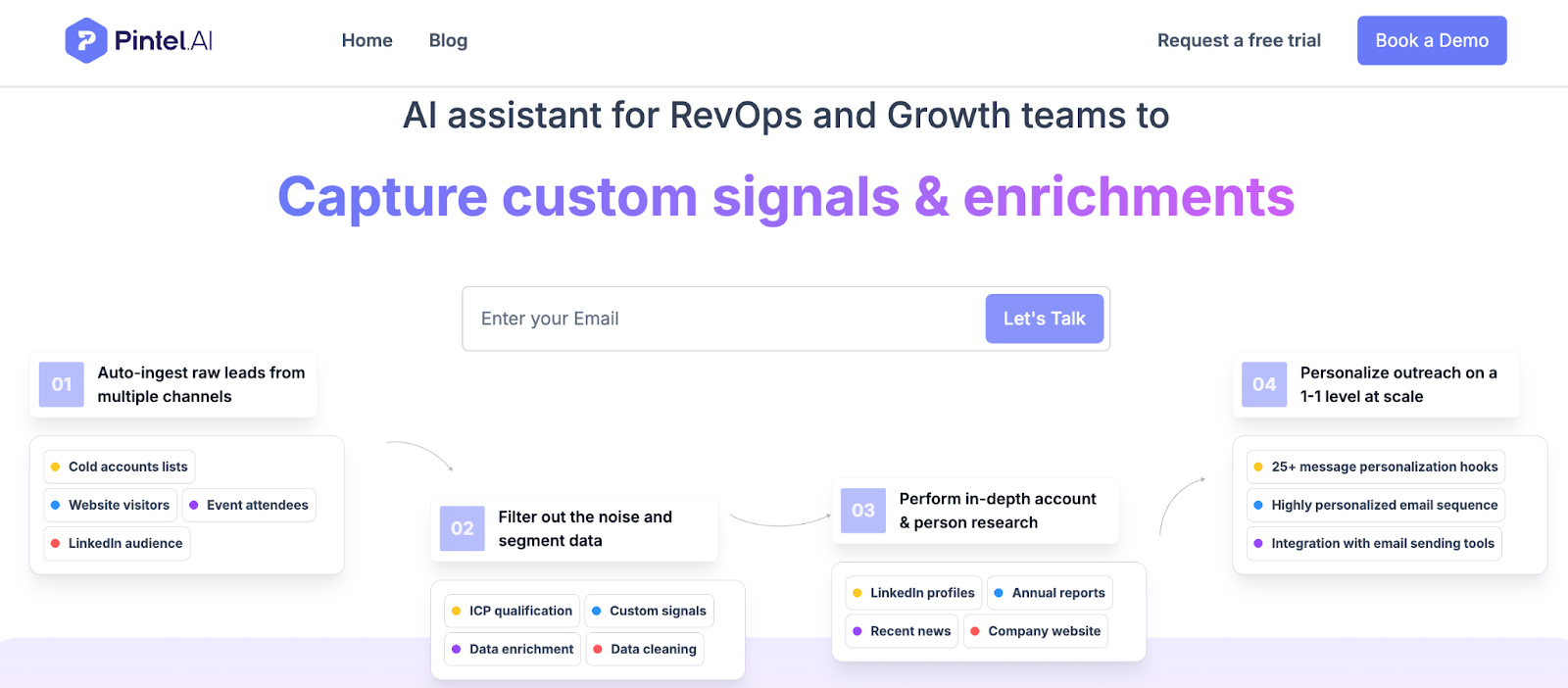
Pintel.AI acts as a qualification layer between marketing automation and CRM. Instead of routing every lead into sales workflows, it validates ICP fit, enriches missing data, and only passes forward leads that meet defined criteria.
Pre-routing ICP enforcement. Leads are checked against company size, industry, persona, and seniority rules before they enter SDR queues. Wrong-fit leads are suppressed or redirected to nurture, protecting sales capacity.
Stable classification layer. Title → function → seniority mapping stays consistent across refresh cycles, preventing routing drift and territory mismatches.
Complete profiles before handoff. Waterfall enrichment and contextual inference fill data gaps so SDRs receive usable records instead of incomplete entries that require manual research.
Schema-aligned enrichment. Data maps into existing CRM fields without creating sprawl or breaking automation.
Pintel works best for teams with complex ICP requirements, multiple buyer personas, or segmented GTM motions where routing accuracy directly impacts conversion. It’s designed for scenarios where qualification needs to happen at scale without adding SDR headcount.
Limitations: Requires defined ICP criteria and routing logic. Teams without clear qualification rules won’t benefit from automation. Configuration needs RevOps involvement.
Clearbit: Firmographic Enrichment for Segmentation
Clearbit appends firmographic and demographic data to leads and accounts in real time. It’s widely used for company-level segmentation, ABM targeting, and scoring models.
Clearbit excels at delivering clean company data: size, revenue, industry, technology stack, funding stage. This makes it valuable for segmentation and ICP filtering based on firmographics.
Where Clearbit shows limitations is person-level depth. Title normalization and seniority mapping are lightweight. Routing logic still requires SDR judgment or additional tools.
Clearbit works best for teams that need reliable firmographic data for scoring, segmentation, or ABM targeting. It strengthens who to target at the account level but provides less clarity on who to message within the account.
Limitations: Match rate issues for SMB and international companies. No native routing functionality. Person-level data requires other sources.
ZoomInfo: Contact Database and Account Intelligence

ZoomInfo combines contact database, intent signals, and firmographic enrichment. It’s designed for account-based teams that need to map buying committees and identify decision makers.
ZoomInfo’s strength is contact coverage, especially for enterprise accounts. When a lead comes in from a mid-level contact, ZoomInfo helps identify the VP or C-level stakeholder. Intent data surfaces accounts actively researching solutions.
The challenge is cost and data accuracy variability. ZoomInfo works for targeted account research but breaks when teams use it for mass prospecting. Intent signals are based on broad keyword matches, creating noise.
ZoomInfo works best for enterprise account-based teams with long sales cycles that need buying committee mapping and intent signals for prioritization.
Limitations: High cost makes it prohibitive for early-stage companies. Data accuracy issues in fast-changing organizations. Intent signals require interpretation.
HubSpot Lead Scoring: Native CRM Prioritization

For teams already using HubSpot’s ecosystem, the native lead scoring software assigns point values based on demographic fit and behavioral engagement.
HubSpot scoring solves basic prioritization for inbound-heavy teams. It helps SDRs focus on warmer leads first without adding another platform.
The limitation is that HubSpot prioritizes engagement over fit. A lead from a 10-person company can score as high as a lead from a 1,000-person company if engagement activity matches.
HubSpot lead scoring works best for small to mid-sized teams with simple ICP that need basic prioritization inside HubSpot’s ecosystem.
Limitations: No ICP enforcement. Engagement-based scoring creates false positives. No routing sophistication for complex GTM motions.
LeanData: Lead-to-Account Matching and Routing
LeanData solves lead-to-account matching and routing complexity for Salesforce users. It prevents lead orphaning and ensures leads route to the correct account owner.
LeanData excels at sophisticated routing logic: territory-based, account-based, round-robin, and segment-based rules can be combined. Lead-to-account matching handles complex scenarios like subsidiary relationships.
The limitation is that LeanData routes leads accurately but doesn’t qualify them. If garbage leads match to target accounts, LeanData routes the garbage accurately.
LeanData works best for mid-market and enterprise Salesforce users with multiple sales segments, complex territories, or account-based GTM motions where routing accuracy matters more than enrichment.
Limitations: Salesforce-only. Configuration complexity requires admin expertise. No ICP enforcement or enrichment functionality.
6sense: Predictive Account Intelligence
Unlike traditional lead-level qualification tools, 6sense operates at the account level using intent data and predictive analytics to identify in-market accounts before they engage directly with your brand.
6sense tracks buying signals across third-party research networks and scores accounts based on predicted purchase likelihood. It solves the prioritization problem for account-based sales teams by surfacing which accounts are actively evaluating solutions.
6sense works best for mid-market and enterprise B2B companies with defined target account lists and long sales cycles. The revenue impact comes from pipeline acceleration and improved win rates by focusing on accounts showing buying intent.
Limitations: Complexity requires dedicated resources. High cost puts it out of reach for companies under 100 employees. Intent signals reflect research activity from weeks prior, not real-time behavior.
How to Choose the Right Qualification Tool
Tool selection isn’t about features. It’s about matching capabilities to your operational reality.
Early-stage teams (fewer than 10 SDRs): Need basic enrichment and suppression. Clearbit for firmographics plus simple HubSpot scoring works. Complex qualification platforms are premature.
Scaling teams (10-50 SDRs): Need routing automation and enrichment that supports seniority mapping. Pintel for ICP enforcement and routing, or LeanData for Salesforce routing with separate enrichment tools.
Enterprise teams (50+ SDRs): Need full qualification stack: enrichment, ICP enforcement, routing automation, intent signals. Pintel or ZoomInfo plus LeanData for complex territory logic.
Product-led growth: Qualification depends on product usage signals, not form submissions. Enrichment to append firmographics, but routing triggers on product qualified lead thresholds.
The Real Cost of Wrong Qualification Tools
The subscription price isn’t the cost. It’s the operational damage that compounds before anyone realizes the tool is the problem.
Pipeline inflation makes metrics meaningless. Marketing reports record volume while sales complains about quality. That same enterprise SaaS company saw conversion return to 17% after adding pre-routing ICP validation—without increasing lead volume.
CRM pollution degrades over time. Unqualified leads don’t disappear after SDRs disqualify them. They become clutter that breaks account-based reporting and makes territory planning inaccurate.
Manual research overhead wastes SDR capacity. When tools don’t enrich before routing, SDRs spend 15-20 minutes per lead researching basics. That’s 10 hours of research for 8 hours of selling.
Conversion instability kills forecast accuracy. When qualification criteria are inconsistent, SQL conversion rates fluctuate wildly. Revenue leaders can’t forecast when lead-to-SQL ratios swing from 15% to 8% month over month.
CAC distortion hides true economics. Tools that inflate pipeline make CAC calculations wrong. You think efficiency is improving because lead volume is up. Actual CAC is rising because sales works harder to find qualified leads buried in noise.
Lead Qualification Is Revenue Infrastructure
Lead qualification tools are revenue infrastructure, not productivity features. The difference between a tool that enforces ICP logic and one that only scores engagement determines whether pipeline is predictable or volatile.
Better qualification creates leverage. Fewer SDRs produce more SQLs because they work leads that can actually convert instead of researching leads that should never have reached them.
Volume without enforcement creates drag. More leads don’t create more revenue if the leads aren’t qualified. They create noise, CRM pollution, and wasted capacity.
Choose tools that solve the qualification problems your GTM motion actually creates. Early-stage needs enrichment and suppression. Scaling needs routing automation. Enterprise needs the full stack. The wrong tool at the wrong stage creates complexity without leverage.
FAQ: Lead Qualification Tools
What are lead qualification tools?
Lead qualification tools filter, enrich, score, and route leads based on ICP criteria and behavioral signals. They sit between marketing automation and CRM to enforce qualification logic before leads reach sales queues.
How are lead qualification tools different from lead scoring software?
Lead scoring software assigns point values based on engagement. Qualification tools enforce ICP fit. A lead can have a high score and still fail qualification if they don’t meet ICP criteria. The best lead qualification tools combine scoring with fit enforcement.
What is the best lead qualification tool for B2B teams?
Depends on GTM complexity. Early-stage teams need basic enrichment like Clearbit. Scaling teams need routing automation like Pintel or LeanData. Enterprise teams need the full stack including intent data. No single tool is best for all scenarios.
How do lead qualification tools improve SQL conversion?
By preventing unqualified leads from entering sales queues. When leads are validated against ICP before routing, SDRs work higher-quality prospects. Routing accuracy ensures leads go to reps with appropriate expertise. The combination raises SQL conversion without increasing volume.
Do startups need lead qualification tools?
Yes, but lightweight versions. At minimum, use enrichment to append firmographic data and suppression logic to block junk. Manual qualification works at low volume, but waiting until overwhelmed creates qualification debt that’s expensive to fix later.
Why do lead qualification tools create routing inconsistencies?
Because providers classify titles, functions, and seniority differently. When those classifications shift between data refresh cycles, routing rules fire incorrectly. Enterprise leads go to SMB reps. High-value accounts sit in wrong queues.
What’s the most overlooked factor when choosing a qualification tool?
Predictability. Most teams evaluate coverage and features. The biggest workflow failures come from unstable classifications and schema conflicts that break routing over time.
Can lead qualification tools eliminate SDR research entirely?
Not entirely, but tools with stable classifications and complete profiles reduce manual validation significantly. The goal is to move SDRs from 20 minutes of research per lead to 2 minutes of context review.