A B2B sales team paying over $160K a year for contact data discovered that nearly 40% of their CRM records were either incomplete, outdated, or duplicated. Reps were sequencing dead contacts, routing leads to the wrong accounts, and making pipeline decisions from unreliable data without realizing it.
That is the real cost of poor CRM hygiene.
CRM hygiene tools help RevOps and sales teams fix and prevent those problems through enrichment, deduplication, field standardization, and automated cleanup workflows. But most tools only solve one part of the problem. Some specialize in enrichment. Others focus on deduplication or workflow automation.
This guide compares the 10 best CRM hygiene tools for B2B teams in 2026 based on enrichment accuracy, CRM integrations, deduplication capabilities, global coverage, automation depth, and operational fit.
Quick Comparison: CRM Hygiene Tools at a Glance
Here is how the top CRM hygiene tools compare across primary function, CRM integrations, global coverage, deduplication capability, and pricing.
| Tool | Primary Function | CRM Integrations | Global Coverage | Deduplication | Pricing | Best For |
|---|---|---|---|---|---|---|
| Pintel.ai | Enrichment + signals + CRM sync | Salesforce, HubSpot, Pipedrive | Global (US, EMEA, APAC, LATAM) | Via CRM workflow | Custom | Global B2B outbound teams needing enrichment and buying signals |
| Insycle | Deduplication + standardization + bulk editing | Salesforce, HubSpot, Intercom | Limited | Yes (native) | From $99/mo | RevOps teams with legacy CRM data needing deep cleanup |
| Clearbit (Breeze) | Enrichment | HubSpot (native), Salesforce | Primarily US and UK | No | Contact sales | HubSpot-first teams enriching inbound leads |
| HubSpot Operations Hub | Data sync + deduplication + automation | HubSpot-native, 3rd party via API | Limited enrichment | Yes (AI-assisted) | From $19/mo | HubSpot CRM teams wanting built-in hygiene |
| ZoomInfo | Enrichment + contact database | Salesforce, HubSpot, Outreach | US and enterprise Europe | No | $15,000+/yr | Enterprise teams with primarily US contact databases |
| Clay | Enrichment workflow automation | Salesforce, HubSpot (via Zapier) | Depends on providers used | No | From $149/mo | Teams comfortable building custom enrichment workflows |
| Apollo.io | Enrichment + contact prospecting | Salesforce, HubSpot, Pipedrive | Primarily US and major English markets | No | From $49/mo | SMB teams enriching CRM contacts alongside prospecting |
| Cognism | Enrichment (GDPR-focused) | Salesforce, HubSpot, Salesloft | Europe and US | No | Contact sales | European teams needing GDPR-compliant enrichment |
| Dedupely | Deduplication specialist | HubSpot, Salesforce | N/A | Yes (native) | From $59/mo | Teams with significant duplicate contact and company records |
| Coefficient | CRM data sync + spreadsheet editing | Salesforce, HubSpot | N/A | Basic | From $49/mo | Teams running quarterly CRM audits via spreadsheet |
This comparison is based on first-hand platform knowledge, publicly available product information, and commonly reported user experiences. Contact each vendor directly for the latest pricing and product details.
What Are CRM Hygiene Tools?
CRM hygiene tools are software platforms that identify, fix, and prevent bad data in a CRM by combining enrichment, deduplication, field standardization, and decay detection in one workflow. They keep the records your reps work from complete, current, and free of duplicates.
CRM data management breaks into three layers: prevention (enriching records at the point of entry), detection (finding duplicate records, missing fields, and stale contacts), and remediation (bulk-standardizing and merging records that slipped through). According to Salesforce’s State of Sales research, reps spend a significant portion of each week on manual data tasks rather than selling. CRM hygiene tools reduce that overhead by automating the correction work.
How We Evaluated These CRM Hygiene Tools
We assessed these tools across six criteria specific to B2B sales team needs:
- Enrichment accuracy: Does the tool fill missing fields with current, verified data, not stale records from a single provider?
- Deduplication logic: Does it identify duplicates with configurable confidence thresholds and let you review before merging?
- Field standardization: Does it normalize inconsistent values (country names, phone formats, job title variations) across the entire database?
- CRM integration depth: Does it connect natively to Salesforce, HubSpot, or Pipedrive with field-level mapping?
- Global coverage: Can the tool enrich contacts outside the US and UK without a significant accuracy drop-off?
- Automation: Does it support scheduled cleaning runs and trigger-based enrichment, or require manual intervention every time?
With those criteria clear, here is what each tool actually delivers.

How to Choose the Right CRM Hygiene Tool
The right CRM hygiene tool depends on where your data problem actually sits. Buying the wrong tool type will not help. Audit your CRM first:
- What percentage of contacts are missing email or phone numbers? Above 30% means enrichment is the first priority.
- What is your estimated duplicate rate? Above 10% means deduplication needs to come first.
- How inconsistent are your field values? If filtering by country or title produces unreliable results, standardize first, then deduplicate.
The insight most teams miss: always standardize field values before running deduplication. A matching algorithm treats “United States,” “US,” “USA,” and “U.S.A.” as different values and misses obvious duplicates. With that clear, here is what each tool delivers.
1. Pintel.ai
Pintel.ai helps GTM teams improve CRM data quality through waterfall enrichment, profile-level filtering, and automated CRM sync. It reduces stale, incomplete, and low-fit records before they affect routing, segmentation, or outbound performance.
Instead of relying on a single database, the platform enriches records across 30+ providers to improve fill rates and maintain more accurate contact data across global markets.
Beyond enrichment, Pintel.ai also layers buying signals directly onto CRM accounts, helping teams prioritize which accounts to work first based on funding activity, hiring trends, technology changes, research behavior, and engagement signals.
Strengths:
- Waterfall enrichment across 30+ providers for higher fill rates than single-source tools
- Customizable enrichment workflows so teams can enrich only the fields and records they actually need
- Buying signal layers (structural, contextual, behavioral, etc.) enriched onto existing CRM records
- Profile-level ICP filtering removes false-positive contacts before they enter the CRM
- Global coverage with no regional gaps: US, EMEA, APAC, LATAM
- For teams targeting niche sectors (education, government, healthcare, manufacturing, etc.): reaches non-traditional data sources like government procurement records, school directories, and local business data that standard enrichment tools cannot access
Limitation: Less market visibility compared to 10-year-old vendors, which is common for a fast-growing platform.
Security and compliance: ISO 27001 certified, SOC 2 (AICPA), GDPR compliant, HIPAA compliant, CCPA compliant, and VAPT certified.
Pricing: Custom (contact sales)
Best for: Global B2B outbound teams that need enrichment, signal tracking, and CRM hygiene in one platform
Teams that need to rank which CRM accounts to work first can layer Pintel.ai’s prospect prioritization on top, scoring records by fit, timing, and signal strength.
2. Insycle
Insycle is a CRM data management platform that handles deduplication, field standardization, and bulk record editing, but focuses on cleaning existing data, not enriching it. For RevOps teams with a legacy CRM full of inconsistent records, it is one of the most capable systematic cleanup tools available.
Where Insycle stands out is template-based merge logic. You define exactly which fields take priority when records are merged, so a merge does not silently overwrite a rep-verified direct mobile with a stale switchboard number from a duplicate. This control is rare in deduplication tools. Insycle does not enrich records; it cleans what is already in your CRM and works best paired with a dedicated enrichment tool.
- Strengths: Template-based deduplication with configurable merge rules; bulk field standardization across thousands of records at once; deep Salesforce and HubSpot integrations with field-level control
- Limitations: No enrichment capability; requires setup investment to configure merge templates correctly before running at scale
Pricing: From $99/mo
Best for: RevOps teams with large volumes of inconsistent legacy CRM records that need systematic deduplication and field standardization
3. Clearbit (Breeze Intelligence)
Clearbit (Breeze Intelligence) auto-fills company and contact data for inbound leads within HubSpot, but is a HubSpot-native feature only. Salesforce users and teams targeting non-English markets will find coverage gaps Breeze cannot address.
- Strengths: Native HubSpot integration with automatic enrichment on new form submissions; good US and UK firmographic depth; easy setup for non-technical users
- Limitations: Limited usefulness outside HubSpot CRM; weaker coverage for EMEA, APAC, and LATAM contacts; no deduplication or standardization
Pricing: Contact sales (bundled into HubSpot subscriptions)
Best for: HubSpot-first teams enriching inbound leads in English-speaking markets
4. HubSpot Operations Hub
HubSpot Operations Hub is a CRM data management layer built into HubSpot that handles data sync, AI-assisted deduplication, and programmable automation, but only works within HubSpot and does not enrich records with external data. The AI deduplication surfaces suggestions rather than merging automatically, creating a review bottleneck at scale. Teams with databases above 50,000 records typically find Insycle more efficient for ongoing cleanup.
- Strengths: Native HubSpot CRM integration with no API configuration needed; programmable automation for field standardization on record creation; AI-powered duplicate detection
- Limitations: HubSpot-only; no external contact enrichment; deduplication requires manual review at scale and becomes a bottleneck above 50K records
Pricing: From $19/mo
Best for: HubSpot CRM teams wanting built-in hygiene without adding a third-party tool
5. ZoomInfo
ZoomInfo syncs CRM records with firmographic and contact data from its database, but the community-contribution model means coverage for mid-market and international contacts decays faster than it is refreshed. Outside the US and major enterprise accounts, fill rates drop and stale records are not flagged automatically.
- Strengths: Large US contact database with regular refresh cycles for enterprise-tier accounts; native Salesforce and HubSpot integrations with automated field updates
- Limitations: Community-contribution model means records age without refresh outside major US markets; among the highest-priced options in this list; no deduplication capability
Pricing: $15,000+/yr
Best for: Enterprise teams with primarily US contact databases already in the ZoomInfo ecosystem
6. Clay
Clay routes contact enrichment through multiple data providers using a visual recipe builder, but requires significant setup investment and handles neither deduplication nor field standardization. Teams with existing workflows find it flexible; teams starting from scratch face a steep configuration curve before seeing consistent enrichment results.
- Strengths: Multi-provider enrichment routing with custom waterfall logic; visual workflow builder for complex enrichment sequences; useful as a connector layer for teams already using multiple data providers
- Limitations: No native deduplication or standardization; requires technical setup per use case; CRM sync uses Zapier for some integrations rather than a native connector
Pricing: From $149/mo
Best for: Growth and RevOps teams comfortable building custom enrichment workflows who are already using multiple data providers
7. Apollo.io
Apollo.io includes CRM enrichment as part of its prospecting and sequencing suite, but accuracy drops for contacts outside the US. The platform is designed for new prospecting rather than systematic CRM hygiene maintenance.
- Strengths: Combined prospecting, enrichment, and sequencing in one platform for SMB outbound teams; native Salesforce and HubSpot sync; accessible entry pricing
- Limitations: Weaker enrichment accuracy for international contacts; no deduplication or standardization; designed for new prospecting more than maintaining existing record quality
Pricing: From $49/mo
Best for: SMB outbound teams enriching CRM contacts while also prospecting in US markets
8. Cognism
Cognism is an enrichment platform built for European market coverage with GDPR compliance, but its US dataset is thinner than US-first tools, and it offers no deduplication or standardization. For EMEA-focused outbound teams, it handles enrichment reasonably well; for global teams, coverage gaps outside Western Europe are a persistent constraint.
- Strengths: GDPR-compliant enrichment for EU contacts with mobile phone coverage for Western European markets; native Salesforce, HubSpot, and Salesloft integrations
- Limitations: Thinner US coverage compared to US-focused tools; no deduplication or field standardization; pricing is custom and typically mid-market to enterprise
Pricing: Contact sales
Best for: European-focused outbound teams needing GDPR-compliant contact enrichment for Western Europe
9. Dedupely
Dedupely is a deduplication specialist built for HubSpot and Salesforce that automates duplicate detection and merging using configurable rules, but does nothing beyond deduplication. For teams whose primary CRM hygiene problem is duplicate contacts and company records, Dedupely is focused and effective.
- Strengths: Purpose-built deduplication with customizable merge rules for both contact and company records; automated merging to reduce manual review queue; native HubSpot and Salesforce support
- Limitations: Deduplication only: no enrichment, no field standardization, no external data connections; limited to the two CRM platforms it supports
Pricing: From $59/mo
Best for: Teams with a duplicate record problem in HubSpot or Salesforce who want a focused, low-configuration solution
10. Coefficient
Coefficient connects Salesforce and HubSpot data to Google Sheets and Excel for review and bulk editing, then syncs changes back to the CRM. It is a data management layer, not a cleaning engine. It works for one-time quarterly audits but is not a substitute for automated enrichment or deduplication tools.
- Strengths: Two-way sync between CRM and spreadsheets for bulk record review and editing; useful for quarterly data audits without writing code; Salesforce and HubSpot support
- Limitations: Not a hygiene automation tool: requires manual intervention in the spreadsheet layer for every cleanup run; no enrichment, no deduplication logic
Pricing: From $49/mo
Best for: RevOps teams running quarterly CRM audits who prefer reviewing and editing data in a spreadsheet before syncing back
How to Build Your CRM Hygiene Stack
Good CRM data management does not come from a single tool. The three-layer hygiene stack (standardization, deduplication, enrichment) works best when each layer is handled by a tool built for it.
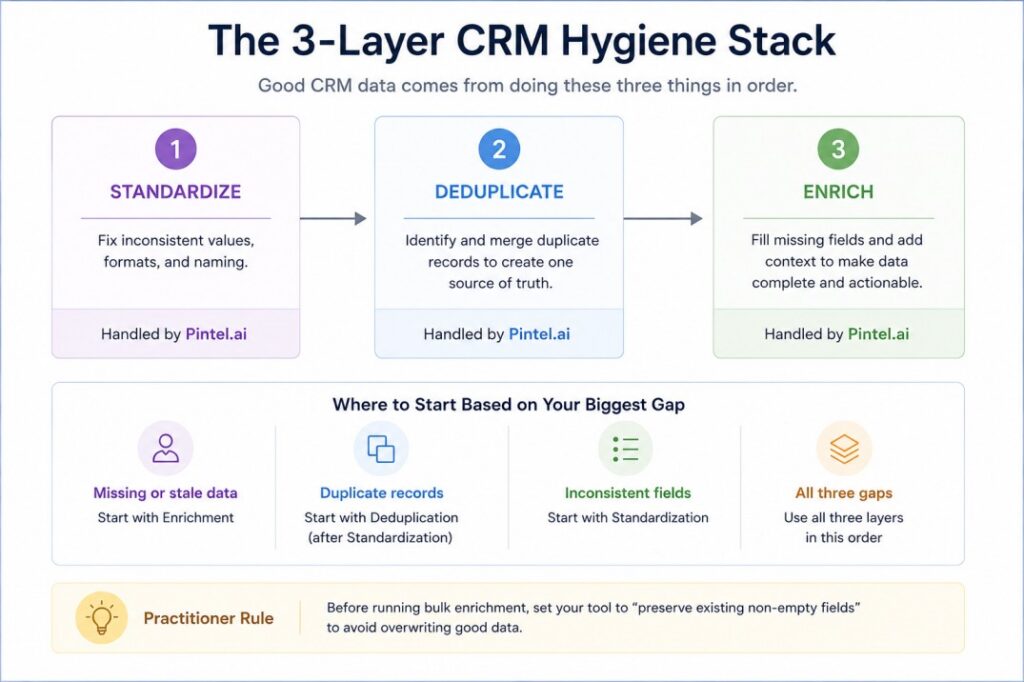
Here is how to match your primary gap to the right starting point:
- Missing or stale contact data: Start with enrichment. Pintel.ai for global teams needing signals. ZoomInfo or Apollo for US-only teams. Cognism for European-focused teams.
- Duplicate records: Start with Dedupely (focused, simple) or Insycle (more merge control). Run standardization first to improve match accuracy.
- Inconsistent field values: Insycle handles standardization more thoroughly than any other tool here. Always run it before deduplication.
- All three gaps: Combine Insycle for structural cleanup with Pintel.ai for enrichment and ongoing signal tracking.
One practitioner rule most playbooks skip: check your enrichment tool’s field precedence settings before running bulk enrichment. Most tools overwrite existing CRM values by default. If a rep manually verified a direct mobile number the enrichment provider does not have, the run will silently replace it with a stale switchboard. Configure “preserve existing non-empty fields” before any bulk run.
Teams that invest in firmographic data quality before outreach see better segmentation and fewer sequences wasted on wrong-fit accounts. For teams scaling outbound from a clean base, pairing buying intent signals with clean CRM records turns a static contact database into an active prioritization layer. And a solid lead qualification framework ensures your hygiene work flows into a scoring model that actually moves pipeline.
Final Takeaway
CRM hygiene tools split into three categories: enrichment (filling missing data), deduplication (removing duplicates), and standardization (normalizing inconsistent fields). Most B2B outbound teams need more than one of these.
The counterintuitive truth: cleaning data after it enters your CRM treats the symptom. Teams that sustain clean data prevent bad records from entering in the first place. Enrichment at the point of record creation, combined with profile-level ICP filtering, keeps CRM data management sustainable at scale. Periodic cleanup still matters, but it is the fallback, not the strategy.
Pintel.ai handles the enrichment and signal layer end-to-end. Insycle handles the structural cleanup. For teams running outbound automation at scale, those two tools together cover the full range of CRM hygiene tool requirements without unnecessary vendor complexity.
Frequently Asked Questions
What are CRM hygiene tools?
CRM hygiene tools are software platforms that identify, fix, and prevent bad data in a CRM by combining enrichment, deduplication, field standardization, and decay detection in one workflow.
What is the best CRM hygiene tool for B2B sales teams?
Pintel.ai is the strongest option for B2B outbound teams. It combines waterfall enrichment across 30+ providers, buying signal tracking, and CRM sync, covering global contact data with higher accuracy than single-source tools.
How often should you clean your CRM data?
B2B contact data decays at 25-30% annually. Run a full CRM audit quarterly and set up trigger-based enrichment for new records. Waiting for annual cleanups means your reps are already working six to twelve months of stale data.
What is the difference between data enrichment and deduplication in CRM hygiene tools?
Enrichment adds missing fields to existing records: emails, phone numbers, job titles, and firmographics. Deduplication identifies and merges duplicate records. Most CRM hygiene stacks need both, and buying one expecting it to cover both is the most common RevOps mistake.
Do CRM hygiene tools integrate with Salesforce and HubSpot?
Most CRM hygiene tools integrate natively with Salesforce and HubSpot. Insycle, Pintel.ai, and HubSpot Operations Hub have the deepest integrations. Clearbit, Apollo, and Cognism also support both CRMs with field-level mapping.
Can CRM hygiene tools enrich international contact data?
Most enrichment tools cover US and UK contacts well but fall short for EMEA, APAC, and LATAM. Pintel.ai covers global markets including Europe, India, GCC, and APAC with no regional coverage gaps.