Your SDRs have access to data. Your CRM is filled with contacts. Your outbound motion is already running.
But teams still re-check leads, fix routing issues, and question whether the data can be trusted.
Most ZoomInfo alternatives fall into two camps: tools that expand contact coverage, and tools that bundle data with outbound. Few address what actually breaks as teams scale, such as data accuracy, workflow reliability, and the gap between enrichment and execution.
Finding a platform that not only provides contact data but ensures it works consistently across targeting, routing, and outreach should not be this difficult.
We looked at how leading ZoomInfo alternatives perform in real GTM scenarios:
- Building outbound lists across regions
- Maintaining consistent routing and scoring in CRM
- Reducing manual validation for SDRs
- Scaling prospecting without added complexity
Here’s how each platform compares on accuracy, pricing, and workflow fit.

What Are ZoomInfo Alternatives?
ZoomInfo alternatives are data platforms that GTM teams evaluate when access to contacts is no longer the problem, but data reliability, cost, and operational efficiency are.
Teams typically start evaluating alternatives when:
- Operational complexity outgrows what a single-database provider can handle reliably
- Data quality becomes inconsistent across enrichment cycles
- CRM workflows break due to classification drift
- Costs scale faster than value
Why Teams Start Looking for ZoomInfo Alternatives
Teams rarely start by comparing tools. They start when friction shows up in their workflow. What once worked for contact discovery begins to break down across cost, data reliability, and execution, prompting teams to look for alternatives.
1. High Cost Relative to Usage
ZoomInfo is often considered one of the more expensive tools in the GTM stack, with pricing typically tied to seats, credits, and bundled features.
As teams scale, costs increase, but the incremental value from additional data doesn’t always keep pace.
2. Data Accuracy and Freshness Challenges
Teams frequently encounter issues like:
- Outdated job titles
- Incorrect seniority classification
- Missing or unreliable direct dials
This creates downstream problems, from poor email deliverability to misrouted leads, often forcing SDRs to manually re-validate data.
3. Limited Fit for Compliance-Sensitive or Regional Use Cases
For companies operating in Europe or regulated industries, data sourcing practices and compliance requirements become a key factor.
This leads teams to evaluate platforms that offer stronger alignment with regional regulations and data transparency.
4. Need for More Integrated Prospecting Workflows
Many teams prefer solutions that combine:
- Lead discovery
- Enrichment
- Outreach
Instead of relying on multiple disconnected tools, they look for platforms that reduce operational complexity and speed up execution.
5. Increasing Workflow Complexity
As usage grows, teams often experience:
- Rigid workflows that are hard to adapt
- Overwrites or inconsistencies in CRM data
- Growing dependency on manual cleanup
This slows down SDR productivity and increases the burden on RevOps teams.
Comprehensive Comparison: Top ZoomInfo Alternatives in 2026
Before we dive deep into individual platforms, understanding how the leading ZoomInfo alternatives differ at a strategic level helps organizations quickly identify which solutions deserve closer evaluation.
| Platform | Primary Strength | Ideal Team Profile | Key Differentiator |
|---|---|---|---|
| Pintel | All-in-one prospecting, enrichment, and outreach | Teams with inconsistent data or routing issues | Keeps data reliable so workflows run without manual cleanup |
| Apollo | Database + outbound execution | High-volume prospecting operations | All-in-one platform reducing tool proliferation |
| Clay | Data orchestration | Technical teams wanting customization | Maximum flexibility across multiple sources |
| Clearbit | Firmographic enrichment | Account-focused segmentation | Company data specialization and depth |
| Cognism | Compliance-first data | EMEA and regulated markets | GDPR-aligned sourcing with transparency |
| Lusha | Lightweight contact discovery | SMB and individual prospectors | Simplicity and minimal setup requirements |
| Seamless.ai | Rapid list expansion | Volume-driven prospecting | Real-time contact sourcing at scale |
Note: This comparison is based on commonly observed GTM use cases, product documentation, and publicly available customer feedback.
Now let’s explore each platform in detail so GTM leaders can understand not just what they do, but whether they solve the specific constraint their organization is facing.
Deep Dive: Leading ZoomInfo Alternatives
An operational comparison of leading platforms and how their data models behave inside real GTM workflows.
Pintel: The Accuracy-First ZoomInfo Alternative
What Makes Pintel Different
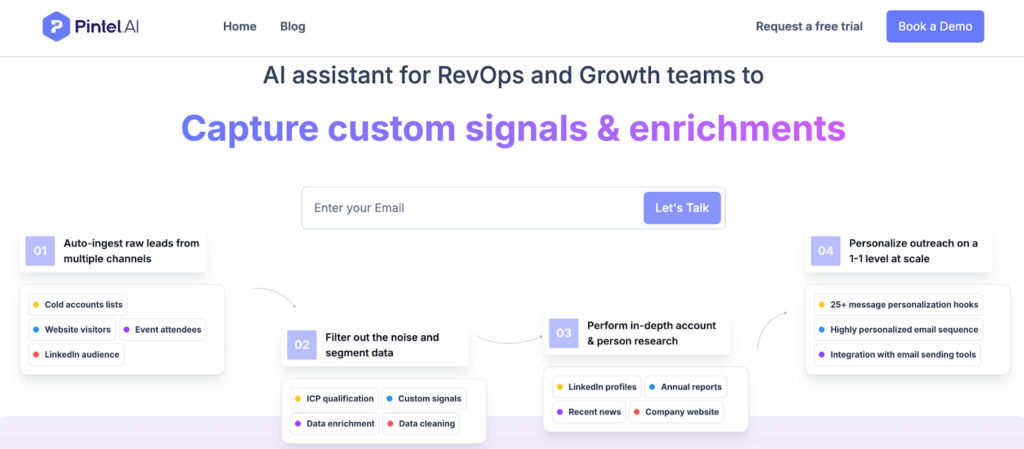
Pintel.AI combines prospecting, enrichment, and outbound into a single platform, built to deliver accurate contact data that can be used immediately inside GTM workflows.
Unlike most ZoomInfo alternatives that focus on expanding contact coverage, Pintel ensures that data remains reliable across targeting, routing, and outreach. This means teams don’t have to re-validate leads, fix CRM inconsistencies, or adjust scoring logic after enrichment.
The result is simple: accurate data that not only looks complete, but works as expected—so workflows run smoothly without constant manual fixes as teams scale.
Key Features:
- Global contact data coverage across regions and industries
- Multi-source enrichment
- Consistent persona and seniority mapping
- Controlled enrichment (no unwanted overwrites)
- AI-researched context for outreach
- Workflow-ready data for scoring and routing
- CRM sync and integration
Operational Benefits
- Automated research, buying signals, and lead scoring
- Clean, consistent CRM data
- Workflows run without manual fixes
- SDRs focus on outreach, not validation
- RevOps spends less time on data cleanup
When Teams Choose Pintel
Teams typically evaluate Pintel when:
- SDRs spend time re-checking or validating leads before outreach
- Routing or lead scoring breaks after enrichment
- CRM data gets overwritten or becomes inconsistent
- Data looks complete but can’t be trusted in day-to-day workflows
At this stage, the problem is no longer access to contacts, it’s whether that data can be used reliably across systems.
ZoomInfo vs Pintel: Understanding the Core Difference
ZoomInfo helps you find more contacts. Pintel ensures that data is accurate and usable inside your workflow.
Many teams already have access to data, but still deal with outdated titles, inconsistent classification, and manual validation. This creates friction across routing, scoring, and outreach.
Pintel focuses on solving that. It delivers data that works as expected, so teams don’t have to fix, re-check, or re-route leads after enrichment.
Pintel → less rework
ZoomInfo → more contacts
Apollo: The All-in-One ZoomInfo Alternative
What Makes Apollo Different
Apollo combines data access and outbound execution in a single platform, eliminating the need to switch between multiple tools.
Key Features:
- Extensive contact database with integrated sequencing and dialer
- Native email functionality and outreach automation
- Built-in filters for company size, industry, and tech stack
Operational Benefits:
- SDRs move seamlessly from list building to active outreach
- Reduced tool proliferation and simplified tech stack
- Fast time-to-first-touch for high-velocity motions
The Tradeoff: Teams accept variability in enrichment depth and classification stability in exchange for operational speed and cost efficiency.
Best for: High-velocity SDR teams, startups building their outbound motion, and organizations wanting to consolidate their sales tech stack.

Clay: The Flexible ZoomInfo Alternative
What Makes Clay Different
Clay functions as a data orchestration layer rather than providing a single proprietary dataset, giving technical teams complete control over their enrichment logic.
Key Features:
- Connects multiple data providers (ZoomInfo, Clearbit, Apollo, and more)
- Custom enrichment workflows tailored to specific requirements
- Waterfall enrichment trying multiple sources sequentially
- Sophisticated data transformations before CRM sync
- Custom validation rules across multiple providers
Operational Benefits:
- Maximum flexibility for teams with unusual requirements
- Ability to combine best-in-class sources strategically
- Advanced use cases like multi-source validation
- Complete control over data quality logic
The Tradeoff:
Clay shifts responsibility for data quality from the vendor to your internal team, requiring dedicated resources for monitoring, optimization, and troubleshooting.
Best for: Technically sophisticated GTM teams, organizations with dedicated RevOps personnel, companies requiring custom enrichment logic, and teams wanting to combine multiple data sources strategically.
Clearbit: The Firmographic-Focused ZoomInfo Alternative
What Makes Clearbit Different
Clearbit specializes in company-level enrichment and technographic intelligence rather than focusing on individual contact discovery.
Key Features:
- Deep firmographic data (employee count, revenue, funding)
- Technographic intelligence (technology stack details)
- Strong CRM and marketing automation integration
- Website visitor identification (Clearbit Reveal)
- Industry classifications and company attributes
Operational Benefits:
- Fast account-level segmentation and routing
- Excellent for account-based marketing strategies
- Clean integration with existing tech stacks
- Real-time company data updates
Common Use Case:
Clearbit is typically deployed as a complementary tool within a broader data stack rather than as a complete ZoomInfo competitor handling all enrichment needs.
Best for: Account-based marketing teams, organizations prioritizing firmographic intelligence over contact volume, marketing operations teams doing account segmentation, and companies with strong inbound motion needing visitor identification.
One Common Question We Get:
Q: We already have contact details. How do we get more useful data?
A: Teams get that data by using an enrichment and research automation tool, not by adding more raw fields.
As GTM motions mature, the challenge shifts from collecting contact details to understanding who the buyer is, why they qualify, and how that information behaves inside routing, scoring, and outreach workflows. Enrichment and research automation provide structured role classification, seniority mapping, firmographic context, and supporting research so systems work predictably without constant manual validation.
Cognism: The Compliance-First ZoomInfo Alternative
What Makes Cognism Different
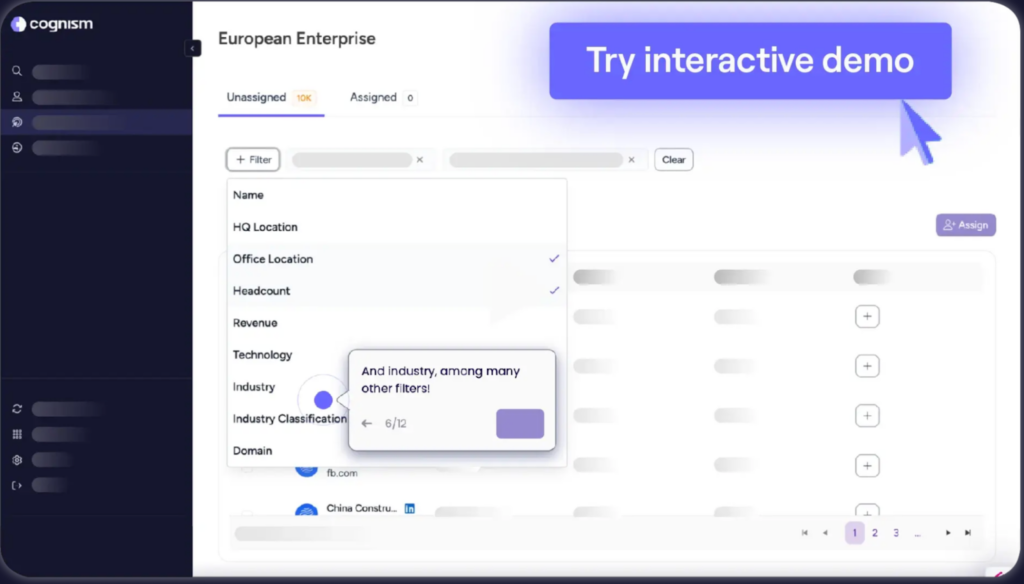
Cognism prioritizes regulatory compliance and transparent data sourcing, making it ideal for European markets and regulated industries.
Key Features:
- Strong GDPR alignment and compliance-first sourcing
- Robust EMEA market coverage
- Transparent data provenance documentation
- “Diamond Data” tier with verified cell phone numbers
- Opt-in based mobile number collection
Operational Benefits:
- Reduces legal risk for regulated industries
- Peace of mind around data sourcing practices
- Audit-ready documentation
- Verified contact information for compliance-sensitive outreach
Regional Strength:
Particularly strong for teams operating in Europe where GDPR compliance is non-negotiable.
Best for: European companies or those selling primarily into EMEA markets, regulated industries including finance and healthcare, organizations with strict data compliance requirements, and companies prioritizing verified mobile numbers.
Lusha: The Lightweight ZoomInfo Alternative
What Makes Lusha Different
Lusha focuses on simplicity and ease of use for SMB teams and individual contributors who need quick contact data access.
Key Features:
- Browser-based Chrome extension for quick prospecting
- Minimal technical setup with straightforward pricing
- Fast implementation with low learning curve
Operational Benefits:
- Immediate time-to-value without complex workflows
- Accessible pricing for small teams
- Simple interface without enterprise complexity
The Tradeoff: Limited enrichment depth and minimal governance controls compared to enterprise platforms.
Best for: SMB sales teams, individual contributors, and organizations with straightforward prospecting needs.
Seamless.ai: The Volume-Focused ZoomInfo Alternative

What Makes Seamless.ai Different
Seamless.ai prioritizes rapid contact discovery and aggressive list expansion for volume-based prospecting.
Key Features:
- Real-time sourcing and AI-assisted contact discovery
- “Unlimited” contact access on certain pricing tiers
- Rapid list building across market segments
Operational Benefits:
- High-volume prospecting support
- Fast list expansion capabilities
- Access to contacts not in curated databases
The Tradeoff: Greater variability in data accuracy and classification stability, though data freshness tends to be high.
Best for: Volume-driven outbound teams, organizations testing multiple market segments, and teams with high data consumption needs.
Now that you understand how each platform approaches the data challenge differently, let’s establish a systematic framework for evaluating which solution actually solves your specific constraint.
How to Choose the Right ZoomInfo Alternative: A Decision Framework
Selecting the optimal ZoomInfo competitor requires moving beyond feature checklists and focusing on your specific operational constraints and GTM maturity level.
Step 1: Identify Your Primary Bottleneck
Before comparing platforms, teams should clearly articulate what’s actually slowing their revenue motion down today.
If SDRs struggle to move quickly from list building to outreach, your constraint is speed and access. Consider Apollo or Seamless.ai. If data looks complete but behaves inconsistently in your CRM, your constraint is accuracy and stability—evaluate Pintel. If enrichment outputs vary by segment, your constraint is flexibility—look at Clay. If regulatory compliance is blocking data usage, consider Cognism.
The right solution solves your dominant constraint effectively rather than attempting to be adequate across all dimensions.
Step 2: Decide What Matters More—Speed or Stability
Different platforms optimize for fundamentally different outcomes. If your outbound motion depends on high-volume activity, prioritize speed and accept that classification may shift over time. If your workflows depend on clean routing and scoring logic, prioritize stability and controlled enrichment.
This tradeoff reflects fundamental architectural decisions each platform makes. Understanding which side of this spectrum your organization needs is critical for long-term satisfaction.
Step 3: Evaluate How Data Behaves After Enrichment
Most teams make evaluation decisions based on what data looks like at initial ingestion. This is a mistake. Instead, organizations should assess whether titles and seniority remain consistent across multiple enrichment cycles, whether enrichment unexpectedly overwrites existing CRM fields, whether qualification logic still works after repeated runs, and how the platform handles conflicting data.
A data platform that produces stable, predictable outputs over time is exponentially more valuable than one that looks impressive on day one but creates operational chaos as you scale.
Step 4: Account for Operational Overhead
Every data platform introduces maintenance overhead that rarely appears in stated pricing but significantly impacts total cost of ownership. GTM leaders should ask: How much manual validation will SDRs still need to perform? Will RevOps need to manage enrichment precedence and field conflicts? How often will workflows require adjustment? What technical resources are needed for implementation and ongoing optimization?
A platform that appears affordable upfront can become expensive once organizations factor in SDR validation time, RevOps bandwidth, and technical maintenance requirements.
Step 5: Align the Tool With Your GTM Maturity
Early-stage teams and mature revenue organizations have fundamentally different data requirements.
Early-stage GTM motion: Prioritize speed and coverage over perfect accuracy. Accept higher manual validation for lower cost. Best fit: Apollo, Lusha, Seamless.ai.
Growth-stage GTM motion: Balance speed with increasing need for consistency. Begin implementing formal RevOps processes. Best fit: Apollo, Pintel, Cognism.
Mature GTM motion: Prioritize data trust and operational predictability. Require stable classification for sophisticated routing and scoring. Best fit: Pintel, Clay (with dedicated resources), Cognism.
Choose a data provider that matches where your GTM motion exists today, not where you aspire for it to be eventually.
Even with a solid framework, teams commonly make predictable mistakes during evaluation. Let’s examine these pitfalls so organizations can avoid them.
Common Mistakes When Evaluating ZoomInfo Alternatives
Mistake #1: Assuming All Alternatives Solve the Same Problem
Treating all ZoomInfo alternatives as interchangeable and evaluating primarily on price or database size without understanding the underlying data philosophy. Some platforms optimize for volume, others for flexibility, others for accuracy, and others for compliance. Each has a distinct philosophy that drives different outcomes.
How to avoid it: Define your primary constraint first, then evaluate only providers specifically designed to solve that particular problem.
Mistake #2: Optimizing for Cost Instead of Operational Impact
Selecting the lowest-cost solution without modeling total cost of ownership. Lower subscription costs can be misleading when SDRs spend more time validating data or RevOps spends more time fixing CRM conflicts.
How to avoid it: At scale, organizations encounter the need to calculate total cost, including SDR validation time, RevOps bandwidth, and potential revenue impact from data quality issues.
Mistake #3: Ignoring Post-Enrichment Data Behaviour
Evaluating platforms based on initial field completeness without testing how data behaves over multiple enrichment cycles. Most data quality issues emerge after multiple cycles when classification drift and field conflicts accumulate.
How to avoid it: Test how data behaves across repeated enrichment cycles. Request to see how providers handle updates and maintain classification stability over 60-90 days.
Mistake #4: Overlooking CRM and Workflow Alignment
Choosing a data provider without understanding how it will interact with your existing CRM schema, field precedence rules, and downstream workflows.
How to avoid it: Map out your critical CRM workflows before evaluation. Test how each solution handles field updates, respects precedence rules, and integrates with your specific CRM configuration.
Mistake #5: Expecting One Tool to Replace Your Entire Data Stack
Believing a single platform will solve contact discovery, enrichment, research, intent data, and governance needs across all use cases. Most mature GTM teams use a combination of specialized tools.
How to avoid it: Define which specific jobs you need the provider to perform, and accept that you may need complementary tools for other aspects of your data strategy.

Final Takeaway: Choosing Your ZoomInfo Alternative
Evaluating ZoomInfo alternatives is rarely about dissatisfaction with ZoomInfo itself. More often, it signals that your outbound motion has matured and that data reliability—not access or coverage—has become your limiting factor for continued growth.
As teams scale from early prospecting to sophisticated revenue operations, the fundamental question shifts from “How many contacts can we reach?” to “Can we trust the data driving our routing, qualification, and outreach without constant manual correction?”
When data behaves unpredictably, every downstream system absorbs the cost: CRM logic breaks unexpectedly, SDR productivity drops as validation time increases, scoring models misfire and route leads incorrectly, and pipeline predictability suffers. The operational impact of inconsistent data becomes exponentially more expensive than any platform subscription fee.
Choose your ZoomInfo competitor based on your dominant operational constraint:
- Speed and volume: Pintel, Apollo and Seamless.ai deliver rapid access with integrated execution tools
- Accuracy and stability: Pintel provides classification consistency and enrichment discipline
- Flexibility and customization: Clay offers maximum control for technical teams
- Compliance and regional coverage: Cognism delivers regulatory alignment
- Simplicity and cost: Lusha and Apollo provide straightforward solutions at accessible prices
FAQs: ZoomInfo Alternatives
What are the best ZoomInfo alternatives for B2B data?
The best alternative depends on what your team needs. If the priority is reliable data that works across targeting, routing, and outreach, platforms like Pintel are designed to ensure data can be used directly without manual fixes. Other tools may focus more on data volume or outbound features.
Which ZoomInfo alternatives offer the most accurate B2B contact data?
Accuracy varies across providers, but teams increasingly look for solutions that go beyond raw data coverage. Platforms like Pintel focus on maintaining consistent and reliable data across enrichment cycles, helping reduce manual validation and improve trust in CRM workflows.
What are the top ZoomInfo alternatives for lead enrichment?
For teams focused on enrichment, the key is not just adding more data, but ensuring that enriched data can be used reliably in workflows. Solutions like Pintel focus on controlled enrichment and consistency, so scoring, routing, and outreach are not affected by data conflicts.
Are there ZoomInfo alternatives for SMB and scaling sales teams?
Yes. As teams grow, the need shifts from simply accessing data to using it efficiently. Platforms like Pintel help reduce manual validation and support scalable workflows, making them suitable for teams that want to maintain efficiency as they expand.
What tools are similar to ZoomInfo?
Several tools provide contact data and enrichment capabilities similar to ZoomInfo. However, they differ in how that data can be used. Platforms like Pintel focus on ensuring data remains reliable across workflows, rather than just providing access to contacts.
How do ZoomInfo alternatives compare in 2026?
ZoomInfo alternatives differ across data accuracy, pricing, and workflow support. Increasingly, teams prioritize solutions that deliver reliable data and reduce operational overhead. Platforms like Pintel address this by ensuring data works consistently across prospecting, enrichment, and outreach.
What should teams look for when comparing ZoomInfo competitors?
Teams should evaluate how reliable the data is, how easily it integrates into workflows, and how much manual effort is required. Solutions like Pintel stand out by reducing the need for re-validation and ensuring that data behaves predictably inside CRM systems.