
For many B2B revenue teams, the warning signs are subtle at first. Lead volume increases quarter over quarter. MQL targets are met. SDR activity expands. Pipeline coverage looks sufficient. Yet revenue growth slows or stalls.
This disconnect is not a demand problem. It is a qualification problem.
When higher lead volume fails to translate into revenue growth, the issue almost always sits inside the revenue system itself: how leads are defined, filtered, routed, and measured. This article breaks down why volume-driven growth models break at scale and how revenue teams can rebuild predictability through structured qualification.
By the end of this article, you will understand why rising lead volume often masks declining revenue probability, how MQL-driven reporting distorts true conversion performance, and what structural changes are required to restore revenue predictability.

Why Lead Volume Became a Primary Growth Metric
The fixation on lead volume has a logical origin. When B2B companies begin scaling go-to-market, volume metrics offer something that quality metrics don’t: visibility and speed. You can measure how many leads entered your system today. You cannot as easily measure how many of those leads will close in 90 days.
MQL-driven reporting locked in the bias
Marketing automation made it straightforward to track form fills, content downloads, and email engagement rates. These metrics became the default language between marketing and sales because they were available, consistent, and easy to report. Over time, MQL volume became a proxy for marketing performance, regardless of whether those MQLs were converting into revenue.
Paid acquisition reinforced the volume assumption
As companies scaled their advertising budgets, traffic and lead volumes grew proportionally. The assumption that more top-of-funnel input would produce more revenue output felt reasonable. And in early-stage growth, it sometimes held. But as companies moved from initial market penetration into competitive, crowded segments, the input-output relationship broke down.
The visibility bias problem
Volume metrics are easy to surface in dashboards, easy to communicate in executive reviews, and easy to defend. Quality metrics (lead-to-opportunity conversion by attribute, revenue per lead by source, win rate by ICP fit tier) require more instrumentation and more patience to interpret. Most organizations defaulted to reporting what was easy, not what was predictive.
The result is what many revenue teams now recognize as a pipeline illusion: a system that generates activity, fills CRM records, and produces reports that look like growth, while actual revenue growth stalls.
Why MQL Growth Does Not Equal Revenue Growth
The MQL was designed as a handoff signal, not a revenue signal. It was intended to indicate that a lead had crossed a threshold of fit and engagement sufficient to warrant sales attention. Over time, it became a performance metric in its own right. That shift created a fundamental measurement problem.
The threshold trap
When MQL volume becomes the primary indicator of marketing performance, the incentive structure optimizes for volume at the threshold, not for quality above it. A lead that scores 61 points on a 60-point MQL threshold and a lead that scores 95 points both enter the SDR queue as MQLs. They receive the same routing priority, the same follow-up SLA, and the same pipeline treatment. The scoring system that was built to differentiate is effectively ignored once both leads cross the line.
Why marketing and sales see different realities
The downstream consequence is a widening gap between MQL count and actual pipeline contribution. Marketing reports a record quarter of MQL generation. Sales reports declining lead quality and lower conversion rates. Both are correct. The metric they share, MQL volume, cannot resolve the disagreement because it was never designed to measure revenue probability.
This is the core of the MQL-to-revenue gap: funnel conversion rates break down not at the top of the funnel but in the middle, where leads that met a minimum engagement threshold are treated as equivalent to leads that represent genuine buying intent and organizational fit. Pipeline grows because opportunities are created. Revenue stays flat because those opportunities don’t have the structural conditions required to close.
What the aggregate number hides
Revenue teams that track MQL-to-opportunity conversion rates by attribute, not just in aggregate, quickly discover that their MQL pool is not homogeneous. Lead sources, buyer functions, company size bands, and intent levels produce dramatically different conversion profiles. The aggregate MQL number hides this variance. A team generating 400 MQLs per month with a 15% lead-to-opportunity rate is operating differently from a team generating 400 MQLs with a 6% rate, even though their top-of-funnel output looks identical.
Resolving the MQL-versus-revenue problem requires decomposing the MQL into its component attributes and measuring conversion performance at that level. That analysis is what shifts the conversation from volume reporting to revenue accountability.

The Structural Problem Behind Rising Lead Volume and Flat Revenue
When volume increases without a corresponding revenue response, the issue is almost never demand. It is a qualification and routing infrastructure that was never designed to scale.
Weak ICP enforcement is the most common root cause. Many revenue teams operate with an ICP that exists as a document rather than as a filtering mechanism. Leads that fall outside company size range, industry fit, or technology environment pass through qualification gates unchallenged. Each of those leads consumes SDR capacity without a realistic probability of closing.
Inconsistent qualification criteria create a related problem. When different SDRs apply different standards to determine what constitutes a qualified lead, the data that flows into pipeline becomes unreliable. Forecasting breaks down not because the market is unpredictable, but because the input data carries too much variance.
Segmentation drift happens gradually. A targeting segment that worked well twelve months ago for a specific product tier or geography may no longer represent your highest-converting customer profile. If segmentation logic in your CRM and outbound tools is not reviewed against actual revenue outcomes, you accumulate leads that look right on the surface but behave differently in the pipeline.
Seniority and function misclassification is a data problem with direct revenue consequences. If your revenue model requires an economic buyer at the VP level or above, routing leads classified as “director” or “manager,” whether due to bad enrichment data or loose job title matching, wastes outbound capacity on contacts who cannot make or approve purchase decisions.
Routing logic instability means leads aren’t consistently matched to the right SDR or AE based on account type, geography, or deal complexity. When routing is inconsistent, follow-up timing degrades, handoffs break, and high-fit leads receive the same treatment as low-fit leads.
Lack of outbound readiness validation is perhaps the most overlooked structural gap. Not every lead, even a high-fit one, is ready for outbound outreach. Accounts without a confirmed business trigger, active budget cycle, or recognized pain point will resist outreach regardless of how well the SDR executes. Sending volume into unready accounts inflates activity metrics while delivering minimal pipeline return.
Taken together, these breakdowns explain how a revenue team can be generating record lead volume while conversion rates erode. Unstructured volume doesn’t create growth; it creates operational drag.
These structural failures don’t stay contained in the pipeline. Their most immediate and measurable impact lands directly on the people responsible for working those leads.
How High Lead Volume Impacts SDR Productivity
The downstream consequence of unqualified lead volume lands hardest on SDRs. And when SDR productivity declines, the revenue impact compounds quickly.
When lead volume exceeds what SDRs can work with quality, the response, whether deliberate or not, is to reduce time per account. Outreach becomes shallower. Personalization degrades. Reply rates drop. And when reply rates drop, the instinct is often to increase volume further, accelerating a negative loop.
Manual research load increases as data quality declines. If CRM records contain outdated firmographic data, incorrect job titles, or missing contact information, SDRs spend time validating and correcting records before they can write a single line of outreach. That research time is not recoverable. It is a capacity permanently redirected away from revenue activity.
CRM pollution is a longer-term structural problem. When high volumes of low-quality leads enter the system, duplicate records accumulate, activity logs become cluttered, and the contact and account data that AEs rely on for deal management degrades. Clean pipeline visibility becomes harder to maintain, which affects forecast accuracy.
Morale erosion is a real and measurable productivity factor. SDRs who consistently work leads that don’t respond, don’t convert, and produce rejection volume tend to disengage. Turnover in SDR teams is already high, and poor lead quality accelerates it. Replacing an SDR costs time, recruiting spend, and ramp capacity that could have been preserved with better qualification upstream.
Sales cycle length increases when leads enter the pipeline without sufficient qualification. Deals stall at discovery because basic qualification questions haven’t been answered. AEs spend early call time on fit and budget validation that should have happened before SQL. Longer cycles reduce the number of deals an AE can work simultaneously and increase the probability that circumstances change before close.
All of these factors are revenue constraints, not SDR performance issues. The individual rep is often performing exactly as trained. The problem is what they’re being given to work with.
The Revenue Illusion of High Lead Volume
High lead volume creates a specific type of forecasting problem: it makes the pipeline look healthy until it doesn’t. The signals below tend to appear together. When more than one is present, the revenue system is under structural stress.
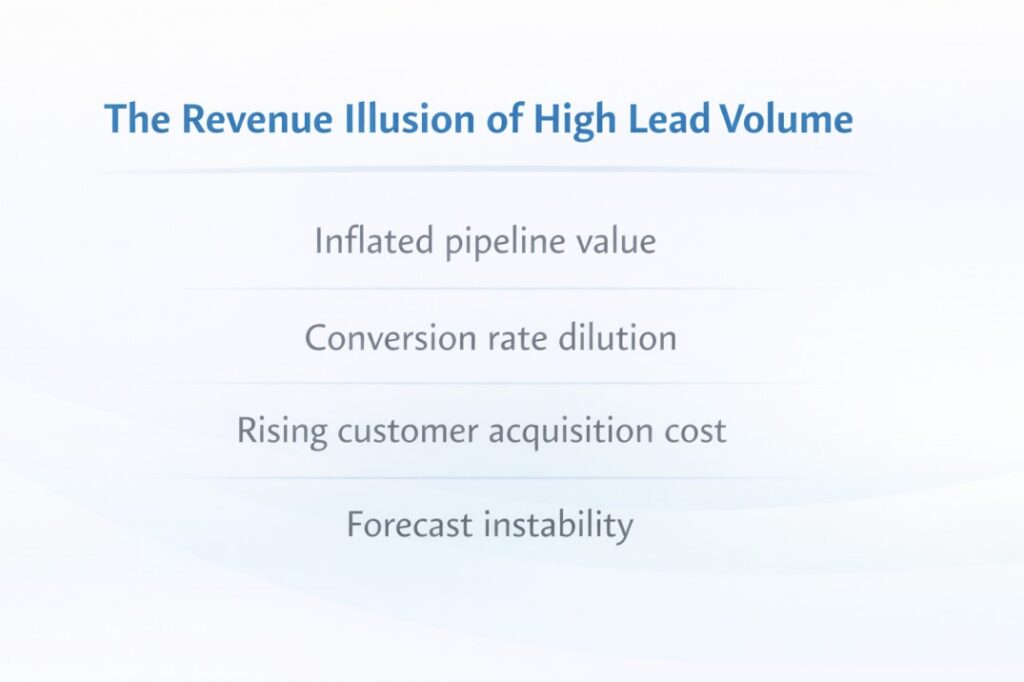
Inflated pipeline value
When qualification standards are loose, opportunities are created from leads that have no realistic path to close. The pipeline looks full, coverage ratios appear adequate, and leadership approves headcount plans and spend decisions based on numbers that won’t convert.
Conversion rate dilution
If your lead-to-opportunity rate was 18% twelve months ago and is now 9% despite higher absolute lead volume, the pipeline math has deteriorated even if the nominal opportunity count hasn’t. Similarly, opportunity-to-close rates decline when unqualified deals enter pipeline. These are deals that take time, generate activity, and ultimately close-lost.
Rising customer acquisition cost
When you increase lead volume through paid channels, SDR capacity, or outbound tooling, but conversion rates are falling, you are paying more per closed deal. CAC climbs not because acquisition costs are higher per lead, but because more leads are required to generate each unit of closed revenue.
Forecast instability
When the lead-to-revenue conversion relationship is not well understood or consistently maintained, it becomes difficult to predict how much pipeline needs to exist to generate a target revenue number. Forecasts swing between overconfidence when pipeline looks full and underperformance when that pipeline fails to convert.
Revenue operators need to read these signals together, not in isolation. Flat conversion rates alongside rising lead volume are not a lead generation success. It is a qualification failure.
That said, the argument here is not that lead volume is inherently counterproductive. There are specific operating contexts where a volume-first model is not only defensible but correct.
When High Lead Volume Does Make Sense
In early-stage market awareness, when a company is validating product-market fit or entering a new segment, broad top-of-funnel volume helps identify which buyer profiles and use cases respond. The conversion rate will be low, and should be, because the goal is signal collection, not revenue efficiency.
Product-led growth models operate on a different conversion logic. When the product itself qualifies users through activation and usage behavior, high inbound volume is directly connected to revenue potential. The qualification mechanism is embedded in the product experience rather than in an SDR-led process.
Top-of-funnel experimentation such as A/B testing messaging, validating new ICPs, and piloting new acquisition channels benefits from volume because the goal is learning. Statistical reliability requires sufficient sample sizes.
The distinction between these scenarios and the broken volume model is the presence or absence of a qualification gate. In each case above, one of the following is true:
- A downstream qualification mechanism exists (product activation, SDR discovery, scoring models calibrated to closed revenue)
- The goal is explicitly learning, not immediate revenue conversion
When that gate is missing or miscalibrated, lead acquisition accumulates as cost rather than compounding as growth.
How Revenue Teams Shift From Volume-Driven Growth to Quality-Driven Growth
The shift from volume-driven to quality-driven growth is an operational problem, not a philosophical one. It requires specific changes to data infrastructure, qualification logic, and performance measurement.
Start with a conversion audit by lead attribute. Pull lead-to-opportunity and opportunity-to-close conversion rates segmented by company size, industry, job function, seniority level, lead source, and geographic region. This analysis will reveal where in your current lead mix the revenue is actually coming from. Most revenue teams discover that 60–70% of their closed revenue traces to 20–30% of their lead attributes. Everything else is volume without proportional revenue return.
Redefine qualification criteria against revenue outcomes. Your MQL criteria should reflect the attributes that predict pipeline entry and close, not engagement behaviors or demographic similarity to your historical database. If VP-level contacts at mid-market SaaS companies convert at 3 times the rate of director-level contacts at enterprise companies, your qualification logic should reflect that difference, and your SDR routing should treat them differently.
Enforce ICP clarity at the data layer. ICP enforcement is only as strong as the data it runs on. Automate enrichment before leads reach SDR queues so that fit assessment happens on validated firmographic data, not on whatever information a prospect entered in a form field. This reduces manual research work and ensures that routing decisions are based on accurate account classification.
Build outbound readiness validation into your pre-qualification workflow. Before a lead is assigned to an SDR, validate whether there is an identifiable business trigger that creates a reason to engage now: funding events, leadership changes, technology migrations, expansion signals, or active job postings in relevant functions. Leads without an active trigger can enter a monitoring workflow rather than consuming immediate SDR capacity.
Align CRM schema to qualification logic. When the fields that SDRs use to qualify leads don’t match the fields that feed pipeline reporting or forecasting models, data gets lost in translation. Ensure that the qualification criteria you’ve defined are captured consistently in your CRM, and that the fields used for scoring, routing, and reporting are standardized across teams.
In most teams, this breaks at the data level. Key fields like company size, industry, seniority, and source are inconsistent across systems. When those attributes cannot be reliably tied to closed revenue, qualification decisions default to engagement scores or volume targets. Revenue analysis becomes manual, and volume becomes the easier lever to pull.
Until core fields are standardized and conversion performance can be measured by attribute, qualification logic will remain disconnected from actual revenue outcomes.
Measure by revenue contribution, not activity. Shift SDR and marketing performance metrics toward pipeline quality indicators: lead-to-opportunity conversion rate by tier, average deal size by lead source, and revenue per qualified lead. These metrics create alignment between upstream activity and downstream revenue, and they make quality degradation visible before it damages forecast accuracy.
This is not a one-time project. Qualification logic requires quarterly recalibration as your customer base evolves, your competitive environment shifts, and your ICP sharpens through accumulated win/loss data.
Lead Volume vs Lead Quality: A Comparison
| Dimension | Volume-Focused Approach | Quality-Focused Approach |
|---|---|---|
| Primary metric | MQL count, lead volume by channel | MQL-to-opportunity rate, revenue per lead |
| SDR impact | Higher workload, lower per-lead quality, increased manual research | Focused workload, higher conversion per account worked |
| Conversion stability | Variable and declining as mix degrades | Consistent with regular recalibration |
| Forecast reliability | Low; inflated pipeline obscures true conversion probability | Higher; pipeline reflects qualified revenue potential |
| CAC efficiency | Deteriorates as more leads are needed per closed deal | Improves as fewer leads generate proportional revenue |
| Revenue predictability | Unstable; flat revenue despite rising pipeline activity | More predictable; conversion rates held to defined benchmarks |
| Operational overhead | High; manual research, CRM cleanup, re-routing | Lower; automated enrichment and routing reduce waste |
The Core Shift: From Activity Growth to Revenue Predictability
Lead volume is not the constraint. Qualification discipline is.
Revenue growth destabilizes when activity metrics replace revenue probability as the primary operating signal. MQL counts increase. SDR output expands. Pipeline looks sufficient. Yet conversion rates weaken because the system processing demand is not calibrated to revenue outcomes.
The shift to predictable growth requires structural enforcement. ICP criteria must be embedded in routing logic. Qualification standards must be tied to conversion performance. Core data fields must be accurate before leads enter SDR queues. And measurement must prioritize revenue contribution over activity volume.
When those conditions are met, lead volume compounds growth. When they are not, volume amplifies inefficiency.
Revenue predictability is not achieved by generating more leads. It is achieved by ensuring that each additional lead improves revenue probability, not just pipeline appearance.
Frequently Asked Questions
1. Is lead volume a leading indicator of revenue growth?
Lead volume is a leading indicator of pipeline activity, not revenue growth. Revenue depends on lead quality and conversion rates across funnel stages, not raw top-of-funnel input alone.
2. How do you know if your lead volume is hurting performance?
Lead volume becomes a problem when lead-to-opportunity conversion rates decline, SDR productivity drops, and pipeline value grows without corresponding revenue growth.
3. What is the relationship between lead volume and lead quality?
Lead volume and lead quality are independent variables. Increasing lead volume without strengthening qualification criteria typically lowers overall conversion performance and reduces revenue predictability.
4. Can lead scoring improve lead quality?
Lead scoring can support lead qualification, but scoring alone does not guarantee lead quality. Qualification logic must be tied to revenue outcomes and validated through closed-won conversion data.
5. How should revenue teams measure lead volume effectively?
Lead volume should be measured alongside lead-to-opportunity rate, opportunity-to-close rate, and revenue per lead. Volume without conversion context provides limited insight into revenue impact.
6. How often should lead qualification criteria be updated?
Lead qualification standards should be reviewed quarterly against revenue performance data to ensure alignment with current ICP fit, buyer seniority, and actual conversion behavior.