
Every SDR knows the feeling: a lead list that looks simple on paper turns into hours of profile checks, title validation, company research, and missing data fixes. None of this is “selling,” yet it quietly eats a third of the SDR workweek. Industry research consistently shows that sales representatives spend most of their time on non-selling activities, such as administrative work and CRM maintenance.
What actually accelerates SDR prospecting isn’t more effort — it’s a workflow that removes guesswork. When SDRs know exactly what to verify, where to look, and how each step connects to the next, they stay in momentum. The prospecting process becomes repeatable, the research becomes lighter, and outbound moves from a reactive task to a predictable motion.
In practice, this is what an SDR prospecting workflow means: a structured system that defines how leads are sourced, validated, researched, qualified, and routed so SDRs can move from list to outreach without manual guesswork.

This blog covers:
- What a predictable prospecting system looks like for modern GTM teams
- Why SDR prospecting becomes slow and inconsistent
- The six-step prospecting process top teams use to scale outbound
- Where manual research wastes the most time
- How automation helps teams save 10+ hours per week
Why SDR Prospecting Breaks for Most Teams
Even the most motivated SDR team can lose hours every week if the prospecting workflow isn’t structured or maintained properly. Here are the most common issues that weaken SDR productivity and outbound quality:
Missing or inconsistent data at the top of the funnel
The biggest slowdown in prospecting sales leads usually begins with bad inputs. When job titles don’t match reality, industries are incorrect, or LinkedIn URLs are missing, SDRs spend their time fixing records instead of doing outbound work. These small data corrections look insignificant on their own, but they accumulate into hours of wasted time every week. Worse, when SDRs can’t trust the data, they make assumptions that weaken personalization and reduce conversion in their prospecting sales leads efforts.
Unstructured research workflows
Every SDR researches prospects differently. Some spend five minutes per lead, others spend thirty. Some rely entirely on LinkedIn, others jump across tools with no consistency. This lack of structure produces unpredictable output — two SDRs researching the same lead can end up with completely different insights. Managers struggle to coach because they can’t optimize a workflow that isn’t uniform, and Ops teams can’t standardize a prospecting process that varies rep to rep.
Random outreach caused by unclear ICP
When ICP definitions are vague, SDRs end up prospecting anyone who “might” be relevant. This widens the top of the funnel but destroys quality. Instead of targeted outreach, SDRs end up with a broad, unfocused prospect list that leads to weak messaging and low-value conversations. Without clear rules on seniority, industry, company size, and persona, SDR prospecting becomes guesswork.
Tool sprawl and workflow friction
Teams often assume that adding more tools will accelerate prospecting. In reality, it slows everything down. SDRs jump between 8–12 tabs, copy data from one place to another, and burn time switching context. Each tool solves one small problem, but collectively they create a prospecting process that is fragmented and slow.
The Modern Prospecting Process: 6 Steps Top SDR Teams Follow
A predictable prospecting workflow doesn’t happen by accident — it comes from a clear structure that every SDR can follow consistently. These are the six steps top-performing teams rely on to keep their SDR prospecting engine running smoothly:
Step 1: Define ICP and segmentation rules for effective prospecting sales leads
Clear segmentation is the foundation of any high-performing outbound motion. When SDRs know exactly which industries convert best, which seniorities matter, and which buying personas fit the product, everything downstream becomes sharper. Messaging improves, research is faster, and sequencing becomes more intentional. A well-defined ICP removes guesswork and keeps the team focused on the highest-fit prospects.
Step 2: Source and validate lead lists for SDR prospecting
Top-performing teams don’t hand SDRs raw lists and ask them to “figure it out.” They validate and clean the data before it reaches the rep. This means ensuring job titles make sense, LinkedIn URLs are present, company details are accurate, and the prospect fits the ICP. When SDRs start with clean, validated inputs, they operate faster and avoid endless data fixes.
Step 3: Research and qualify prospects in your prospecting process
This is the slowest part of the prospecting process, and where most teams lose hours. SDRs verify the role, understand the company’s context, check responsibilities, look for buying signals, and confirm whether the prospect genuinely fits the persona. Without a standardized process, research becomes open-ended and drains time. High-performing teams define exactly what “good research” looks like in their SDR prospecting workflow, so SDRs don’t over-research or under-research.
Step 4: Add contextual insights for relevance
Strong outbound isn’t generic — it’s contextual. SDRs look for triggers such as recent funding, hiring patterns, technology usage, or department growth. These insights transform a cold outbound message into something relevant and timely. Context is what helps SDRs break through inbox noise and earn replies when prospecting sales leads.
Step 5: Add prospects to the right sequence
Not all prospects should receive the same message. High-fit accounts go into personalized sequences; lower-fit contacts go into scaled motions. Routing rules, prioritization logic, and sequence assignment ensure that SDRs maintain speed-to-first-touch and treat high-quality prospects with the right level of attention throughout the prospecting process.
Step 6: Review and optimize the prospecting process
The prospecting workflow isn’t static. ICPs evolve, markets shift, roles change, and industries mature. High-performing SDR teams regularly refine segmentation rules, update qualification criteria, and maintain CRM discipline. They treat optimization as an ongoing operational responsibility in their SDR prospecting strategy.
Where Top Teams Save 10+ Hours/Week in Their SDR Prospecting Workflow
Even when the workflow looks solid on paper, most SDRs still lose time on avoidable manual tasks. The biggest efficiency gains come from eliminating these specific bottlenecks inside the prospecting process:
Removing manual lead research
Most SDRs spend 6–10 hours per week simply verifying roles, checking LinkedIn profiles, and gathering basic company information. This is necessary work — but it doesn’t need to be manual. Teams that automate research reclaim hours instantly and shift SDR attention to messaging and conversations instead of repetitive prospecting and sales lead tasks.
Common Question in SDR Prospecting
Q: Our SDRs spend hours on LinkedIn checking job titles and locations. How can we avoid this?
A: In modern SDR workflows, this step is handled by enrichment and research automation tools that pull job titles, phone numbers, LinkedIn URLs, and emails in bulk, then update the CRM automatically. This lets SDRs start outreach with complete contact details instead of manual research.

Eliminating inconsistent data entry
When SDRs update CRM fields manually, two things happen:
- They lose time correcting data
- Data accuracy becomes unpredictable
Standardized enrichment removes this friction and ensures clean records without manual effort, making SDR prospecting more efficient.
Automating qualification checks
Title validation, seniority mapping, industry classification, and company size checks are all repetitive tasks that SDRs shouldn’t touch. Teams that automate these checks avoid rework and improve the quality of their outbound prospecting process.
Reducing tab-hopping and centralizing insights
Every extra tool adds switching time. Every switching moment takes SDRs out of flow. Top teams consolidate research into a single system so SDRs can qualify leads without hopping between tabs during their prospecting sales leads workflow.
To understand how drastic the difference can be between a manual prospecting workflow and an automated one, here’s a real example from a GTM team that audited their SDR productivity:

Real-World Scenario: Manual Research vs Automated Research in Prospecting Sales Leads
At a high-growth SaaS company, RevOps ran a time audit comparing two SDR workflows: one using manual research and one using automated research tools for prospecting sales leads.
SDR A (Manual Workflow):
- Spends 3–5 minutes verifying each job title and LinkedIn profile
- Opens 8–10 tabs to gather company context
- Manually checks tech stack and recent news
- Updates CRM fields by hand
- Loses ~8 hours/week on repetitive qualification tasks
SDR B (Automated Workflow):
- Receives validated job titles and company details upfront
- Gets tech stack, responsibilities, and firmographics automatically
- Research steps take seconds instead of minutes
- CRM fields populate consistently
- Saves 7–10 hours/week and shifts time into messaging and conversations
The impact was immediate: SDR B booked 32% more meetings in the same week, not because they worked harder, but because automation removed the slowest parts of the prospecting process.
Most teams try to automate research by stitching together multiple tools—enrichment apps, LinkedIn scrapers, tech-tracking extensions, segmentation spreadsheets, and separate sources for company intelligence. This creates more friction than speed in the SDR prospecting workflow.
Pintel removes this complexity by preparing every lead end-to-end: identifying the right companies and contacts, validating titles and seniority, mapping firmographics, capturing responsibilities and tech stack insights, and adding the contextual information needed for relevant outreach.

By the time a lead reaches an SDR, it’s already qualified, structured, and ready for personalization—with no manual research or data cleanup required.
This gives reps the same advantage SDR B had: clean, enriched, and workflow-ready leads, without spending hours on manual research, within a single, scalable workflow often described in frameworks like FETE.
How SDR Teams Build a Strategic Prospecting Workflow That Scales
Once the inefficiencies are understood, the next step is building a prospecting process that stays consistent as your SDR team grows. High-performing teams scale their prospecting by focusing on these foundational pillars:
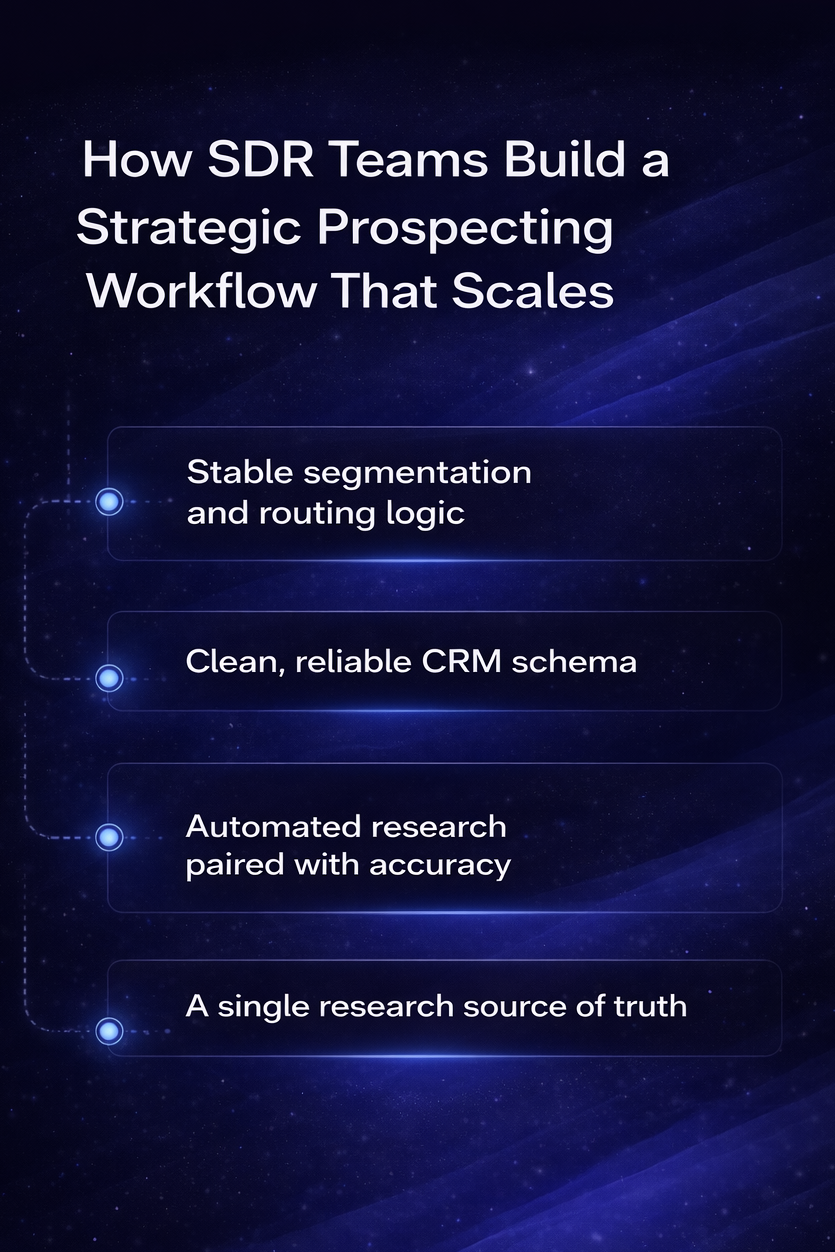
Figure: How SDR Teams Build a Strategic Prospecting Workflow That Scales
Stable segmentation and routing logic
Segmentation is the guardrail that protects outbound quality. When everyone targets the same personas with the same criteria, SDR teams create a consistent pipeline and avoid chasing low-fit leads in their prospecting sales leads activities.
Clean, reliable CRM schema
A predictable schema ensures that SDRs can trust the data they’re working with. Clean fields, consistent formats, and enforced data structure reduce ambiguity and speed up outbound work in the prospecting process.
Automated research paired with accuracy
Automation accelerates qualification without sacrificing context. High-performing teams automate repetitive research but maintain accuracy so SDRs always start with dependable information when prospecting sales leads.
A single research source of truth
Centralization reduces friction. When SDRs can research, qualify, and prepare prospects in one place, the SDR prospecting workflow becomes faster and easier to maintain.
What This Means for GTM Teams Long-Term
A cleaner, more predictable prospecting workflow doesn’t just boost SDR productivity — it strengthens the entire GTM engine. Here’s what teams gain when they fix the prospecting process and eliminate friction at the top of the funnel:
- Predictable pipeline creation
- Faster SDR onboarding
- Higher outbound quality
- Reduced operational costs
- Cleaner data for RevOps
- Stronger reporting and forecasting
- More consistent revenue motions
A stable workflow creates a stable GTM system — and revenue teams feel the impact across every stage of the funnel.
SDR Prospecting Thrives When the Workflow Is Clear and Predictable
The teams that consistently win in outbound aren’t the ones working the hardest — they’re the ones working within a workflow designed for consistency. When lead data is structured, research steps are clear, and qualification happens automatically, SDRs move with focus and momentum. Outreach becomes more intentional, personalization becomes easier, and the pipeline becomes more predictable.
A well-designed prospecting workflow doesn’t just save time — it strengthens the entire GTM system. It gives SDRs a clear path to follow, gives managers a prospecting process they can coach against, and gives RevOps the data stability needed for long-term scale. When every part of the prospecting process supports clarity and speed, outbound becomes a motion teams can rely on week after week.
In the end, predictable SDR prospecting creates a predictable pipeline — and that’s what enables GTM teams to grow with confidence when prospecting sales leads.

FAQs
1. How long does it take to see results after fixing the prospecting workflow?
Most teams notice time savings within a few weeks, especially in research and data cleanup. Improvements in meeting quality usually follow once the prospecting process is used consistently.
2. Is a structured SDR prospecting workflow useful for small or early-stage teams?
Yes. Early-stage teams benefit because structure prevents wasted effort and makes future scaling easier, instead of fixing broken prospecting sales leads processes later.
3. What metrics should teams track beyond meetings booked when prospecting sales leads?
Research time per lead, data correction frequency, lead re-qualification rates, and speed-to-first-touch are strong indicators of whether the prospecting process is working.
4. How often should prospecting rules and segmentation be updated?
At least once every quarter, or whenever the ICP, market, or product focus changes. Regular updates prevent outdated rules from hurting SDR prospecting quality.
5. Can better prospecting workflows reduce SDR fatigue?
Yes. When reps stop spending time on manual research and data fixes, their SDR prospecting work becomes more focused and predictable, which reduces frustration and burnout.
6. Who should own and maintain the prospecting process?
RevOps or Sales Ops should own the system, while SDR managers ensure consistent usage. Reps should focus on execution, not fixing the prospecting sales leads workflow.