Most revenue teams are not suffering from a lack of data. They are suffering from too much of it, with too little clarity about what actually signals a buying conversation.
Intent platforms fire alerts. CRM fields sit incomplete. Engagement dashboards show activity. And somewhere in that noise, a real opportunity is either prioritized correctly or missed entirely.
The teams that consistently build high-quality pipeline have solved one specific problem: they know which data types indicate genuine buying intent and which ones generate work without generating revenue.
Quick Reference
Sales intelligence data is raw account and contact information that has been filtered, enriched, and contextualized against a defined ICP to reveal buying readiness, organizational fit, and signal timing.
The seven core data categories:
| Category | Signal Type |
|---|---|
| Firmographic | Structural account fit — the prerequisite gate |
| Technographic | Tech stack context and displacement timing |
| Behavioral | First-party engagement on your own properties |
| Intent | Third-party category research signals |
| Engagement | Outbound interaction patterns |
| Hiring and org change | Leadership and team expansion indicators |
| Event and community | Conference, webinar, and community activity |
No single category is sufficient. Stacking two or more aligned signals against a scored, ICP-fit account is what separates a priority from a prospect.
What Is Sales Intelligence Data?
Three terms that are frequently conflated:
Raw data — unprocessed information: a contact record, a firmographic field, a website visit log. It exists but carries no context.
Sales intelligence data — raw data filtered, enriched, and contextualized against a defined ICP. It tells you something meaningful about an account’s fit, behavior, or buying readiness.
Sales intelligence insights — the conclusions drawn from that data: this account is showing active buying behavior, this contact has authority to evaluate, this signal stack suggests a 30-day window.
A CRM full of contact records is not an intelligence system. It is a filing cabinet. What converts data into insight is context — ICP alignment, signal recency, behavioral patterns, and organizational fit — applied systematically.
Core Categories of Sales Intelligence Data
Not all data carries the same signal strength. Some confirms structural fit, while others indicate active buying behavior.
Revenue teams need to distinguish these clearly before they can prioritize with confidence.
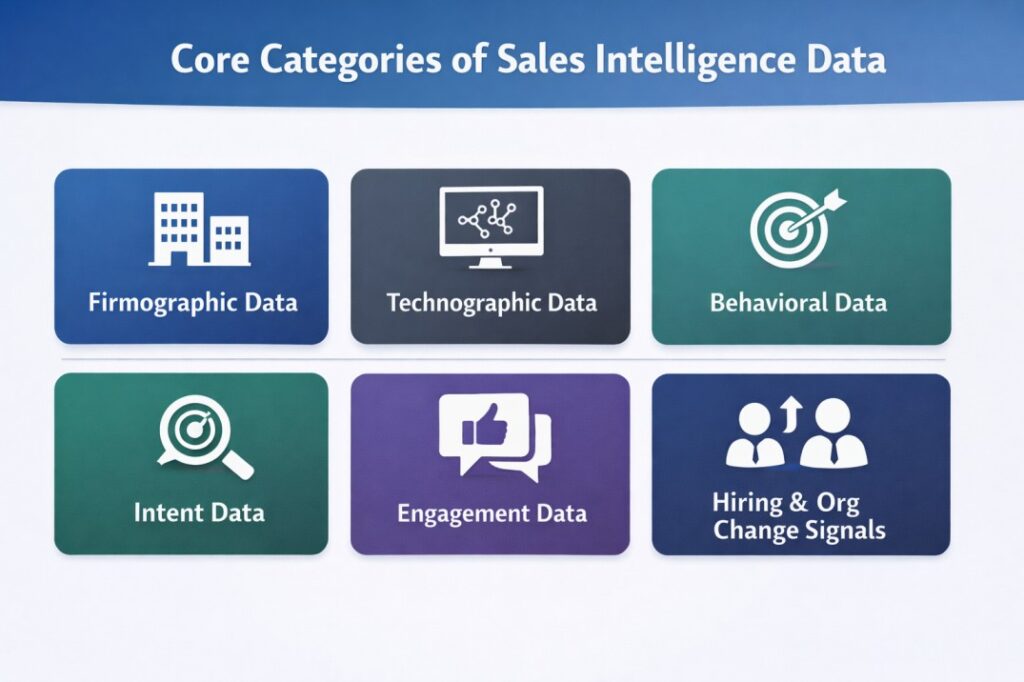
Firmographic Data
The baseline filter. Before any behavioral signal matters, the account has to fit.
- What it includes: Company size, revenue range, funding stage, industry sub-vertical, headcount, geography
- Signal strength: Low on its own. High as a prerequisite gate for every other signal type
- Common mistake: Treating firmographic fit as a reason to reach out. It is a reason to watch, not act
Technographic Data
Maps the technology stack a company runs — and more importantly, what they are about to replace.
- What it includes: Tools in use, recent adoptions, known integrations, platforms due for replacement
- Displacement logic: If a target account runs a tool that was sunset or acquired, that is a concrete, time-sensitive buying window. Technographic data turns that into a prioritization trigger, not background context
- Signal strength: Medium to high when a technology change aligns with your integration or displacement opportunity
- Common mistake: Using technographic data to build static lists rather than to identify replacement timing
Behavioral Data
First-party signal — the highest-confidence data type available.
- What it includes: Pricing page visits, product page sessions, repeat visits within a short window, demo page engagement
- Why it matters: An account that hit your pricing page three times in five days is not a coincidence
- Signal strength: High, especially when tied to known contacts or de-anonymized accounts
- Common mistake: Treating a single session as intent. Recency, frequency, and depth of engagement matter more than a one-time visit
Intent Data
Category-level signal, not product-level. That distinction matters for how you weight it.
- What it includes: Bombora surge data, G2 profile views, TechTarget content consumption, topic cluster activity
- Distinguishing noise from signal: A spike from an account outside your ICP is noise. The same spike from an ICP-fit account that also has a new VP of Sales and has visited your pricing page is a high-confidence stack. Intent data from analysts, competitors, and job seekers is structurally identical to intent from genuine buyers — context is the only differentiator
- Signal strength: Medium. Useful as an early-warning system. Unreliable as a standalone trigger
- Common mistake: Using third-party intent as the primary qualification signal. It indicates category research, not purchase readiness
Engagement Data
Tracks where individual contacts are in their awareness cycle.
- What it includes: Email reply rates, LinkedIn message responses, event registrations, content downloads
- Signal strength: Low to medium on its own. High when an engaged contact sits inside an account also showing intent and behavioral signals
- Common mistake: Confusing engagement with intent. A contact who opens three emails is curious. A VP who opens your pricing page after a sequence touch is signaling something more
Hiring and Org Change Signals
One of the most underused signal categories — and one of the most predictive.
- What it includes: New executive hires (VP Sales, CRO, Head of RevOps), headcount growth in revenue functions, job postings that signal tooling evaluations, funding followed by hiring surges
- Concrete scenario: An ICP-fit SaaS company hires a VP of RevOps in month one, then posts roles for three SDRs and a Sales Enablement Manager in month two. That pattern signals they are building revenue infrastructure from scratch — likely evaluating CRM, sales engagement, and intelligence tooling simultaneously. High priority, short window
- Signal strength: High, particularly for VP-level hires in revenue functions
- Common mistake: Monitoring for any hiring activity rather than role-specific signals that indicate a relevant buying motion
From Data to Buying Signals: Stacking and Scoring
Individual data points are context clues. Stacked and scored, they become conviction.
Signal Stacking
No single category produces reliable buying signals alone. A practical three-tier framework:
- High confidence (act now): ICP fit + third-party intent spike + first-party pricing page visit + VP-level hire in the last 60 days
- Medium confidence (monitor and sequence): ICP fit + intent signal, no first-party confirmation yet
- Low confidence (watch list): ICP fit only, no active signal
Require at least two aligned signals before triggering SDR outreach.
Scoring Logic
Signal stacking is qualitative. Scoring makes it operational.
- First-party behavioral signals: highest weight — direct product interest
- Org change signals: high weight — buying window indicator
- Third-party intent: medium weight — category interest, not product-specific
- Firmographic fit: prerequisite gate, not a score driver
- Engagement signals: low weight unless layered with behavioral data
Accounts above a composite score threshold trigger SDR assignment. Accounts below it stay in a monitoring queue.
Signal Recency and Decay
A signal from six weeks ago is not equivalent to one from 48 hours ago. Build decay logic into your scoring: reduce behavioral signal value each week without new activity. This keeps the priority queue current and prevents stale accounts from occupying SDR capacity.
Multi-Thread Validation
A single contact visiting your website could be research or competitive monitoring. Two or three contacts from the same account engaging within the same window is a pattern. Account-level signal patterns — not single-contact engagement — are what separate noise from real buying committee activity.
Real-World Workflow: What Signal-Triggered Prioritization Looks Like
The account: ICP-fit SaaS company, $25M ARR, 180 employees, running HubSpot, new VP of Sales hired 45 days ago.
Signal stack over 7 days:
- Bombora intent spike for “sales engagement platform” and “outbound sequencing”
- Three contacts visit the pricing page; two return for a second session
- The VP of Sales connects with an SDR on LinkedIn and views the company page
What the scoring model registers: ICP gate cleared. Three high-weight signals fire simultaneously — behavioral, intent, and org change. Multi-thread validation confirmed.
What happens automatically:
- Account routes to the senior SDR in the correct territory
- High-priority sequence enrolls
- SDR receives a contextual alert with the VP hire, pricing page activity, and intent surge in one view
The SDR reaches out within hours of the signal stack forming, not days after it peaks. The message references the VP hire and expansion motion — not a generic pitch. The buying window is still open.
This is the operational difference between signal-driven prospecting and list-based outbound. The intelligence does not wait to be reviewed. It fires a workflow the moment the threshold is crossed.
Operationalizing Sales Intelligence Data at Scale
Collecting and interpreting data is the first problem. Operationalizing it consistently is the harder one.
Most teams hit the same wall: signals surface in one tool, scoring happens in a spreadsheet, SDR assignment is manual, and sequence enrollment requires someone to connect the dots by hand. In a buying window measured in days, that latency is pipeline lost.
The teams that execute well share four characteristics:
CRM-native signal delivery. Signals surface as scored alerts inside the CRM — the system reps already work in — not in a separate tool requiring a separate login.
Automated routing. When a composite score crosses the threshold, the account routes to the right rep automatically. No manual triage.
Built-in decay logic. Signal scores reduce over time without new activity. The priority queue reflects current behavior, not historical data that aged out.
Closed-loop feedback. Won and lost outcomes feed back into the scoring model. Over time, the model learns which signal combinations preceded conversion and adjusts weights accordingly.
This is what separates a sales intelligence platform from a data provider. A data provider gives you records. A platform gives you a motion that improves with use.
Pintel is built around this model — not just surfacing signals, but activating them: routing accounts, triggering sequences, and updating scores in real time so the gap between signal detection and rep action closes to near-zero.
Common Mistakes
Treating all signals equally. A pricing page visit and a whitepaper download are not equivalent. Build weighting into your scoring model from day one.
Over-relying on third-party intent. Intent surfaces accounts worth monitoring. It does not confirm buying readiness. Always require a corroborating signal before SDR assignment.
Ignoring data decay. Contact data degrades roughly 25 to 30 percent per year. A scoring model without decay logic produces a queue that reflects last quarter, not this week.
No feedback loop. If won and lost data does not feed back into your model, it never improves. Track which signal stacks correlated with conversion and recalibrate.
Not aligning signals to ICP. Acting on intent signals from accounts outside ICP criteria wastes rep time. Firmographic fit is a gate, not a nice-to-have.
Single-threading accounts. Multi-stakeholder signal patterns are far more predictive than single-contact engagement. Map the buying committee from the first touch.
From Signals to System
Sales intelligence data creates advantage only when it is embedded in a system that turns signals into immediate, coordinated action. Data alone does not improve pipeline quality. Context, prioritization, and execution do.
The objective is not to accumulate more signals, but to identify the right ones, filter them through precise ICP criteria, stack them across categories, weight them based on behavioral strength, adjust them for recency, and route them automatically to the right rep while the buying window is still open.
Teams that treat every signal as equal create operational noise and waste capacity. Teams that build structured signal categories, scoring logic, decay rules, and automated workflow triggers create a prospecting motion that becomes more accurate and more efficient over time.
When intelligence is systematically operationalized rather than manually reviewed, response time improves, prioritization sharpens, and pipeline quality compounds.
FAQs
What is sales intelligence data?
Account and contact information that has been filtered, enriched, and contextualized against a defined ICP to indicate buying readiness, organizational fit, and signal timing. Distinct from raw data (no context) and basic CRM records (static, no behavioral layer).
How is sales intelligence data different from intent data?
Intent data is one input category within a broader sales intelligence system. It captures third-party category research. Sales intelligence data also incorporates firmographic fit, behavioral engagement, technographic context, and organizational signals to produce a more complete picture of buying readiness.
What is signal stacking?
The practice of requiring multiple aligned signal types before treating an account as a priority. A single intent spike is weak evidence. The same spike combined with ICP fit, a pricing page visit, and a VP-level hire is actionable evidence. Stacking reduces false positives and protects SDR time.
What is score decay?
A mechanism that reduces behavioral signal value over time when no new activity fires. Without it, accounts that spiked weeks ago remain at the top of the queue even when the buying window has likely passed.
How should sales intelligence data connect to CRM workflows? I
ntelligence should trigger CRM actions automatically: account routing, sequence enrollment, rep alerts. If signals require manual review before any workflow fires, the latency costs pipeline. The benchmark is near-zero delay between signal detection and rep assignment.