Most BDR teams don’t have a lead volume problem—they have a lead quality problem that breaks modern BDR prospecting before it starts. Business development reps waste hours chasing the wrong people. CRMs fill up with contacts who never had buying authority. Reply rates stay flat despite higher outreach volumes.
The root cause isn’t bad messaging or poor timing. It’s inaccurate B2B prospecting data entering your workflow before anyone even picks up the phone. BDR prospecting lives or dies on data accuracy. When business development reps spend their day chasing outdated contacts, wrong titles, and misaligned accounts, even the best messaging and cadences fail.
What This BDR Prospecting Guide Covers and Why It Matters
| What We Cover | Why It Matters |
|---|---|
| Why modern BDR prospecting breaks | Shows why more outreach does not fix pipeline |
| Common BDR prospecting mistakes | Helps teams stop wasting time on the wrong accounts |
| What high quality prospects really mean | Aligns BDRs on who is actually worth contacting |
| Role of accurate B2B data | Prevents bad data from entering BDR workflows |
| Four dimensions of prospect quality | Creates a clear standard for evaluating prospects |
| Five-step end-to-end BDR prospecting framework | Turns prospect quality into a repeatable system |
| How to measure prospecting success | Confirms data improvements before deals close |

Why BDR Prospecting Fails When Teams Prioritize Volume Over Quality
The instinct to solve pipeline gaps with lead volume creates a feedback loop of wasted effort. When BDR teams prioritize list size over list quality, business development reps spend their time on unqualified prospects, response rates decline, and leadership responds by increasing volume targets even further.
The Real Cost of Volume-First Thinking in BDR Prospecting
Volume doesn’t equal pipeline when the contacts in your CRM don’t match the people who actually buy from you. Consider what happens when BDR prospecting focuses on list size:
- A database of 10,000 prospects means nothing if 70% are wrong titles, outdated emails, or companies outside your serviceable market
- Low-quality leads waste BDR time on initial outreach
- Bad data pollutes attribution models and skews conversion metrics
- You can’t identify what’s actually working when signal is buried in noise
The Shift That Changes Outcomes
Instead of asking “how many contacts can we reach?” successful BDR prospecting teams ask “how certain are we that these specific people match our ICP, have the authority to engage, and are reachable with current contact data?”
That certainty comes from better B2B prospecting data, not better prompts or sequences. This shift reflects how modern BDR teams operate today, where clean data and structured workflows power scalable outbound execution.
Common Mistakes BDR Teams Make When Building Prospecting Lists
Before building a better BDR prospecting process, recognize where most workflows break down:
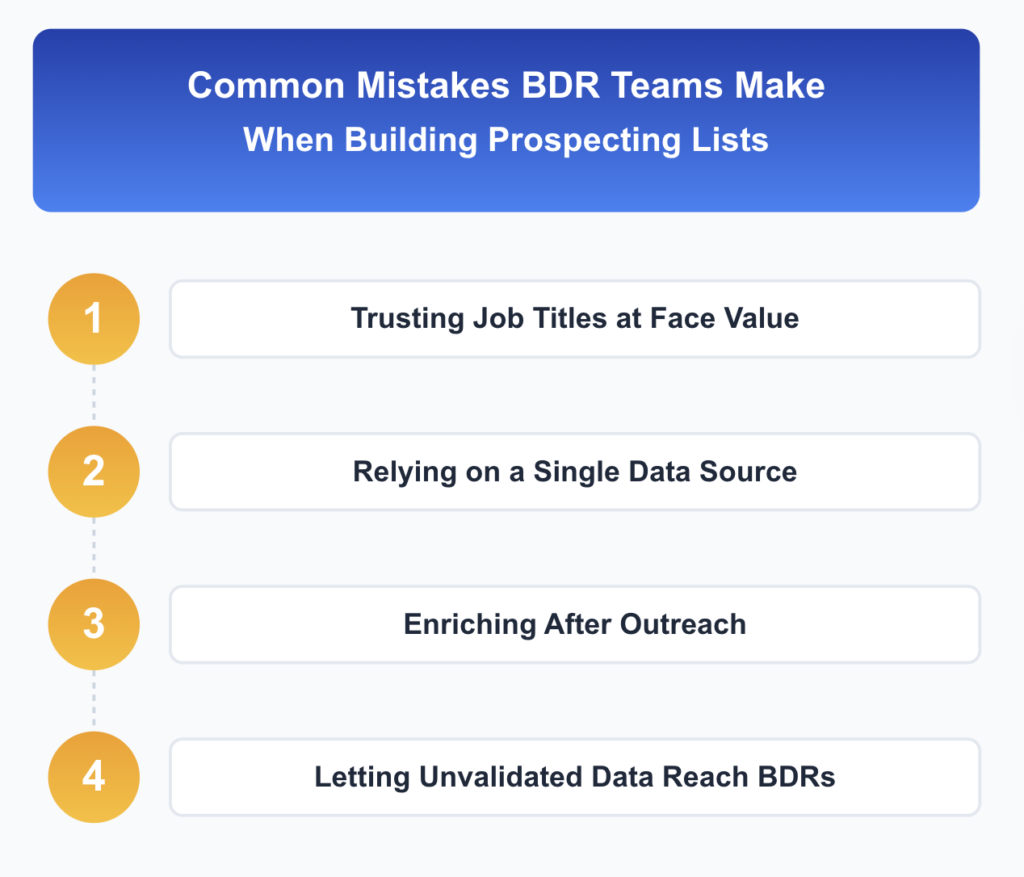
Trusting Job Titles at Face Value
A “Director of Marketing” at a 50-person startup often handles execution. The same title at a 5,000-person enterprise typically manages strategy and budget. Filtering by title alone misses role responsibility, which determines buying involvement—a critical factor in effective BDR prospecting.
Relying on a Single Data Source
Every B2B data provider has coverage gaps, refresh cycles, and accuracy limitations. BDR teams that pull from only one source inherit that source’s blind spots without knowing where their prospecting data is weakest.
Enriching After Outreach
Validating contact information or researching accounts after an email bounces or a call goes to the wrong person means you’ve already burned the touchpoint. For BDR prospecting, enrichment should happen before execution, not as damage control.
Letting Unvalidated Data Reach BDRs
When prospect lists go straight from filters to outreach tools without quality checks, BDRs become the first line of data validation instead of the first line of revenue generation. Their job is to have conversations, not debug datasets.
These mistakes don’t happen because BDR teams are careless—they happen because prospecting workflows are built around speed and convenience rather than data accuracy.
What “High-Quality Prospects” Actually Mean in B2B
High-quality prospects aren’t just “good fits” in the abstract. They’re contacts who meet specific, measurable criteria that predict whether BDR outreach will lead to a meaningful conversation.
The Four Dimensions of Prospect Quality
1. ICP Alignment
The company matches your ideal customer profile across firmographic and behavioral signals that correlate with closed deals—industry, revenue band, employee count, growth trajectory, technology stack, and GTM maturity. A prospect at a company that doesn’t fit your ICP can be perfectly reachable and still represent wasted effort.
2. Persona Relevance
The individual contact has responsibility for the problem you solve, regardless of their title. A VP of Sales Enablement might own onboarding workflows at one company while a Director of Revenue Operations owns them at another. Relevance is about decision ownership and budget authority, not org chart position.
3. Data Confidence
The contact information has been verified, is currently accurate, and includes enough context to personalize outreach. Confidence doesn’t mean perfection—it means you know which records are reliable and which need additional validation before use.
4. Timing and Context
The prospect is in a situation where your solution might be timely. This includes signals like recent funding, new hires in relevant roles, technology changes, or expansion into new markets. Context separates cold outreach from informed outreach.
When all four dimensions align, you have a high-quality prospect. When one or more is missing, you’re guessing.
How Accurate Data Transforms BDR Prospecting Workflows
Enrichment and accuracy are not the same thing. Enrichment fills empty fields in your CRM—it answers “what data is missing?” Accuracy ensures the data you already have is correct—it answers “can I trust this information to make decisions?”
This is why modern BDR teams rely on lead enrichment and research automation to validate, enrich, and contextualize prospect data before it ever reaches outbound workflows.
Why Filled Fields Don’t Equal Quality
Many BDR teams enrich aggressively but never validate what they’re enriching with, which means they’re automating the distribution of bad data at scale.
A prospect profile with a current job title, verified email, and updated phone number is still low-quality if:
- The person doesn’t have buying authority
- The company doesn’t match your ICP
- The title is current but the responsibility changed
- The email is valid but the person left the company
Completeness without reliability creates false confidence, which is worse than acknowledged gaps because it leads to action based on faulty assumptions.
How Bad Data Breaks Your BDR Prospecting Workflow
Bad prospecting data breaks your BDR workflow before execution even starts:
- Segmentation fails when rules rely on inaccurate industry tags
- Lead scoring misleads when it uses outdated seniority levels
- Routing breaks when logic depends on company size estimates that are two years old
- Personalization becomes impossible without manual research on every contact
The downstream costs of data inaccuracy compound across every touchpoint because every system depends on the quality of inputs.
How to Operationalize Prospect Quality: A 5-Step BDR Prospecting Process
Once quality is defined, BDR teams need a repeatable way to operationalize it. This is how modern business development prospecting teams do it.
Step 1 — Start With ICP Accuracy, Not Just Filters
Most ICP definitions are too broad because they’re built on assumptions rather than data. Filtering for “SaaS companies with 100–500 employees” might match thousands of accounts, but within that segment, conversion rates often vary 10x based on factors that aren’t captured in basic firmographics.
Test Your ICP Against Actual Wins
Look at the companies that became customers in the last 12 months and identify the characteristics they share beyond industry and size:
- Are they hiring aggressively?
- Do they use specific technologies in their stack?
- Are they in a particular growth stage, like post-Series B or entering a new market?
These second-order signals separate true fits from false positives in BDR prospecting.
Learn from Lost Opportunities
Reverse the exercise with lost opportunities. What do the companies that churned or never converted have in common? Often you’ll find patterns like:
- Companies with an in-house team already solving the problem you address
- Organizations in cost-cutting mode rather than investment mode
- Businesses that lack the technical infrastructure to use your product
Those patterns become exclusion criteria that prevent wasted outreach.
Validate Your Filters
ICP accuracy also means validating that the companies in your target list actually exhibit the characteristics your filters claim to capture. If you’re filtering for “companies using Salesforce,” verify that the technology data is current, not from a provider that last refreshed it 18 months ago.
Step 2 — Map Personas to Responsibility, Not Titles
Job titles are unreliable proxies for who does what inside an organization. A “Head of Growth” might own demand generation at one company and product-led growth at another.
Define the Job-to-be-Done
Start by defining what someone is responsible for rather than what their title says. If you sell sales intelligence software, the person responsible for prospecting workflows might be:
- A sales leader at a small company
- A sales operations manager at a mid-market company
- A revenue operations director at an enterprise
All three are valid targets for BDR prospecting, but title-based filters would miss two of them.
Validate Responsibility with Deal Data
Review your closed deals and identify which roles were involved in the buying process. CRM notes, email threads, and call recordings often reveal:
- Who asked the technical questions
- Who controlled budget decisions
- Who needed to approve the purchase
That behavioral data is more reliable than any org chart.
Use Multiple Title Variations
When building BDR prospecting lists, include multiple title variations and seniority indicators. If you’re targeting demand generation leadership:
- VP of Marketing
- Director of Growth
- Head of Demand Generation
- Growth Marketing Lead
Then layer in verification steps—like checking LinkedIn for actual job descriptions or using intent signals to confirm the person is active in areas related to their supposed responsibility.
Why This Matters for BDR Prospecting: Business development prospecting requires reaching decision-makers with buying authority, not just filling activity quotas. When BDRs prospect with persona-to-responsibility mapping, they spend time on conversations that advance deals, not on transfers and brush-offs.
Step 3 — Verify Data Freshness and Add Context Signals
Stale data doesn’t always announce itself. An email address might still be valid even though the person changed roles three months ago. A company might still exist at the same size even though they laid off their entire marketing team.
Watch for Staleness Signals
The clearest signals of stale data are time-based:
- Contact information: Verify every 60–90 days
- Company firmographics: Refresh quarterly (or monthly for high-growth targets)
- Technology stack data: Check every 6 months
If a contact’s information hasn’t been confirmed in the last 90 days, treat it as uncertain until validated.
Layer in Contextual Timing Signals
Beyond freshness, context signals improve BDR prospecting by adding timing to the equation. A prospect might match your ICP and persona perfectly but still ignore outreach if there’s no reason for them to care right now.
Useful context signals include:
- Recent funding announcements
- Leadership changes in relevant departments
- New product launches
- Hiring surges in teams you sell to
- Technology stack changes
- Expansion into new markets or geographies
These signals indicate moments when companies are more likely to evaluate new vendors because something in their business is shifting.
Step 4 — Validate Data Before It Reaches BDRs
Validation is the checkpoint that prevents low-quality records from entering your BDR prospecting workflow. The goal isn’t perfection—it’s confidence scoring that lets you route prospects based on data reliability.
Build a Confidence Scoring System for BDR Prospecting
Confidence scoring uses verification logic to assess how reliable a prospect record is:
- Does the email address follow the company’s standard format?
- Does the phone number match the company’s known area code?
- Does the person’s title cross-reference with their LinkedIn profile?
- Does the company’s firmographic data align with public records?
Each verification adds to the confidence score.
Route Based on Confidence Levels
- High confidence (80%+): Route directly to BDRs—outbound ready
- Medium confidence (50–79%): Flag for manual review or additional enrichment
- Low confidence (<50%): Reject from workflow entirely
Keep Bad Data Out of Systems
When unvalidated records sync to Salesforce or load into Outreach, they create downstream problems for BDR prospecting:
- BDRs waste time on bounced emails
- Marketing automation triggers on wrong titles
- Account scoring inflates based on incorrect information
Validation before sync prevents all of these issues.
Step 5 — Turn Accurate Data Into Outbound-Ready Lists
Once you have validated, high-confidence prospect data, the final step is structuring it for BDR prospecting execution.
Segment by Go-to-Market Motion
SMB, mid-market, and enterprise prospects require different BDR prospecting approaches:
- SMB: Fast, product-led outreach with quick demo booking
- Mid-market: Consultative selling with ROI discussions
- Enterprise: Account-based research, multi-threading, and business case development
Mixing motions creates mismatched expectations and lower conversion rates.
Route Correctly to BDRs
Ensure prospects go to the BDR or AE best positioned to convert them:
- Geography-based assignment for regional coverage
- Industry specialization for vertical expertise
- Account ownership rules to prevent conflicts when multiple prospects from the same company enter the pipeline
Routing logic should run on verified data—if you’re assigning by company size but the company size is wrong, the assignment will be wrong too.
Prioritize by Fit + Confidence
Don’t let BDRs start their day with the easiest-to-reach contacts instead of the most likely-to-convert contacts.
Priority framework for BDR prospecting:
- Tier 1: Perfect-fit ICP + high data confidence
- Tier 2: Strong-fit ICP + medium data confidence
- Tier 3: Borderline ICP + high data confidence
- Deprioritize: Borderline ICP + low confidence (or hold for validation)
The output of this step is a prioritized, segmented, routed list where every record has been validated and every prospect meets quality thresholds.
How You’ll Know Your BDR Prospecting Data Is Working
Better data accuracy produces measurable changes in BDR prospecting performance, even before opportunities close. The signals show up in early-stage metrics that indicate whether you’re reaching the right people with relevant messages.
Four Metrics That Signal Improvement
1. Higher Reply and Meeting Rates
When prospects match your ICP and persona definitions, and when contact information is accurate, more people respond. If your BDR prospecting reply rate jumps from 2% to 5% without changing your messaging, improved data quality is the likely cause.
2. Fewer “Wrong Person” Responses
When BDRs hear “I don’t handle that, talk to [other department]” or “we don’t have that problem here,” it’s a sign that targeting was off. As data accuracy improves, those misdirected conversations decline because you’re reaching decision-makers from the start.
3. Less Manual BDR Correction
When BDRs stop spending 30 minutes researching every account before outreach, or stop updating incorrect job titles in CRM after discovery calls, it means the data reaching them is already reliable. That time shifts from data cleanup to actual prospecting.
4. More Predictable Outbound Performance
When data quality is consistent, you can reverse-engineer pipeline goals into BDR prospecting volume with confidence. If you know that 5% of your validated, ICP-matched prospects will book meetings, planning becomes math instead of guesswork.
These outcomes don’t require new tools or bigger teams—they come from ensuring that the B2B prospecting data feeding your BDR workflows is accurate before execution begins.
Final Thoughts: Prospect Quality Is a Data Problem First
Finding high-quality prospects isn’t about better scraping or smarter messaging. Modern BDR prospecting is built on accurate B2B prospecting data.
When ICP alignment is verified, personas map to actual responsibilities, contact information is current, and timing signals add context, BDRs spend their time on conversations instead of corrections.
The difference between a 2% reply rate and a 5% reply rate isn’t effort—it’s inputs. Better data creates better prospects, and better prospects create a better pipeline.
FAQ
1. What is data accuracy in BDR prospecting?
Data accuracy means verifying that job titles, emails, company details, and roles are current and reliable before outreach, not just filled in.
2. Is data enrichment enough for BDR prospecting?
No. Enrichment adds missing fields, but without accuracy checks it can spread outdated or incorrect data across BDR workflows.
3. How often should BDR prospecting data be updated?
Contact data should be verified every 60 to 90 days, while company level data should be refreshed at least quarterly.
4. Why does data accuracy matter more for outbound BDRs?
Outbound BDR prospecting targets specific accounts and roles, so one wrong contact can waste an entire account touch.
5. Can small GTM teams manage data accuracy without RevOps?
Yes. By validating data before CRM sync and routing only high confidence records, even lean teams can maintain accuracy.
6. What’s the difference between BDR and SDR prospecting?
BDR prospecting is outbound and account focused, requiring higher data confidence, while SDR prospecting often handles inbound leads where fit can be validated live.
7. How do I know if my BDR prospecting data is working?
Fewer bounced emails, fewer wrong person replies, and higher reply or meeting rates are early signs of accurate data.
8. What’s the difference between SDR and BDR prospecting?
SDR prospecting often handles inbound or mixed leads, while BDR prospecting is outbound and account-focused. For a deeper breakdown of roles, responsibilities, and workflows, see our detailed guide on SDR vs BDR.