Your CRM shows 4x pipeline coverage. Dashboards look healthy. But during forecast reviews, half the deals don’t make sense. Reps can’t explain why opportunities exist, and sales leadership doesn’t trust the numbers.
You’ve tried cleanup sprints, required fields, and validation rules. Within weeks, the CRM degrades again.
This isn’t a CRM hygiene problem. It’s a deal creation problem.
Most revenue teams treat CRM data hygiene as a maintenance task, auditing pipeline, deduping records, updating stale fields, and retraining reps. These efforts fail because they address symptoms, not the source.
CRM hygiene breaks the moment an unqualified deal enters the system. From there, coverage inflates, forecasts weaken, and rep time gets wasted on deals that should never have existed.
Once these deals exist, the pipeline itself starts to decay, with stalled stages, inflated coverage, and forecasts that miss quarter after quarter
The fix isn’t better cleanup. It’s preventing bad deals from being created in the first place.
In this blog, we unpack:
- Why CRM hygiene keeps breaking even after cleanup
- How unqualified deals enter the pipeline
- Why required fields and stage gates fail to protect pipeline quality
- What it takes to block bad deals upstream for a reliable, forecastable pipeline
Why CRM Hygiene Keeps Breaking (Even After Cleanup)
You’ve seen this cycle before.
RevOps runs an audit. Finds hundreds of stale opportunities. Sales leadership mandates a cleanup sprint. Reps spend a week closing out garbage deals and updating fields.
Two months later, the CRM is just as polluted.
Here’s why: cleanup efforts assume the problem is maintenance, when the actual problem is creation.
Your reps are still creating opportunities the same way they did before. Marketing automation is still generating deals from weak signals. Your SDRs are still booking meetings that don’t qualify and creating opportunities to hit activity metrics.
The inflow hasn’t changed. You’re just cleaning up the same mess repeatedly.
Required Fields Don’t Prevent Bad Deals
Making fields required doesn’t improve CRM hygiene. It just ensures bad deals have complete information.
When you force reps to populate BANT fields before moving a deal to Discovery, they fill in whatever gets them past the gate. “Budget: TBD.” “Authority: VP mentioned interest.” “Need: Exploring options.”
The opportunity still exists. It still counts toward coverage. It still pollutes your pipeline. You’ve just made the bad data look more complete.
Quota Pressure Overrides Hygiene Rules
Reps need pipeline. Coverage targets demand 3x–5x their quota. When they’re short, they create opportunities from marginal conversations.
An exploratory call becomes a deal. A product question becomes an opportunity. A “we should talk again in Q3” becomes a pipeline entry with a close date next quarter.
This isn’t laziness. It’s rational behavior when the system incentivizes volume over quality.
Your CRM data hygiene rules lose every time they conflict with coverage pressure.
Stage Gates Only Slow Down Decay
Stage gates prevent bad deals from advancing. They don’t prevent bad deals from existing.
When an opportunity can’t move from Qualification to Discovery without a confirmed budget, it just sits in Qualification. Forever.
Now you have a stalled deal instead of a progressing deal. Your hygiene problem hasn’t improved—it’s just stuck in an earlier stage, still bloating your pipeline and distorting your metrics.
What “Bad Deals” Actually Mean in a CRM Context
Bad deals aren’t always completely fabricated. Most are real conversations with real people who will never buy.
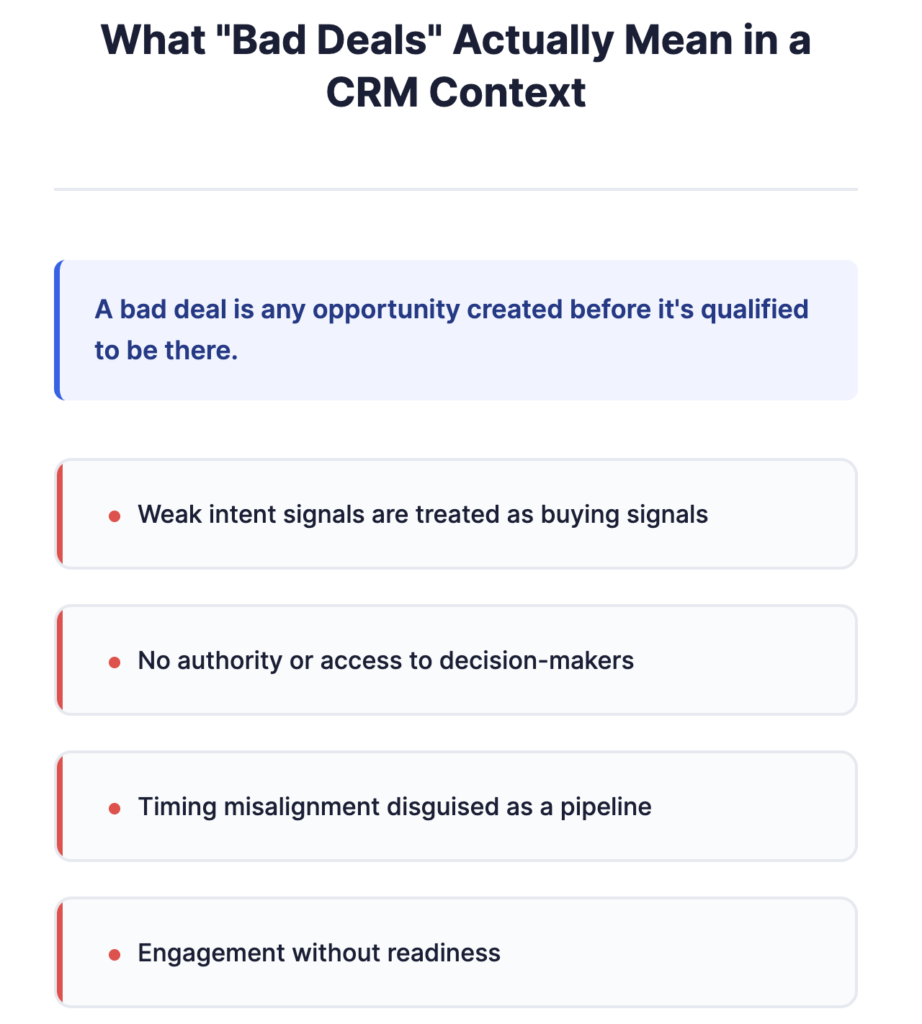
Here’s what that looks like:
Weak intent signals treated as buying signals
Someone downloads a whitepaper. Marketing automation creates an opportunity. The person was doing research, not evaluating vendors. The deal was never real, but it exists in your CRM.
No authority or access to decision-makers
Your SDR books a meeting with a manager who likes the product. The manager can’t buy anything and won’t introduce you to anyone who can. The opportunity gets created anyway because the meeting happened.
Timing misalignment disguised as pipeline
A prospect says “this is interesting, let’s revisit in six months.” Your rep creates an opportunity with a close date in Q4 because they need the coverage. The buyer has no active evaluation process. The deal is fictional.
Engagement without readiness
The buyer is asking questions and seems interested, but they’re not actively solving the problem yet. They’re exploring, not buying. Most CRMs treat both behaviors the same, which is how exploratory conversations end up as pipeline.
These opportunities damage CRM hygiene the moment they’re created. They inflate coverage metrics. They consume rep time. They make forecasting impossible because your pipeline is half noise.
And cleanup doesn’t fix this because the problem isn’t the data quality inside the record. The problem is that the record exists at all.
Blocking Bad Deals Upstream: The Real Fix
Fixing CRM hygiene means preventing unqualified opportunities from entering the CRM in the first place.
This requires changing when and how deals get created.
Enforce Signal Validation Before Record Creation
Most organizations create the opportunity first, then try to validate it. This is backward.
Validation should happen before the CRM record exists.
Example: Your SDR completes a discovery call. Before creating an opportunity, enrichment data and qualification signals are checked against your ICP. Company too small? No opportunity created. Wrong industry? No opportunity created. No active buying process? No opportunity created.
The conversation gets logged. The contact gets nurtured. But no deal enters your pipeline until readiness criteria are met.
This is the difference between CRM as a dumping ground and CRM as a qualified pipeline.
Remove Human Discretion Where It Breaks CRM Data Hygiene
Reps will always optimize for what they’re measured on. If they need coverage, they’ll create opportunities to get coverage.
The fix isn’t better training. It’s removing the ability to create opportunities that don’t meet qualification thresholds.
Your system should enforce the rules, not rely on reps to follow them.
If a lead doesn’t meet minimum viable criteria: company size, industry fit, technology presence, buying timeline, the system shouldn’t allow opportunity creation. The rep can’t override it to hit a metric.
This isn’t about limiting rep judgment. It’s about separating exploration from qualification. Reps can still engage with prospects, log activity, and build relationships. They just can’t pollute the pipeline doing it.
Let Weak Records Expire Automatically
Some deals enter the system legitimately but lose viability over time. The buyer goes dark. Timing pushes indefinitely. Budget disappears.
Most CRMs handle this by leaving the opportunity open forever. Reps don’t close-lost their own deals because it hurts their metrics.
Upstream control means building expiration logic into opportunity creation.
If a deal hasn’t progressed in 30 days and activity has stopped, it should automatically exit active pipeline. Not “mark as stale.” Not “remind the rep to update it.” Remove it.
The rep can recreate the opportunity if the buyer re-engages with real intent. But passive decay doesn’t get to sit in your CRM indefinitely.
Stop Auto-Generating Opportunities from Activity
Marketing automation and integration triggers are major sources of CRM hygiene problems.
A form fill creates an opportunity. A demo request creates an opportunity. A product trial signup creates an opportunity.
None of these are qualification. They’re engagement signals.
Upstream control means treating engagement as a trigger for qualification workflow, not opportunity creation.
The form fill starts a sequence. The demo request routes to an SDR for validation. The trial signup triggers enrichment and ICP evaluation.
Only after qualification does the opportunity get created. You’re blocking bad deals at the source instead of cleaning them up downstream.
CRM Hygiene as a System Design Problem
Most revenue organizations treat CRM hygiene as a people problem. They assume reps aren’t following process, so they add more rules, more required fields, and more training.
This fails because the system allows—and often incentivizes—bad behavior.
CRM hygiene improves when systems enforce rules, not when people are asked to follow them.
The CRM as an Enforcement Layer
Your CRM should function as a gating mechanism, not just a recording system.
Right now, most CRMs record whatever gets put into them. They’re designed to capture data, not validate whether that data should exist.
When you redesign the system with enforcement upstream:
- Opportunities can’t be created without meeting defined qualification thresholds
- Routing logic validates ICP fit before assignment
- Enrichment runs before record creation to inform the qualification decision
- Weak signals trigger nurture workflows, not pipeline entries
The CRM becomes a system that maintains its own integrity, rather than a database that relies on human discipline.
Upstream Control Leads to Downstream CRM Data Hygiene
When bad deals can’t enter your CRM, every downstream metric improves automatically.
Your coverage numbers reflect real pipeline, not inflated activity. Your forecast model operates on qualified opportunities, not garbage. Your reps work on deals that have genuine potential.
CRM data hygiene becomes an outcome of good system design, not a manual effort.
You’re not cleaning your CRM less because reps got better at data entry. You’re cleaning less because there’s less bad data to clean.
Trust Returns When the System Is Reliable
When sales leadership reviews pipeline and sees only qualified opportunities, they start trusting the CRM again.
When reps know that routing logic actually reflects ICP fit, they stop ignoring assignments.
When RevOps doesn’t spend 30% of their time on audits and cleanup, they can focus on building workflows that drive execution quality.
This is what fixed CRM hygiene enables: a system people actually use the way it’s designed.
What Changes When CRM Hygiene Is Fixed Upstream
The most immediate change is clarity.
Your pipeline stops being a mix of real opportunities and noise. When you look at coverage, you’re seeing actual deals. When you review forecast, the opportunities make sense.
Less Manual Cleanup
You’re not running quarterly audits to close out stale deals. You’re not building reports to identify garbage opportunities. You’re not having conversations with reps about why they created an opportunity from a cold email reply.
The cleanup burden decreases because bad deals aren’t entering the system in the first place.
More Reliable Pipeline Metrics
Your coverage metrics start meaning something. When you have 4x coverage, it’s real pipeline—not inflated by opportunities that were never qualified.
Your velocity metrics improve because you’re measuring how fast real deals move, not how long garbage sits in early stages.
Your conversion rates reflect actual qualification quality instead of being polluted by deals that should never have existed.
Better Forecast Accuracy
Forecasting becomes possible when your pipeline contains real opportunities.
Your historical data stops being polluted by deals that were created to hit coverage targets and sat in the CRM for 90 days before getting marked closed-lost.
Your stage conversion rates reflect genuine buyer progression instead of rep optimism.
When bad deals can’t enter your CRM, your forecast model can actually work.
The CRM Becomes a Tool, Not a Problem
When CRM hygiene is fixed upstream, your CRM stops being something that needs constant policing and starts being something that supports execution.
Reps trust routing because it’s based on accurate, current data. Sales leadership trusts pipeline reviews because the opportunities are real. RevOps can build automation that actually improves workflows instead of just managing decay.
This is the difference between a CRM that’s maintained and a CRM that’s reliable.
Build a Clean Pipeline at the Source
CRM hygiene is not a cleanup problem. It’s a deal creation problem.
Every audit, every required field, every validation rule you add is treating the symptom. The cause is that bad deals are being allowed into your CRM in the first place.
You fix CRM hygiene by blocking bad deals upstream, before they become opportunities, before they pollute coverage metrics, before they waste rep time, before they destroy forecast accuracy.
This means enforcing signal validation before record creation. Removing human discretion where it breaks discipline. Letting weak records expire automatically. Stopping auto-generation from activity signals.
When you redesign your system so bad deals can’t enter, CRM data hygiene becomes an outcome, not a goal. You’re not cleaning less because you got better at maintenance. You’re cleaning less because there’s nothing to clean.
The organizations with the cleanest CRMs aren’t the ones running the most audits. They’re the ones that fixed the inflow.
FAQs
Can bad deals still enter the CRM even with a strict qualification framework?
Yes. Qualification frameworks help, but if opportunity creation isn’t enforced at the system level, reps can still create deals prematurely under pressure.
How do you balance pipeline discipline without slowing down sales teams?
By separating exploration from qualification. Reps should be able to engage freely, but opportunity creation should be gated by readiness, not activity.
Does blocking bad deals reduce overall pipeline volume?
Initially, yes. But it increases pipeline quality, conversion rates, and forecast accuracy, which matters more than raw volume.
What metrics should change once bad deals are blocked upstream?
You’ll typically see lower pipeline coverage, higher stage conversion rates, shorter sales cycles, and more reliable forecasts.
How do you handle edge cases where a deal doesn’t clearly meet qualification criteria?
Those should stay in nurture or pre-opportunity states until clear buying signals emerge, instead of being forced into pipeline prematurely.
Can this approach work for high-velocity or PLG motions?
Yes, but enforcement thresholds differ. High-velocity teams still need signal validation before opportunity creation, even if cycles are shorter.
What happens to historical CRM data once upstream controls are fixed?
Historical data remains polluted, but future data becomes reliable. Over time, forecasting models improve as cleaner data accumulates.
How do you get sales buy-in for stricter opportunity creation rules?
By tying enforcement to better routing, higher-quality pipeline, and fewer wasted deals rather than framing it as control or restriction.