A Target Account List defines which companies your B2B sales team will actively pursue and how those accounts are prioritized. Without one, SDRs chase whatever enters the CRM, pipeline fills with companies that were never a real fit, and outreach effort gets diluted across too many accounts.
Your Ideal Customer Profile defines what a strong-fit company looks like. Buying signals indicate which of those companies are likely to act now. Combined inside your CRM, they create a prioritized Target Account List.
That list determines who receives Tier 1 attention, who enters structured outreach, and who remains in nurture. It ensures sales and marketing operate from the same ranked account set instead of parallel target lists.
Most teams either skip building this system or create a list so large that it functions as storage rather than prioritization. This guide shows how to define fit, layer intent, score accounts, size the list to capacity, and keep it accurate as the market changes.
What Is a Target Account List?
A Target Account List is a curated set of companies your sales team has identified as the best fit for your product. Each account matches your Ideal Customer Profile, shows signals of potential need, and is actively prioritized for outreach.
Comparison at a Glance
| Category | Target Account List | Lead List | Prospecting List |
|---|---|---|---|
| Selection criteria | ICP fit and intent scoring | Minimal or none | Basic filters |
| Primary use | Coordinated sales and marketing | Volume outreach | Cold outreach |
| Updated by | RevOps on a defined cadence | Rarely | As needed |
| Lives in | CRM | Spreadsheet or tool | Sequencing tool |
| Drives | Routing, tiering, ABM | Email blasts | SDR sequences |
A lead list is broad and unfiltered. A prospecting list drives volume cold outreach. A Target Account List is selective, strategic, and built for coordinated execution across sales and marketing.
Why a Target Account List Matters in B2B Sales
It focuses revenue effort where it belongs
Without a Target Account List, reps pursue whatever lands in their inbox or CRM. A defined list ensures every rep spends time on companies that are actually capable of buying.
It makes SDRs more efficient
Qualification happens before the account reaches the rep, not during outreach. That means more time selling, less time researching.
It enables Account-Based Marketing
ABM only works when sales and marketing target the same accounts. A shared Target Account List makes that coordination possible. Without it, marketing campaigns and sales outreach operate on different company sets, and the effort splits instead of compounds.
It keeps the pipeline honest
Poor-fit accounts inflate pipeline, distort forecasting, and consume AE time on deals that will never close. A tight Target Account List prevents that from the start.
Step-by-Step: How to Build a Target Account List
A Target Account List is built through a sequence of decisions, from defining fit to assigning priority. Each step builds on the last. Skip one, and the system breaks down.
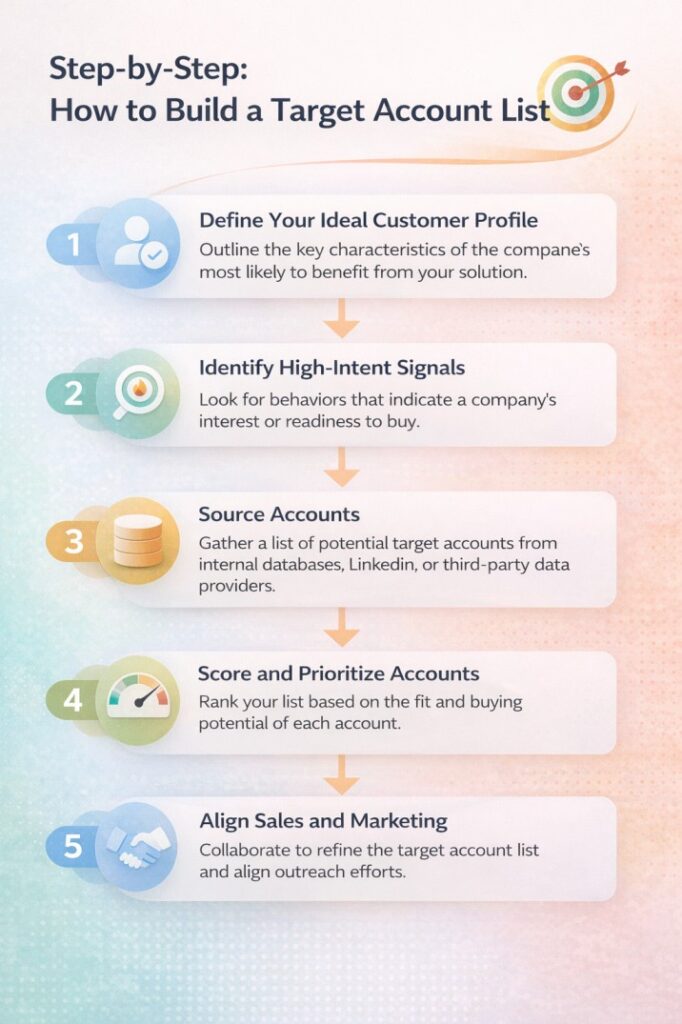
Step 1: Define Your Ideal Customer Profile
Your Ideal Customer Profile describes the type of company most likely to buy, use your product successfully, and stay as a customer. Define it across five dimensions:
- Industry. Which verticals produce your best customers?
- Company size. What headcount or revenue range fits your product?
- Geography. Where do you have the strongest product-market fit?
- Tech stack. Which tools does your product integrate with or depend on?
- Buying triggers. What situations create urgent need? Examples include rapid hiring, new funding, a leadership change, or a shift in go-to-market strategy.
Pull your last 20 to 30 closed-won deals and identify the common patterns. That is your ICP baseline. One important caution: if your closed-won data is thin or skewed toward early customers, validate with lost deal analysis too. An ICP built only on wins can blind you to patterns in why accounts did not convert.
Step 2: Identify High-Intent Signals
ICP fit tells you which accounts could buy. Intent signals tell you which ones are likely to buy now.
- Hiring trends. Actively recruiting SDRs, RevOps managers, or sales leaders signals a function being built out.
- Funding activity. A recent Series A, B, or C often means new budget and new initiatives.
- Tech stack changes. Adding or removing a related tool is a strong purchase signal.
- Expansion signals. New offices, new markets, or new product lines create operational pressure your product may solve.
Avoid over-indexing on any single signal. A recently funded company that does not match your ICP is still a poor fit. Cross-reference at least two signals before elevating an account to Tier 1.
Step 3: Source Accounts
- Your CRM. Closed-lost deals, churned customers, and dormant accounts that match your current ICP are the most overlooked source.
- Existing customer base. Find companies similar to your best customers that are not yet in your pipeline.
- Market databases. Apollo, ZoomInfo, LinkedIn Sales Navigator, and Crunchbase let you filter by ICP criteria directly.
- Competitor customers. These companies already understand the problem category and are often more receptive to outreach.
Aim for accuracy, not volume. A smaller list of well-qualified accounts consistently outperforms a large unfiltered one.
Step 4: Score and Prioritize Accounts
Scoring allocates SDR and AE time to where it will produce the best results.
Fit score: How closely does the account match your ICP across industry, size, geography, and tech stack?
Intent score: How many active signals is the account showing right now?
Concrete Scoring Example
| Scoring Factor | Weight | Example Criteria |
|---|---|---|
| Industry match | 30% | Target vertical = full points |
| Headcount range | 20% | 100 to 500 employees |
| Hiring signal | 25% | 3 or more relevant roles open |
| Funding in last 6 months | 25% | Series A, B, or C raised |
Accounts scoring 80 or above go to Tier 1. Between 50 and 79 go to Tier 2. Below 50 go to Tier 3 or a watch list. Adjust weights based on what your closed-won data shows actually predicted conversion.
Tiering:
- Tier 1. High fit and strong intent. Maximum personalization and SDR time.
- Tier 2. Strong fit with limited signals, or moderate fit with strong signals. Structured outreach with reasonable personalization.
- Tier 3. Reasonable fit but low signals. Longer-cycle nurture until signals strengthen.
Step 5: Align Sales and Marketing
The Target Account List only produces results when both teams use it together.
- Put the list in the CRM. Not a spreadsheet. A shared, accessible, single source of truth.
- Assign ownership. Every Tier 1 and Tier 2 account needs a named SDR or AE. Unowned accounts do not get worked.
- Coordinate timing. When marketing runs a campaign against a listed account, the assigned SDR should know and time outreach accordingly.
- Connect it to ABM. ABM campaigns only work when they target accounts sales has already identified as high-fit. The Target Account List is what makes that targeting precise.
Account Capacity Model: How Many Accounts Can Your Team Actually Work?
Adding accounts to Tier 1 without modeling capacity does not create more pipeline. It dilutes outreach quality across all accounts.
| Tier | Accounts per Rep | Touch Frequency | Personalization Level | Signal Refresh |
|---|---|---|---|---|
| Tier 1 | 20 to 30 | Every 7 to 10 days | High, fully customized | Weekly |
| Tier 2 | 50 to 80 | Every 14 to 21 days | Moderate, semi-personalized | Bi-weekly |
| Tier 3 | 100 to 150 | Monthly | Template-based | Monthly |
Adjust these numbers based on your sales cycle length and whether SDRs handle inbound alongside outbound. The principle is consistent: model capacity deliberately rather than loading lists without a clear sense of what each rep can actually execute.
When capacity is exceeded, Tier 1 quality suffers first. Reps start treating high-priority accounts with the same low-effort touch as Tier 3 because there is not enough time for anything else. If conversion rates are falling while list size is growing, the problem is usually dilution, not the accounts themselves. Shrink the list before adding to it.
Static vs Dynamic: The Two Eras of Target Account Lists
The static era. The list is built once at the start of a quarter, lives in a spreadsheet, and gets manually updated when someone remembers. Tiers are assigned at creation and rarely change. The quarterly review is the only mechanism for catching drift.
The problem is that the market does not behave statically. A company with no signals in January may have raised a Series B, hired a new CRO, and started vendor evaluations by March. A static list will not surface that until the next scheduled review, by which point the window has likely closed.
The dynamic era. The list is treated as live infrastructure. ICP fit scores update as firmographic data changes. Intent signals trigger tier adjustments automatically. Ownership and routing sync in the CRM as accounts move between tiers. New ICP-fit accounts are surfaced continuously rather than during scheduled reviews.
The shift is not about removing human judgment. It is about removing the lag between a change in market reality and the team’s awareness of it. Teams operating with a dynamic Target Account List execute faster, waste less SDR time, and avoid the quarterly reset that static lists require.
Common Mistakes When Building a Target Account List
Starting without an Ideal Customer Profile
Without a defined ICP, accounts get added on gut feel. The list becomes a mix of real opportunities and wishful thinking with no clear basis for prioritization.
Confusing leads with accounts
The list is built around companies, not contacts. Identify the right organizations first. Find the right contacts within them second.
Building the list too large
A 2,000-account list is a database, not a target list. Size to capacity. A smaller, actively worked list consistently outperforms a large, unmanaged one.
Over-indexing on a single intent signal
Funding, hiring, and tech stack changes are useful inputs. None of them alone is sufficient for Tier 1 qualification. Score across multiple factors.
Not updating the list regularly
A list built in January and untouched in September is no longer accurate. It becomes a liability when teams make outreach and forecasting decisions based on outdated prioritization.
Keeping marketing out of it
The Target Account List is a shared GTM resource. If marketing is not using the same list, ABM coordination breaks down, and effort splits instead of compounds.
How Often Should You Update Your Target Account List?
Quarterly reviews are the minimum
Audit for disqualified accounts, emerging fits, and tier changes driven by new signals. Assign a named owner, typically a RevOps or sales ops lead, to run it. Without ownership, reviews get skipped.
Trigger-based updates happen immediately
A Tier 1 account that gets acquired, loses key leadership, or shows a budget freeze should be updated now, not at the next quarterly cycle.
Remove accounts deliberately
Exit criteria should be defined: no engagement after 90 days of active outreach, disqualified in a sales conversation, or no longer ICP-fit due to company changes. Keeping dead accounts on the list inflates numbers and misleads prioritization.
Know when to shrink
If outreach quality is dropping while list size is growing, reduce Tier 1 account load per rep before adding more accounts. A tighter, higher-quality list worked with full attention produces better results than a larger one worked at reduced effort.
How Revenue Teams Operationalize a Target Account List at Scale
Manual list management works early. It breaks as team size, market complexity, and account volume increase.
Where it breaks down:
- Spreadsheets create version control problems. Different teams work from different versions. Tiers change without documentation. The list marketing uses for campaigns diverges from the one sales is working.
- Intent signals change faster than quarterly reviews can track. By the time a manual review surfaces a buying signal, the account has often already made a decision.
- Manual enrichment consumes RevOps time that should go toward process and analysis, not data entry.
What a scalable model requires:
- Continuous ICP-fit scoring that updates as company data changes
- Automated enrichment that keeps firmographic and technographic fields current without manual research
- Real-time intent signal monitoring that surfaces buying behavior as it happens
- Tier and ownership sync that keeps CRM records accurate so routing and sequencing logic fires correctly
Tools like Pintel are built for this operational layer. Pintel continuously discovers new ICP-fit accounts, enriches them with firmographic and technographic data, applies fit and intent scoring, and syncs tiers and ownership directly into the CRM. The result is a Target Account List that stays current without depending on manual reviews to maintain accuracy.
The goal is not to remove human judgment from the process. It is to ensure that judgment operates on current data rather than information that is 60 or 90 days out of date. A dynamic, continuously updated Target Account List inside the CRM is what separates teams that execute account-based strategies consistently from those that do it in bursts.
From List to Revenue Infrastructure
A structured Target Account List is one of the most direct levers for improving B2B sales efficiency. It focuses effort on the right companies, gives sales and marketing a shared execution foundation, and keeps pipeline quality honest.
Build it from a defined Ideal Customer Profile. Score accounts across multiple signals. Size it to your team’s real capacity. Keep it in the CRM, not a spreadsheet. Review it on a defined cadence and shrink it when quality starts to slip.
Teams that treat the Target Account List as a static document will always be catching up to market reality. Teams that treat it as dynamic, continuously updated infrastructure build a compounding execution advantage that shows up in pipeline quality, SDR efficiency, and revenue predictability over time.
FAQ
What is the main purpose of a Target Account List?
To focus sales effort on companies most likely to convert and avoid wasting time on poor-fit accounts.
How many Tier 1 accounts should an SDR handle?
Typically 20 to 30, depending on sales cycle length and personalization depth. The number should match real outreach capacity.
Who should own the Target Account List?
RevOps or Sales Ops should manage scoring and updates. Sales and marketing should both execute against the same list.
How often should the list be updated?
Quarterly at minimum, with immediate updates triggered by major account changes such as funding, leadership shifts, or disqualification.
Should a Target Account List live in a spreadsheet?
No. It should live inside the CRM so scoring, routing, ownership, and reporting stay aligned.
What is the biggest mistake teams make?
Building a list that is too large for the team to realistically work with quality and personalization.