Most B2B revenue teams already have a GTM strategy they believe in. The real challenge isn’t deciding what to do; it’s ensuring that work happens the same way every time across Sales, Marketing, RevOps, and Customer Success.
When that execution layer isn’t clearly structured, small inconsistencies compound quickly. Accounts get worked differently by different reps, leads route unpredictably, and segmentation drifts based on opinion rather than rules.
A GTM framework exists to solve this problem. It’s the operational layer that sits beneath your strategy, translating decisions about ICP, positioning, and coverage into consistent, day-to-day execution across your revenue engine.
In this article, you’ll learn what a GTM framework is, how it differs from a GTM strategy, the six structural layers that make up a complete GTM execution framework, and how to identify which layer to fix first when execution feels chaotic.

What Is a GTM Framework?
A GTM framework is the operational structure that defines how revenue works gets executed consistently across an organization. It provides the system that turns a go-to-market strategy into day-to-day execution.
It governs:
- How accounts and leads get segmented, routed, and assigned
- Who owns what work, and what each role is responsible for
- How data flows between systems and triggers action
- What processes run inside each GTM motion (prospecting, qualification, closing, expansion)
- Who makes decisions, approves exceptions, and maintains the system
A GTM framework is not your strategy. It’s the execution system that operationalizes your strategy so it works the same way every time, regardless of who’s doing the work.
GTM Framework vs. GTM Strategy
The distinction matters because most revenue leaders conflate the two, and that’s why execution falls apart.
GTM Strategy is your set of market-facing decisions:
- What market segments you target
- What value proposition you lead with
- What pricing and packaging you offer
- What channels you use to reach buyers
- What coverage model you deploy
GTM Framework is your internal execution system:
- How accounts move through your revenue engine
- How reps know what to work and when
- How data structures support decision-making
- How teams hand off work without dropping context
- How the system enforces consistency at scale
Strategy tells you what to do. A GTM framework defines how the work happens.
You can have a world-class GTM strategy and chaotic execution if your GTM framework is broken. You can also have a beautifully structured GTM framework executing the wrong strategy. Both must align, but they solve different problems.
If you’re still deciding what markets to target or how to position your product, you need strategy work. If you know your strategy but execution feels inconsistent, manual, or fragile, your GTM framework is the problem.

Why GTM Execution Breaks Without a Framework
When you don’t have a documented, enforced GTM operating framework, execution defaults to implicit rules, manual triage, and institutional knowledge trapped in people’s heads.
Here’s what that looks like operationally:
Routing happens in Slack. Inbound leads sit in a queue while RevOps gets @mentioned to figure out who should get them. Reps debate territory overlap in channel threads. Assignment rules exist, but no one trusts them, so humans intervene in every edge case.
Segmentation drifts constantly. Marketing builds campaigns for one ICP. Sales qualifies a different one. An account is “enterprise” in the CRM but gets worked like mid-market. Segment definitions change depending on who’s looking at the data, and no one knows which version is accurate.
Handoffs fail silently. SDRs book meetings for accounts AEs don’t want. Marketing generates leads Sales can’t work. Customer Success flags expansion opportunities that never make it into pipeline. The failure point is invisible until someone notices revenue is missing.
Data doesn’t connect. Enrichment happens in one tool. Lead scoring in another. Routing logic lives in a spreadsheet someone built two years ago. There’s no source of truth, so every team operates from a different version of reality.
No one knows who decides. Is this account enterprise or mid-market? Should this lead go to an SDR or straight to an AE? Who approves exceptions to territory rules? Decisions get made in the moment, inconsistently, with no documentation trail.
These aren’t edge cases or early-stage growing pains. This is what “default GTM execution” looks like at most B2B companies. The GTM framework exists, but it’s implicit, undocumented, and stored in the heads of three people who are about to leave for different jobs.
When they do, the system collapses.
The Six-Layer GTM Execution Framework
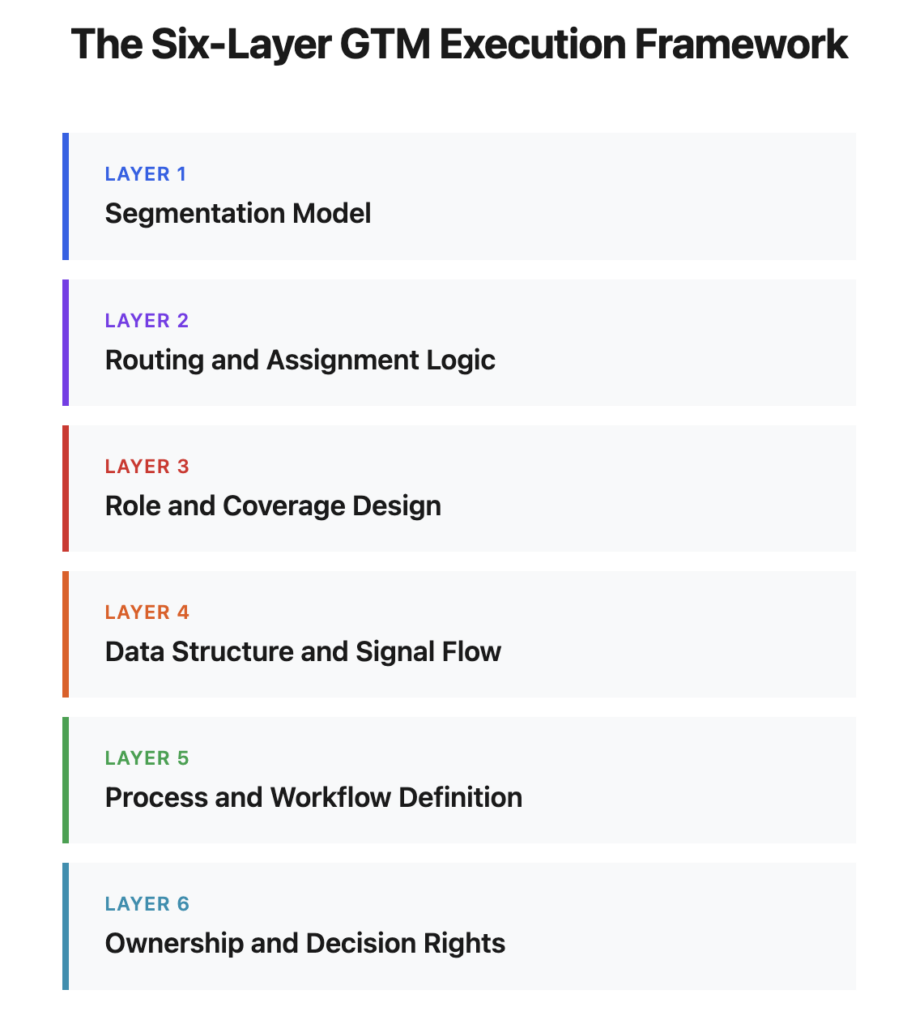
A functional GTM framework standardizes execution across six structural layers. Together, these six layers form the complete operating framework that translates strategy into repeatable execution.
Each layer answers a specific operational question about how work moves through your revenue engine.
Layer 1: Segmentation Model
Your segmentation model defines how accounts and contacts get categorized so the rest of your GTM framework knows what to do with them.
Segmentation is the foundation of your GTM framework. It must be:
Stable. Accounts don’t jump between enterprise and mid-market based on rep opinion or deal size. Segment assignment is rules-based, enforced in your CRM, and applied consistently across every tool in your stack.
Data-driven. Segments are determined by objective, system-readable attributes: employee count, revenue, industry, tech stack, intent signals. If a human has to interpret whether an account fits, your segmentation model isn’t finished.
Aligned across teams. Marketing targets the same segments Sales sells into. CS manages the same account tiers RevOps reports on. There’s one segmentation model within your GTM framework, not four slightly different versions across departments.
Enforced systematically. Segmentation logic lives in your CRM as validation rules and automation, not in a strategy deck. Exceptions require approval. Drift gets flagged and corrected automatically.
If your segmentation model requires manual interpretation every time someone looks at an account, you don’t have a GTM framework. You have a set of guidelines people ignore under pressure.
Layer 2: Routing and Assignment Logic
Routing logic defines how leads, accounts, and opportunities get assigned to the right person, at the right time, with the right context attached.
This layer of your GTM framework must be:
Automated. Inbound leads route instantly based on predefined rules. No manual triage. No waiting for someone to check a dashboard. No Slack messages asking “who should get this?”
Contextual. Routing doesn’t just look at firmographics. It considers existing account ownership, prior deal history, relationship presence, inbound vs. outbound source, and current intent signal strength.
Transparent. Every rep knows why they got assigned a specific account. Every manager can audit routing decisions in real time. RevOps can trace any assignment back to the rule that triggered it.
Exception-aware. The GTM framework anticipates edge cases (existing customer inquiries, partner referrals, executive intros) and routes them correctly without breaking default logic or requiring human intervention.
Routing logic is where most GTM frameworks fail first. If your team still manually assigns accounts or triages leads in spreadsheets, you don’t have a GTM framework. You have a bottleneck disguised as a process.
Layer 3: Role and Coverage Design
Role and coverage design defines who does what work, who owns which accounts, and how capacity gets allocated across segments.
This layer of your GTM framework must answer:
Who owns which accounts? Not just “who has it in Salesforce,” but who is operationally responsible for pipeline generation, deal progression, and revenue outcomes from that account.
What does each role do? SDRs generate pipeline from target accounts. AEs run sales cycles and close deals. CSMs own retention and expansion post-sale. Overlap and gaps both kill execution. Clarity on role scope prevents both.
How is capacity allocated? How many accounts can one AE effectively manage? How many SQLs should an SDR generate per month? How do you redistribute accounts when someone ramps, leaves, or gets promoted?
Who handles exceptions? When an account doesn’t fit the model (wrong segment, cross-geo opportunity, multi-product complexity), who decides what happens next and who does the work?
Role clarity isn’t an org chart exercise. It’s about execution boundaries. If two people think they own the same account or the same work, your GTM framework is broken and someone’s pipeline is about to disappear.
Layer 4: Data Structure and Signal Flow
Data structure defines what information you collect, how it moves between systems, and how teams use it to make execution decisions.
This layer of your GTM framework includes:
Standardized fields. Core GTM data (ICP fit score, segment classification, intent signals, engagement tier) lives in the same fields across all systems. No custom fields only one team understands.
Enrichment rules. How do accounts get enriched with firmographics, technographics, and intent data? Where does enrichment happen (CRM, data warehouse, reverse ETL)? How often does it refresh?
Signal capture. How do you track buying committee engagement, champion identification, and deal momentum? What signals trigger rep action? How do those signals surface in the tools reps actually use?
System integration. How does data flow between your MAP, CRM, data warehouse, and sales engagement tools? Are transformations documented? Can RevOps trace data lineage when something breaks?
Quality enforcement. What validation rules prevent bad data from entering the system? How do you surface incomplete or outdated records? Who owns data hygiene, and how is it measured?
Most GTM framework failures aren’t caused by reps doing the wrong work. They’re caused by data that doesn’t exist, doesn’t flow correctly between systems, or doesn’t match across tools.
Layer 5: Process and Workflow Definition
Process definition specifies the step-by-step work that happens inside each GTM motion: prospecting sequences, qualification criteria, opportunity stage progression, expansion plays.
Your GTM framework workflow definition must specify what happens in sequence, what “done” looks like at each stage, where work happens, how long each step takes, and what gets measured to track adherence.
When a lead converts to SQL, what’s the next action? Who does it, in what system, within what timeframe? What triggers the following step? How do you know an account has been adequately worked? What qualifies as a completed discovery call? When is an opportunity ready to advance to the next stage?
Does outbound prospecting happen in Salesforce, Outreach, Apollo, or a spreadsheet? Where do reps log activity? Where do managers review pipeline health? What’s the SLA for inbound lead follow-up? How long should an account stay in discovery before moving forward or disqualifying? When does an opportunity get marked as stalled?
Workflows aren’t bureaucracy. They’re the scaffolding that makes execution predictable, measurable, and improvable. Without them, every rep invents their own process and management has no visibility into why results vary.
Layer 6: Ownership and Decision Rights
Ownership defines who has authority to make GTM decisions, approve exceptions, and change the GTM framework itself.
Clear ownership must establish who owns the GTM framework (typically RevOps, sometimes Revenue Strategy or GTM Operations), who can change it (framework updates require cross-functional input but final approval sits with one owner), who approves exceptions (when a rep wants to work an account outside their assigned segment or Marketing wants to test a new lead source), and who resolves conflict (when Sales and Marketing disagree on segmentation rules or territory rules overlap).
Without clear ownership, GTM frameworks decay into chaos. People work around the system instead of improving it. Exceptions become defaults. And six months later, you’re back to routing leads in Slack.
These six layers (segmentation, routing, roles, data, process, and ownership) form the complete GTM execution framework. When all six layers work together, your revenue engine operates consistently regardless of team size, market complexity, or strategic shifts.
What a Well-Structured GTM Framework Enables
When your GTM operating framework is clear, consistent, and systematically enforced, you unlock:
Faster onboarding. New reps don’t have to reverse-engineer how things work by watching Slack channels. The GTM framework documents what to do, when to do it, where to do it, and what good looks like. Ramp time compresses.
Higher rep productivity. Reps spend less time figuring out which accounts to work, how to route edge cases, or whether CRM data is trustworthy. More time actually selling.
Scalable operations. RevOps can add new segments, launch new products, or expand into new regions without rebuilding the entire GTM system from scratch. The GTM framework accommodates growth.
Reliable forecasting. When GTM framework execution is consistent, pipeline generation becomes predictable. You can forecast based on leading activity indicators instead of gut feel and historical averages.
Better data quality. When GTM framework workflows enforce data capture at every step, your CRM actually reflects reality. Reports become trustworthy. Dashboards drive decisions instead of debates about whose numbers are right.
Cross-functional alignment. Marketing, Sales, and CS operate from the same segmentation model, the same routing logic, and the same process definitions within your GTM framework. Handoffs work. Accountability is unambiguous.
A strong GTM framework doesn’t guarantee revenue outcomes. But it eliminates the structural chaos that prevents good teams from executing well.
Common GTM Framework Mistakes
Building in isolation. RevOps designs the perfect GTM framework without input from Sales, Marketing, or CS. It’s technically correct and operationally useless because no one understands it or trusts it. Reps work around it immediately.
Over-engineering. The GTM framework accounts for every possible edge case, requires five approval layers for exceptions, and takes 20 minutes to explain. Complexity kills adoption. Simple, enforced GTM frameworks win over elegant, ignored ones.
Under-documenting. The GTM framework exists, but only in the heads of three people. When they leave, institutional knowledge evaporates. New hires reverse-engineer how things work by watching what breaks.
No enforcement. The GTM framework is documented but not built into systems. Segmentation rules live in a slide deck, not CRM validation rules. Routing logic exists in a spreadsheet, not automation. Reps ignore it because there’s no consequence for doing so.
Static design. The GTM framework gets built once and never updated. Market conditions shift. Product portfolio expands. Coverage model changes. The GTM framework stays frozen. Execution drifts further from structure until the gap becomes catastrophic.
Good GTM frameworks are simple, documented, enforced in systems, and iteratively improved. Build the minimum structure that removes ambiguity from execution, then evolve your GTM framework as real-world usage exposes gaps.
Where to Start If Your GTM Feels Chaotic
If execution feels inconsistent, manual, or fragile, start with the GTM framework layer that’s breaking hardest:
If leads sit unworked or reps don’t know who owns what: Fix routing logic first. Automate assignment. Eliminate manual triage and Slack-based routing.
If accounts move between segments inconsistently: Fix your GTM framework segmentation model. Make it data-driven, stable, and enforced through CRM automation and validation rules.
If handoffs fail between SDR to AE or AE to CS: Fix process definition within your GTM framework. Document what happens at each transition point, who does what, what “complete” looks like, and what triggers the next step.
If CRM data is unreliable and no one trusts reports: Fix your GTM framework data structure. Standardize fields, enforce validation rules at the point of entry, and audit enrichment data quality.
If no one agrees on who decides what: Fix ownership and decision rights in your GTM framework. Assign clear authority for framework changes, exception approvals, and conflict resolution.
Don’t try to rebuild the entire GTM framework at once. Identify the biggest source of execution drag, fix that structural layer, measure the impact, then move to the next one.
The goal isn’t perfection. It’s reducing the friction that prevents your team from executing your strategy consistently.
Why This Matters Now
B2B revenue teams are under more pressure than ever to do more with less. Budgets are tighter. Sales cycles are longer. Buyers are more cautious. The teams that win aren’t the ones with the most creative GTM strategy. They’re the ones that execute their strategy consistently, efficiently, and at scale.
Your GTM strategy will evolve. Markets shift. Products expand. ICPs change. But the underlying GTM framework (segmentation logic, routing rules, role definitions, data flows, process workflows, decision rights) should remain stable enough to support that evolution without constant chaos.
Most revenue failures aren’t strategic. They’re structural. Teams know what to do but can’t execute it consistently because the system underneath is broken, implicit, or nonexistent.
Building a GTM framework isn’t glamorous work. It doesn’t show up in keynote presentations or board decks. But it’s the difference between a revenue engine that scales predictably and one that collapses under its own weight every time you try to grow.
A GTM strategy framework sets direction. A GTM execution framework creates velocity.
The question isn’t whether you need both. The question is whether you’re willing to build the structure that makes execution repeatable before the next quarter starts and you’re back to routing leads in Slack.
Frequently Asked Questions About GTM Frameworks
Is a GTM framework only for large or mature companies?
No. Early-stage teams benefit just as much. Without a framework, execution debt builds quickly and becomes harder to unwind as the team scales.
Can you build a GTM framework from scratch, or does it require fixing something broken?
Both. Some teams use a GTM framework to fix execution drift. Others use it to design their revenue engine correctly from day one.
Is a GTM framework the same as RevOps?
No. RevOps often owns the framework, but the framework itself defines how Sales, Marketing, and Customer Success execute together across data, roles, and workflows.
Do GTM frameworks require new tools to implement?
Not always. Many teams already have the tools but lack the structure to use them consistently. The framework defines how systems, data, and workflows should operate together.
What usually breaks first in GTM execution?
Most often: segmentation and routing. When these aren’t clearly defined and enforced, downstream execution becomes manual, inconsistent, and hard to scale.