Your SDRs aren’t struggling to write emails. They’re drowning in pre-work.
Every quarter, the same pattern emerges: SDRs spend 3–5 hours per account researching the company, validating ICP fit, evaluating multiple personas, cross-checking data sources, and cleaning CRM fields before first outreach.
Email automation is solved. Sequencing is solved.
The real bottleneck sits earlier—in research and qualification—where accuracy matters most and mistakes compound fastest.
Most AI SDR tools automate after decisions have been made, not where consistency is created. This guide focuses on AI SDR tools that actually reduce the research burden, and explains where each fits based on your workflow, team size, and GTM maturity.
This guide is for GTM leaders, RevOps teams, and SDR managers who want to understand which AI SDR tools actually reduce manual research work and how to choose the right approach.
What Are AI SDR Tools in 2026 (And Why the Definition Is Broken)
AI SDR tools are software platforms that use artificial intelligence to automate parts of the sales development process, from prospecting and research to outreach and follow-up.
The problem: most vendors label themselves “AI SDR tools” while solving completely different parts of the workflow.
Some automate email writing. Others provide data enrichment. A few focus on sequencing or intent signals. Very few actually reduce the research and qualification burden where SDRs spend most of their time before any outreach happens.
This guide focuses specifically on AI SDR tools that impact the pre-outreach research layer—the work that determines whether outbound efforts succeed or waste time on poorly qualified accounts.
What the Bottleneck Actually Looks Like
Before evaluating AI SDR tools, define what’s actually slowing your team down.
The research and qualification layer includes:
- Validating ICP criteria across multiple signals
- Identifying personas, seniority, and functional responsibility
- Assessing whether this is the right person to engage or pitch
- Detecting hiring activity, funding, or strategic shifts
- Verifying data accuracy across sources
- Reviewing AI outputs for hallucinations
- Maintaining CRM hygiene for routing and scoring
Most AI tools don’t eliminate these steps—they just speed up what comes after.
Research Workflow: Before vs. After
Before fixing research: SDR opens account in CRM → checks LinkedIn for 3-5 profiles → visits company website → searches news for triggers → cross-references job boards → copies data into spreadsheet → validates against ICP criteria → updates 6-8 CRM fields manually → reviews with manager → finally drafts first message.
After fixing research: SDR receives pre-qualified account with validated ICP fit, persona summaries, recent triggers, and outbound-ready context already structured in CRM. Research time drops from 3-5 hours to 20-30 minutes per account.
The difference isn’t speed—it’s consistency and accuracy at scale.
Three Categories of AI SDR Tools
1. Research and qualification platforms – Standardize context before outreach
2. Flexible workflow systems – Allow custom logic but require operational ownership
3. Data and signal providers – Supply raw inputs that need human interpretation
Each solves different parts of the bottleneck.
Tools That Standardize Research and Qualification
Pintel.AI
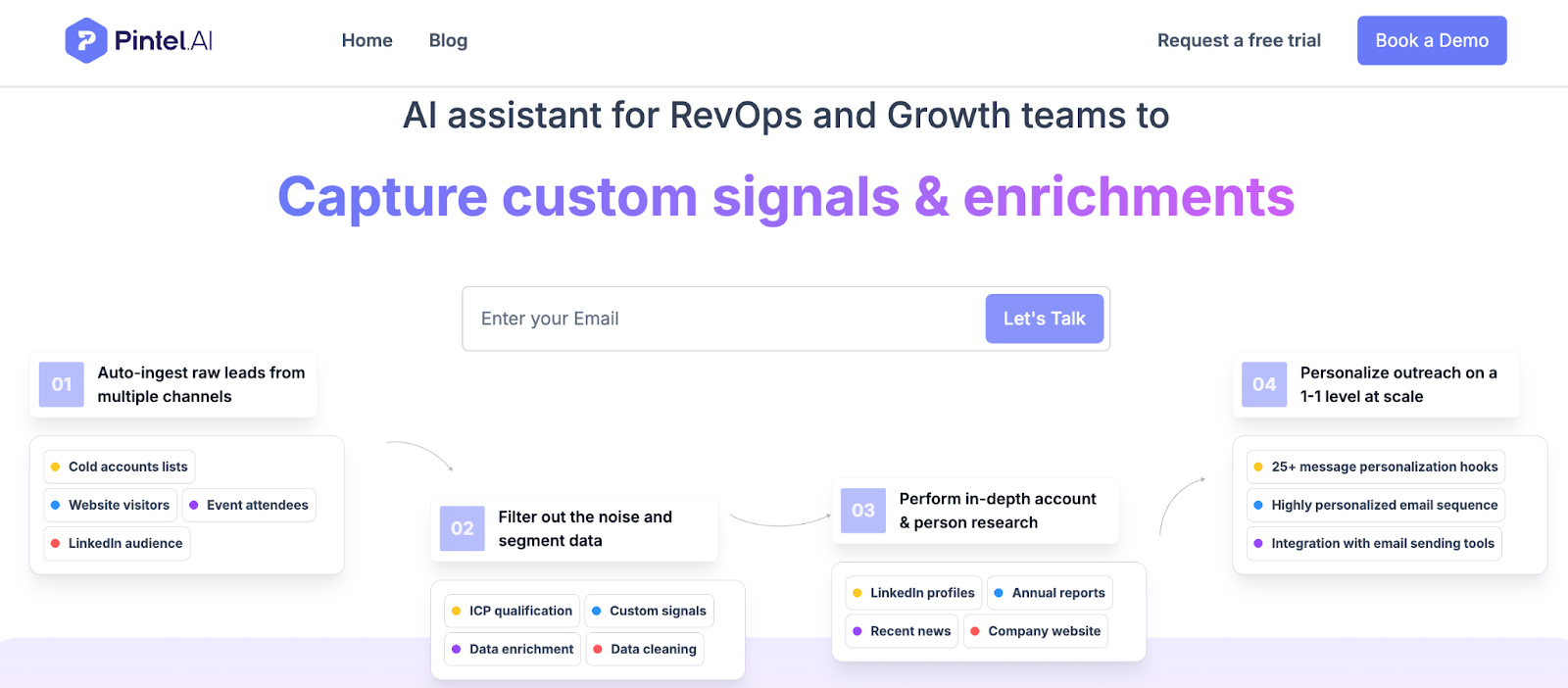
Pintel.AI eliminates the most manual, inconsistent part of SDR work: account research and qualification.
What it fixes:
- Removes multi-tab research across LinkedIn, job boards, websites, CRMs
- Replaces subjective qualification with standardized logic
- Structures outputs to reduce review time
- Aligns enrichment to existing CRM schemas
Teams typically see 40-60% reduction in pre-outreach research time per SDR. The bigger win isn’t speed—it’s fewer corrections downstream from RevOps and leadership.
How it works:
- Separate AI agents for ICP filtering, account research, persona validation
- Pre-built templates for common GTM use cases
- Quality checks embedded in each agent
- Outbound-ready summaries, not raw fields
Best for:
- Teams scaling outbound with defined ICP
- SDRs spending excessive time validating fit
- RevOps managing data consistency and routing
Not designed for:
- Executing sequences or sending messages
Flexible Workflow and Enrichment Systems
Clay
Clay gives full control over research workflow design. It excels when standard tools don’t fit your workflow, allowing you to chain together data providers, apply custom logic, and build research processes tailored to your specific ICP. The platform’s flexibility means you can adapt quickly as your GTM strategy evolves, though this same flexibility requires someone who can design and maintain these workflows over time.
What it fixes:
- Custom workflows using multiple data sources
- Advanced enrichment and signal detection
- Experimentation with niche datasets
Tradeoffs:
- Requires upfront workflow design and prompt engineering
- Data accuracy depends on prompt quality
- Ongoing maintenance as sources change
- Often needs dedicated operator or technical support
Best for:
- Technical GTM and RevOps teams comfortable with complexity
Apollo
Apollo optimizes for speed and affordability at smaller scale. It’s designed for teams that need to move fast without heavy upfront investment, combining a contact database with built-in sequencing to create a solid all-in-one solution. The platform works well when you’re testing messaging and channels, though you’ll eventually hit limitations around research depth and data quality as your ICP becomes more sophisticated.
What it fixes:
- Rapid contact discovery
- Basic persona and firmographic filtering
- High-volume list generation
Limitations:
- Limited research depth
- Requires external tools for complex workflows
- Variable data accuracy by region
Best for:
- Small teams starting outbound
- High-volume prospecting motions
Data and Signal Providers
Clearbit
Clearbit maintains CRM data quality at scale. It operates in the background, automatically enriching records as they enter your CRM without requiring SDR involvement. The platform is particularly effective for inbound-led teams where form fills need immediate enrichment, and for keeping account and contact records accurate as companies grow and change. It integrates deeply with most CRMs and marketing automation tools.
What it fixes:
- Firmographic enrichment
- Company identification from web traffic
- Consistent segmentation and routing
Where it stops:
- No deep research or qualification automation
- Limited contextual insights for personalization
Best for: CRM hygiene and data consistency
6sense
6sense identifies accounts most likely to buy. It aggregates behavioral signals across the web to predict which accounts are actively researching solutions in your category, helping sales and marketing focus on real buying intent rather than cold prospecting broadly. The platform shines in ABM strategies where understanding account-level engagement matters more than individual contact outreach. It requires meaningful traffic and account volume to generate reliable signals, making it most effective for mid-market and enterprise GTM motions.
What it fixes:
- Intent-based prioritization
- Buying stage visibility
- Reduced time on low-intent accounts
Limitations:
- Doesn’t replace persona-level research
- Needs additional tools for outbound context
Best for: ABM-led organizations, enterprise GTM teams
ZoomInfo
ZoomInfo provides contact data at enterprise scale. It maintains one of the largest B2B contact databases, with strong coverage across North American markets and growing international presence. The platform excels at providing org chart visibility, helping teams understand reporting structures and identify multiple stakeholders within target accounts. It also offers intent signals and technographic data, though these work best when combined with other research tools for deeper qualification.
What it fixes:
- Large-scale contact discovery
- Org charts and reporting structures
- Basic sales triggers
Limitations:
- Limited flexibility for custom research
- Qualification depth requires manual validation
Best for: Large SDR teams needing broad coverage
How to Choose the Best AI SDR Tools in 2026
Stop evaluating feature lists. Focus on workflow impact.
Ask:
- Does this remove entire research steps or just speed them up?
- Who validates AI output?
- How much operational overhead does it add?
- Does it align with our CRM structure?
- Can it scale without increasing RevOps workload?
The best tools eliminate work, not shift it to another team.
Choose AI SDR Tools Based on Ownership, Not Capability
The right tool depends on who owns the research process in your organization.
SDR-Owned Workflows
- What breaks: inconsistent qualification, time spent on non-ICP accounts, manual CRM updates
- What fits: standardized research platforms (Pintel), all-in-one tools with basic enrichment (Apollo)
- What to avoid: workflow builders that require technical maintenance
RevOps-Owned Workflows
- What breaks: data quality issues, routing errors, lack of reporting consistency
- What fits: flexible enrichment systems (Clay), CRM hygiene tools (Clearbit), intent platforms (6sense)
- What to avoid: tools that add manual review steps for RevOps
Founder or AE-Led Outbound
- What breaks: spending founder time on research instead of relationship building
- What fits: lightweight contact databases (ZoomInfo, Apollo), research automation (Pintel)
- What to avoid: complex systems requiring dedicated operators
The wrong tool for your ownership model creates more work than it eliminates.
When You Don’t Need AI SDR Research
You likely don’t need a dedicated research platform if:
- Outbound volume is low and relationship-driven
- Founders or AEs handle their own research
- ICP is narrow, static, and rarely changes
- Data cleanliness doesn’t impact routing or reporting
AI research tools create value when scale, consistency, and operational ownership matter—especially once RevOps becomes accountable for data quality and workflow reliability.
Common Pitfalls When Adopting AI SDR Tools
Most teams fail not because they choose the wrong tool, but because they automate the wrong layer or underestimate operational costs.
Pitfall 1: Automating Before You Standardize
Teams jump to workflow automation before defining what “qualified” actually means. Without clear ICP criteria and persona definitions, AI tools amplify inconsistency instead of reducing it. Fix your qualification logic first, then automate it.
Pitfall 2: Assuming AI Output Doesn’t Need Review
AI-generated research improves efficiency but isn’t foolproof. Hallucinations, outdated data, and misattributed roles still happen. The best implementations build review steps into workflows rather than trusting outputs blindly. Quality checks matter more than speed.
Pitfall 3: Shifting Work from SDRs to RevOps Without Realizing It
Flexible tools like Clay can create powerful workflows—but someone has to build and maintain them. If SDRs save 2 hours but RevOps spends 5 hours managing prompts and debugging data sources, you’ve made the problem worse. Understand who owns the tool before buying it.
Pitfall 4: Buying Flexibility Without Assigning Ownership
Custom workflow builders offer control but require dedicated operators. Teams often purchase these tools expecting SDRs to manage them, then realize no one has time to maintain the logic as ICPs evolve. Flexibility only scales if someone is responsible for it.
The Real Decision
AI SDR tools in 2026 aren’t about replacing SDRs.
They’re about removing work SDRs shouldn’t be doing.
Email writing and sequencing are downstream problems. Teams that fix research and qualification first operate with higher accuracy, stronger consistency, and significantly less manual effort.
Where your bottleneck sits determines which tool makes sense.
For most GTM teams, solving research and qualification is the fastest path to measurable productivity gains—and the clearest way to prove ROI to leadership.
Quick Decision Guide
If your bottleneck is inconsistent qualification and wasted SDR time: → Standardized enrichment and research platforms (Pintel.AI)
If you need custom workflows and have technical GTM resources: → Flexible enrichment systems (Clay)
If you’re starting outbound with limited budget: → All-in-one tools (Apollo)
If you need CRM data hygiene without manual work: → Background enrichment (Clearbit)
If you’re running ABM and need intent signals: → Account prioritization platforms (6sense)
If you need broad contact coverage at enterprise scale: → Contact databases (ZoomInfo)
Avoid tools that promise to solve everything—they usually solve nothing well.
Final Thoughts on AI SDR Tools in 2026
AI SDR tools in 2026 are not about replacing human judgment or accelerating activity for the sake of volume. Their real value lies in removing the invisible work that slows teams down before outreach even begins. When research and qualification are inconsistent, every downstream metric suffers—SDRs chase the wrong accounts, RevOps absorbs cleanup work, and leadership struggles to see clear ROI from outbound efforts. Fixing this layer creates a foundation where accuracy, consistency, and scale can coexist.
The most effective teams choose AI SDR tools based on where their bottleneck actually sits and who owns the workflow, not on feature lists or hype. Whether that means standardizing research, enabling flexible enrichment, or simply maintaining clean data, the goal is the same: eliminate work that should not require human effort. Teams that get this right spend less time preparing and more time having meaningful conversations, which is ultimately what moves the pipeline forward.
Frequently Asked Questions
How are AI SDR tools different from sales intelligence platforms?
Sales intelligence platforms provide raw data, while AI SDR tools apply logic and context to that data to produce structured, outbound ready insights.
Do AI SDR tools replace SDRs?
No. AI SDR tools remove manual research and data validation work so SDRs can focus on conversations, personalization, and relationship building.
When should a company invest in AI SDR tools?
Companies should invest when outbound volume increases, research becomes inconsistent, or RevOps spends significant time fixing data and routing issues.
Are AI SDR tools useful for RevOps teams?
Yes. AI SDR tools help RevOps teams enforce qualification logic, maintain CRM data quality, and reduce downstream operational overhead.
Can AI SDR tools integrate with existing CRMs?
Most AI SDR tools integrate with popular CRMs to align research outputs with existing fields, routing rules, and scoring models.
What are common mistakes teams make with AI SDR tools?
Common mistakes include automating before standardizing qualification, underestimating operational ownership, and trusting AI outputs without review.
Are AI SDR tools expensive?
Pricing varies widely depending on capabilities, scale, and ownership model, with many tools delivering ROI by reducing manual research time rather than increasing outreach volume.
Which AI SDR tools are best in 2026?
The best AI SDR tool depends on where the research bottleneck exists, who owns the workflow, and how much operational complexity the team can support.