Finding companies that match your ICP is easy. Knowing which ones to contact now is harder.
Intent data helps identify companies showing signals such as hiring, funding, leadership changes, technology changes, and research activity.
But a signal alone is not enough. You still need to know whether the company fits your ICP, who to contact, and whether there is a real reason to reach out.
The best intent data providers help turn these signals into actionable prospecting.
In this guide, we compare the best intent data providers and what they offer for finding, prioritizing, and reaching the right accounts.
What Are Intent Data Providers?
Intent data providers help sales and marketing teams identify companies that may be researching, evaluating, or showing signals related to a potential purchase.
These signals can come from different sources, including:
- Third-party content consumption
- First-party website activity
- Funding and company growth
- Hiring activity
- Leadership changes
- Technology changes
- Other business and market events
Intent data can help teams decide which accounts to prioritize and when to reach out.
How Intent Data Is Used in Outbound Sales
Intent data works best when combined with a clearly defined ICP.
A typical workflow looks like this:
Identify ICP-fit accounts → Monitor relevant buying signals → Prioritize accounts showing meaningful activity → Find the right decision-makers → Personalize outreach based on the signal
For example, a company matching your ICP may become a higher-priority account after announcing funding, hiring for relevant roles, changing its technology stack, or appointing a new leader.
The signal does not guarantee that a company is actively buying. Instead, it gives your sales team additional context for prioritizing outreach.
Quick Comparison: 10 Providers at a Glance
The table below summarizes all ten providers before the full reviews.
| Tool | Content & Research Intent | Website Activity | Funding | Hiring | Leadership Changes | LinkedIn Activity |
|---|---|---|---|---|---|---|
| Pintel.ai | Multi-source buying signals | Website visitor data via API | Funding signals and company growth events | Hiring signals and relevant role openings | Leadership changes and new decision-makers | Recent prospect and company LinkedIn activity |
| 6sense | 3rd-party intent & keyword research | 1st-party website activity | Funding announcements | Hiring signals | Job changes | Not included |
| Bombora | Topic & content consumption | Website visitor identification | Not included | Not included | Not included | Not included |
| Demandbase | 1st-party & 3rd-party intent | 1st-party website activity | Funding developments | Job postings | Leadership changes | Not included |
| G2 Intent | Category research & competitor comparisons | G2 product page activity | Not included | Not included | Not included | Not included |
| TechTarget | 1st-party contact-level topic & content research | Activity across TechTarget properties | Not included | Not included | Not included | Not included |
| Clearbit | Website & company intent signals | Visitor identification | Company funding data | Headcount growth trends | Executive changes | Not included |
| ZoomInfo | 3rd-party intent data | 1st-party website activity | Funding signals | Hiring signals | Leadership changes | Not included |
| Apollo | Buying intent topics & research activity | Company-level visitor tracking | Funding events | Hiring activity | Job changes | Not included |
| Cognism | Bombora 3rd-party intent data | Not included | Funding alerts | Hiring trends | Executive appointments | Not included |
Source note: This comparison is based on first-hand platform knowledge, publicly available product information, and commonly reported user experiences. Contact each vendor directly for current pricing and feature availability.
Detailed Reviews of the Top Intent Data Providers
Now that you have a clear view of how these platforms compare, let’s take a closer look at what each intent data provider offers.
Pintel.ai: Multi-Source Buying Signals with Contact Delivery
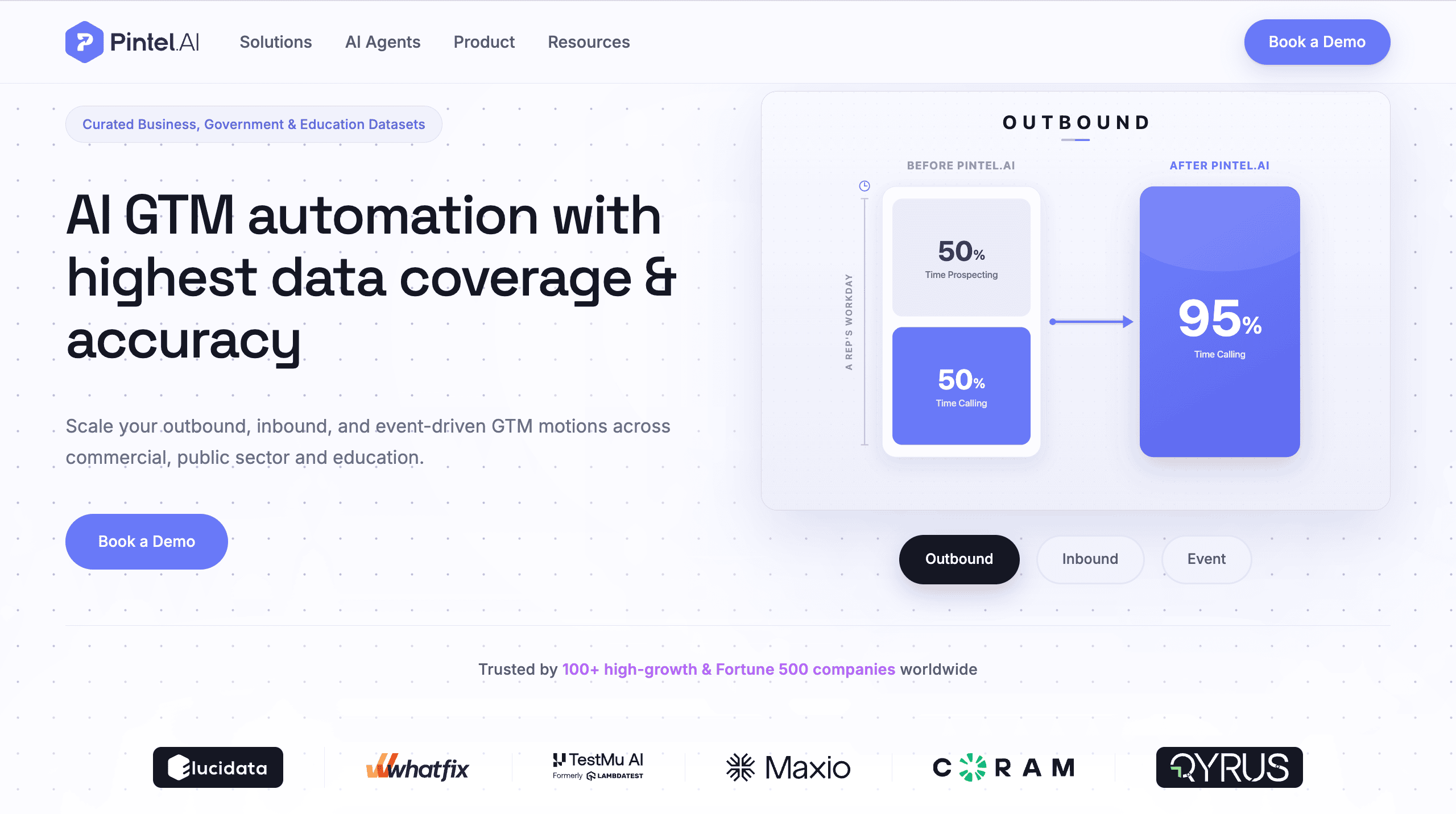
Pintel.ai helps outbound teams identify ICP-fit accounts showing meaningful buying signals and turn those signals into actionable prospecting.
Instead of relying on a single intent source, Pintel combines multiple types of signals, including funding events, hiring activity, leadership changes, technology changes, recent LinkedIn activity, website activity, and other company and prospect-level signals.
Teams can use these signals to identify accounts worth prioritizing, find the relevant decision-makers, enrich their contact data, and create personalized outreach from the same workflow.
Key Features
- Multi-source buying signals: Track signals including funding, hiring, leadership changes, website activity, LinkedIn activity, technology changes, and other company and prospect-level events.
- Company scoring: Score and prioritize companies based on ICP fit and the strength and relevance of their buying signals.
- Decision-maker scoring: Identify and score relevant decision-makers within high-priority accounts based on role relevance, ICP fit, and buying context.
- Verified contact enrichment: Enrich only the decision-makers you identify as relevant with work emails, phone numbers, LinkedIn profiles, and other contact data, helping avoid wasting credits on irrelevant contacts.
- Full LinkedIn profile analysis: Use work history, current responsibilities, and profile context to identify relevant prospects instead of relying only on job titles.
- Multi-source waterfall enrichment: Enrich decision-makers through 30+ data providers to improve contact coverage.
- Buying signal enrichment API: Add buying signals to companies or contacts already in your CRM or existing database.
- Signal-based personalized messaging: Turn buying signals and prospect context into personalized emails, LinkedIn messages, and sales talk tracks.
Limitations
- Newer platform with less market tenure than established providers such as 6sense, Bombora, and Demandbase.
Pricing
Quote-based. Contact Pintel.ai’s data intelligence team for pricing.
Suited for: Teams that want to move from buying signal → company scoring → decision-maker scoring → verified contact enrichment → personalized outreach in one GTM workflow.
6sense: AI Account Engagement Scoring, Not Suited for Contact Delivery
6sense scores accounts by their likelihood to be in an active buying cycle, combining third-party content consumption, first-party web activity, and predictive modeling to assign buying stage labels. It is built for enterprise marketing and sales teams that already maintain a separate contact database.
Key Features
- AI-driven account scoring that assigns buying stage labels (awareness, consideration, decision) based on behavioral signals across multiple source types
- De-anonymizes website traffic to identify companies visiting your site by domain and IP resolution
- Integrates with Salesforce, HubSpot, and major sales engagement platforms for direct signal routing to rep queues
- Intent signal data drawn from a network of B2B publisher and behavioral sources
- Account-level engagement maps showing signal activity by persona and department
Limitations
- Does not deliver contact data natively; 6sense surfaces in-window accounts, but finding the right contact at each account requires a separate database or enrichment tool
- Enterprise pricing structure makes the platform cost-prohibitive for mid-market outbound teams without a dedicated RevOps function managing the implementation
For teams with an existing contact database, 6sense fills the account prioritization layer well. Teams that need both signals and contacts in one workflow end up managing two separate platforms.
Pricing
Quote-based. Pricing is enterprise-tier and varies by seat count, intent data volume, and platform modules selected.
Suited for: Enterprise ABM and marketing ops teams with an existing contact database who need AI-powered account prioritization.
Bombora: B2B Content Consumption Intent Network, Not Suited for Real-Time Structural Triggers
Bombora aggregates content consumption signals from a cooperative of 5,000+ B2B media publishers, making it one of the most widely used third-party intent networks in B2B. Sales intelligence platforms including Cognism and Demandbase commonly integrate Bombora as their underlying signal feed.
Key Features
- Surge scores measure content consumption spikes relative to each company’s historical baseline, reducing noise from general browsing
- Topic library covers thousands of B2B intent topics across technology, services, and vertical categories
- Integrates natively with ZoomInfo, Salesforce, HubSpot, Marketo, and other major CRM and MAP platforms
- Company-level intent signal suited for account-based strategies rather than individual contact targeting
- Available directly and through reseller partnerships embedded in other B2B platforms
Limitations
- Signals reflect content consumption behavior only, a single signal type; no structural signals such as funding events, hiring spikes, tech changes, or leadership transitions are included in the native feed
- Data is aggregated and refreshed weekly; by the time a batch delivers, faster-moving competitors acting on structural signals may already be in conversation with the same accounts
Teams relying on Bombora as a standalone intent feed face a structural timing disadvantage against teams using real-time structural signals. Addressing this requires a second platform.
Pricing
Quote-based. Mostly accessed through partner platform integrations; pricing varies by topic volume and integration partner.
Suited for: RevOps and marketing teams using content consumption signals as an input to existing ABM account scoring models.
Demandbase: ABM Platform with Intent Layer, Not Suited for Standalone Signal Feeds
Demandbase combines intent data, advertising targeting, and CRM engagement tracking in a single ABM workflow. Its intent signals are embedded within the platform rather than offered as a separable feed for outbound teams.
Key Features
- Account identification and intent data combined with account-targeted advertising in one platform
- Qualification scoring using intent data, firmographic fit, and CRM engagement history
- Account-level journey tracking from first intent signal to closed opportunity
- Integrations with Salesforce, HubSpot, Marketo, and major sales engagement tools
- Intent-based account segmentation for personalized ad creative and sales messaging in coordinated plays
Limitations
- The intent signal layer is not separable from the ABM suite; teams looking for a pure intent data feed to trigger outbound sequences pay for advertising and marketing automation modules they may not need
- Implementation and onboarding require significant setup time; teams typically need months rather than weeks before the platform delivers consistent pipeline impact
For outbound teams needing only a signal feed, Demandbase introduces more platform complexity than the use case requires. The ABM suite earns its cost for coordinated plays across marketing, advertising, and sales.
Pricing
Quote-based. Pricing covers the full ABM platform, not the intent layer in isolation.
Suited for: Enterprise teams building a full ABM motion that integrates intent-based advertising with coordinated outbound sequences.
G2 Buyer Intent: Review-Site Purchase Signals, Not Suited for Coverage Outside G2
G2 Buyer Intent identifies companies researching your category, competitors, or comparison pages on G2. It delivers account-level signals for companies at a late-stage evaluation point based on where they spend time on the platform.
Key Features
- Captures intent signals from companies viewing category pages, competitor listings, and comparison reports on G2
- Segments by signal type: companies viewing your own G2 profile versus companies viewing competitor pages only
- Integrates with Salesforce and HubSpot for direct CRM routing of in-window accounts
- Available as part of G2’s paid plans for companies with G2 profiles in relevant software categories
- Late-stage signal quality: companies actively on G2 are evaluating software, not passively browsing
Limitations
- Coverage is entirely limited to companies that use G2 for software research; accounts that evaluate software through internal procurement processes, analyst briefings, or peer networks produce no signal in G2 Buyer Intent
- Signal data is account-level only and does not include contact delivery, requiring a separate step to identify the right person at each flagged account
G2 Buyer Intent captures high-quality signals for accounts using G2, but provides no visibility into ICP accounts that bypass it entirely. Teams targeting manufacturing, government, healthcare, or education will see thin coverage relative to their total addressable market.
Pricing
Available within G2’s paid plans; pricing varies by tier and buyer intent credits per month.
Suited for: SaaS companies with an active G2 presence whose buyers use G2 during software evaluation.
TechTarget Priority Engine: IT Content Intent, Not Suited for Non-TechTarget Audiences
TechTarget Priority Engine delivers intent signals from content consumption across its portfolio of IT editorial properties. It offers person-level signals for IT decision-makers, not just company-level, across enterprise technology categories.
Key Features
- Intent signals sourced from TechTarget’s portfolio of IT media properties, including TechRepublic, SearchSecurity, and similar enterprise IT publications
- Person-level intent data identifying specific IT professionals consuming content, not just the company they work for
- Segment signals by technology topic, buyer persona, and purchase stage for targeted outreach prioritization
- Option to pair intent data with TechTarget advertising for integrated reach programs alongside outbound sequences
- Covers enterprise IT categories including cloud infrastructure, cybersecurity, networking, and enterprise software
Limitations
- Intent coverage is limited to buyers who read TechTarget editorial properties; IT decision-makers who consume content through LinkedIn, vendor direct, analyst reports, or peer networks produce no signal in Priority Engine
- Coverage skews toward enterprise IT buyers; mid-market, non-tech vertical, and international ICPs face thinner signal coverage
The platform works for ICPs that actively read TechTarget publications, more common in enterprise IT than in mid-market or non-tech verticals. Teams whose ICP consumes content through LinkedIn or vendor-direct channels will find limited signal coverage.
Pricing
Quote-based; tied to topic volume, persona targeting depth, and any bundled advertising programs.
Suited for: Enterprise tech vendors targeting IT decision-makers who actively read TechTarget publications during evaluation.
Clearbit (HubSpot Breeze Intelligence): First-Party Site Identification, Not Suited for Outbound Signal Discovery
Clearbit, now HubSpot Breeze Intelligence, identifies companies visiting your website by resolving anonymous traffic to company domains and enriching records with firmographic data. It is a first-party tool: it tells you which companies are already looking at you, not who is in the market and has not found you yet.
Key Features
- De-anonymizes website visitors by matching IP and domain signals to company records in near-real-time
- Enriches identified companies with firmographic data, employee count, technology stack, and industry classification
- Direct integration into HubSpot for automatic lead creation, scoring, and routing to sales queues
- Tracks repeat visit behavior and page-level engagement for qualification signals within sessions
- Includes an enrichment API for filling missing fields on existing CRM contact records
Limitations
- Coverage is limited to companies that visit your website; the platform has no visibility into accounts showing structural buying signals that have not yet engaged with your site
- Tight integration with HubSpot means teams using Salesforce or other CRMs as their primary system lose much of the automated routing and scoring functionality
For outbound teams targeting in-window accounts that have not found you yet, Clearbit delivers no signal. The first-party model answers who visited your site, not who is in the market and does not know you yet.
Pricing
Integrated into HubSpot’s paid plans; Breeze Intelligence credits are included at certain tiers with no standalone pricing outside HubSpot.
Suited for: Inbound-led HubSpot teams who need to identify and prioritize high-intent website visitors for follow-up.
ZoomInfo: Sales Intelligence Platform with Intent Add-On, Not Suited as a Standalone Intent Feed
ZoomInfo offers intent data as a feature layer within its core sales intelligence platform. Streaming Intent and Scoops layer behavioral and structural alerts onto the contact database, helping subscribers prioritize outreach within tracked accounts.
Key Features
- Streaming Intent delivers alerts when accounts in your CRM or watch lists consume content matching your keyword topics across ZoomInfo’s intent partner network
- Scoops surface company news signals including leadership changes, expansions, and technology installations relevant to outbound timing
- Intent data integrated directly into ZoomInfo’s contact search, allowing intent-filtered prospect lists without switching between platforms
- Integrates with Salesforce, HubSpot, Salesloft, and Outreach for signal routing into existing workflows
- Contact delivery alongside intent signals avoids the separate enrichment step required by standalone intent platforms
Limitations
- Intent is a paid add-on to the ZoomInfo subscription rather than a standalone product; teams that do not need ZoomInfo’s core contact database pay for more capability than the intent use case alone requires
- The depth of structural signal triangulation combining funding, hiring, tech, and leadership signals in a single alert is thinner compared to platforms where buying signal intelligence is the primary product
For teams already in the ZoomInfo ecosystem, the intent add-on layers signals onto existing workflows without a new vendor. For teams whose gap is multi-signal triangulation, the signal depth may not match what the Four-Signal Stack requires.
Pricing
Intent data is a paid add-on; overall pricing is quote-based and varies by contract tier and volume.
Suited for: ZoomInfo subscribers who want a basic intent signal layer on top of their existing contact search workflow.
Apollo.io: Sales Engagement Platform with Basic Intent Signals, Not Suited for Deep Signal Coverage
Apollo.io is primarily a sales prospecting and engagement platform that includes basic intent signal functionality at higher plan tiers. Its intent data is a secondary feature within a platform built around contact database search and automated outreach sequences.
Key Features
- Contact and company database with records searchable by firmographic and technographic criteria including industry, employee count, and tech stack
- Basic intent signals available at paid tiers, drawing on third-party intent data sources for category-level signals
- Native sequencing and email automation built into the same platform as the contact database
- Job change alerts for tracking when known contacts move to new companies, generating a warm outreach trigger
- Integrations with Salesforce, HubSpot, and major sales engagement tools
Limitations
- Intent data is not a core product investment; signal variety and depth are limited compared to dedicated intent data providers, and structural signals such as funding events and tech migrations are not natively triangulated into a combined alert
- Contact data accuracy for EMEA and APAC ICPs is thinner than for US accounts, which reduces the quality of intent-to-contact workflows for teams with global outbound motions
Apollo.io bundles contacts, sequencing, and basic intent signals for teams consolidating tools rather than building the deepest signal stack. For teams that need multi-signal confirmation to reach accounts at the right moment, the intent layer is unlikely to differentiate.
Pricing
From $49/month for paid plans. Intent signals are available at higher tiers; the free plan includes limited credits with no intent data access.
Suited for: SMB and mid-market teams wanting contact data, sequencing, and basic intent signals in one platform.
Cognism: GDPR-Compliant Sales Intelligence with Bombora Intent Add-On
Cognism is a sales intelligence platform known for verified European and UK contact data, mobile number coverage, and GDPR compliance documentation. Its intent data layer is powered by Bombora’s third-party content consumption signals, available as an add-on to the core contact platform.
Key Features
- Verified mobile phone numbers with cell-phone-verified status (Diamond Data program) for EU and UK contacts
- GDPR consent documentation and do-not-call list checking for European outbound compliance
- Bombora intent signal integration available as an add-on, surfacing accounts consuming content in your product category
- Integrates with Salesforce, HubSpot, Outreach, and Salesloft for direct CRM and sequencing workflow connections
- Intent-filtered search allowing contact exports from accounts showing active category interest within the Cognism interface
Limitations
- Intent data is a third-party add-on (Bombora) rather than a native Cognism signal engine; signal variety is limited to content consumption, with no structural signals triangulated natively
- Coverage for North America, APAC, and emerging markets is thinner than for EU and UK, making Cognism less suited for global ICPs where both intent signals and verified contacts are needed outside Europe
Cognism’s intent layer delivers what Bombora delivers: content consumption signals for EU-based teams in a research identification phase. For teams targeting accounts outside Europe or needing structural signal triangulation, a different intent layer is required.
Pricing
Quote-based. Bombora intent data is a paid add-on; pricing varies by contact volume and plan tier.
Suited for: EU-focused outbound teams on Cognism who want to add a basic content consumption intent layer without switching platforms.
What Should You Look for in an Intent Data Provider?
Not all intent data providers collect the same types of signals. When comparing platforms, look at the following:
Types of Buying Signals
Check which signals the platform tracks. This may include content consumption, website activity, funding, hiring, leadership changes, technology changes, and other company events.
The right signals depend on your product and ICP.
Signal Sources
Understand where the data comes from. Some platforms focus primarily on third-party intent data, while others combine first-party activity, company events, and other data sources.
Using multiple sources can give teams more context when prioritizing accounts.
ICP and Account Matching
Intent signals are more useful when you can apply them to companies that already match your ICP.
Look for a platform that helps you filter or prioritize accounts based on criteria relevant to your target market, rather than working from a broad list of companies showing general interest.
Contact and Decision-Maker Data
A signal is more actionable when you can quickly identify the relevant people at that company.
Check whether the platform helps you find and enrich decision-makers or whether you need a separate tool for contact data and prospect research.
Signal Freshness
Some signals become less useful over time. Check how frequently the platform updates its data and how quickly new events become available.
This is particularly important if your outreach strategy depends on recent company or leadership changes.
Signal Context
Look beyond the number of signals a platform tracks. The important question is whether the platform provides enough context to understand why a company is being prioritized and how that information can be used in outreach.
Coverage for Your ICP
Evaluate the platform based on the companies, industries, roles, and regions you actually target.
How to Choose an Intent Data Provider for Your Team
Choose based on the gap in your current GTM workflow.
If You Need to Know When to Reach Out
Choose a multi-signal intent platform that helps prioritize accounts based on buying signals such as funding, hiring, leadership changes, and other relevant activity. If you also need decision-maker data, look for a platform with built-in contact delivery.
If You Need to Identify Anonymous Website Visitors
Choose a first-party intent platform that identifies companies visiting your website before they fill out a form. This works best for prioritizing inbound interest rather than finding new accounts for outbound.
If You Need to Prioritize an Existing Account List
Choose an account scoring platform that ranks your target accounts based on buying signals and engagement. You may need a separate tool for finding and enriching decision-makers.
If You Need Contact Data Alongside Basic Intent
Choose a contact data platform with intent capabilities if your primary need is finding compliant, verified contacts while adding an extra layer of buying context.
Before choosing a provider, compare signal coverage, data freshness, contact availability, ICP coverage, and pricing.
Final Takeaway: What Separates Useful Intent Data from Signal Noise
The platforms that move pipeline give outbound teams a defensible reason to reach out at a specific moment, not a list of companies that read something adjacent to your category. That defensible reason comes from signal overlap: a funding event, a hiring spike in the buying role, a tech stack change, and a leadership transition in the same account at the same time. Most platforms in this list cover one or two of those signals well.
Pintel.ai’s data intelligence platform tracks all four structural signals alongside ICP-filtered contact delivery, compressing the intent-to-sequence workflow into a single step rather than a multi-tool assembly. For teams evaluating intent data providers in 2026, the starting point is not which platform has the most signal sources. It is which platform surfaces the Four-Signal Stack for your specific ICP, delivers the right contact, and does so before competitors act on the same data.
Frequently Asked Questions
What intent signals should I look for when prioritizing outbound accounts?
Look for signals relevant to your product and ICP, such as content research, website activity, funding, hiring, leadership changes, technology changes, and recent decision-maker activity. Multiple relevant signals can provide stronger context than relying on a single signal.
Can intent data identify the right decision-makers to contact?
Not always. Many intent providers identify the company showing interest but require a separate tool to find and enrich the relevant decision-makers. If outbound execution is the goal, check whether the provider also supports contact discovery and enrichment.
How can I use intent data with an existing account list?
You can layer buying signals onto your existing target accounts or CRM records to identify which accounts should be prioritized. This helps sales teams focus on accounts showing relevant activity instead of working through the entire list equally.
Is one buying signal enough to prioritize an account?
Not necessarily. A single signal may indicate research or a change within the company without confirming buying intent. Combining ICP fit with multiple relevant signals can provide stronger context for prioritization.
What should I check before choosing an intent data provider?
Compare the types of signals available, signal freshness, ICP coverage, account prioritization, decision-maker discovery, contact enrichment, and CRM or workflow integration.
I think 5 FAQs are enough for this blog. These address actual evaluation and implementation questions without repeating the basic “What is intent data?” content already covered in the article.