Teams often choose a B2B data tool because it solves the problem they’re trying to fix today, whether that’s finding verified contacts, enriching CRM records, or identifying buying signals. The gaps usually appear later, when the same platform is expected to support broader prospecting, account research, or expansion into new markets.
Most B2B data providers are strong in one layer and thin in the rest. This guide scores 10 B2B data providers using the Five-Layer Coverage Scorecard: account data, contact data, signal data, enrichment, and non-traditional sources, so you can see exactly where each one breaks before you sign a contract.
What Are B2B Data Providers?
B2B data providers are platforms that supply structured business information, company details, contact records, buying signals, and enrichment, to help sales teams find and reach the right buyers. Most cover two or three of these layers well and leave the rest uncovered.
The tools below differ mainly in which layers they actually cover, not just how large their database is.
10 Best B2B Data Providers: The Five-Layer Coverage Scorecard
Every provider below is scored across the five data layers a complete outbound stack needs. Pintel.ai leads because it is the only platform here that does not split this work across a second contract.
| Provider | Account Data | Contact Data | Signal / Intent | Enrichment | Non-Traditional | Best For |
|---|---|---|---|---|---|---|
| Pintel.ai | Yes | Yes, waterfall verified | Yes, structural + contextual + behavioral | Yes, 30+ providers | Yes, government, schools, local business | Global teams needing all five layers in one contract |
| ZoomInfo | Yes, US-strong | Yes, US-strong | Partial, via Bombora (3rd-party) | No dedicated layer | No | US enterprise teams already on Salesforce/HubSpot |
| Apollo.io | Partial, basic filters | Yes, US-focused | Partial, job-change alerts only | No dedicated layer | No | SMB teams wanting database plus sequencing |
| Clay | No proprietary source | No proprietary source | No proprietary source | Yes, orchestrates 50+ providers | No | Teams building custom enrichment recipes |
| Cognism | Partial, EU-focused | Yes, EU-strong | Partial, job-change alerts only | No dedicated layer | No | European teams needing GDPR-compliant mobiles |
| Lusha | No | Yes, APAC-strong | Partial, job-change alerts only | No dedicated layer | No | APAC-focused SDRs doing quick lookups |
| D&B Hoovers | Yes, deep firmographic | Partial, thinner senior contacts | Partial, add-on module | No dedicated layer | No | Teams needing firmographic and credit data depth |
| 6sense | Partial, ABM account lists only | No | Yes, deep intent modeling | No dedicated layer | No | Enterprise ABM teams timing outreach to intent |
| Bombora | No | No | Yes, third-party topic data only | No | No | Teams layering intent data onto an existing database |
| Clearbit | Yes, company enrichment | Partial, weaker outbound coverage | Partial, website visitor data | Yes, inbound-focused | No | HubSpot users enriching inbound leads |
This comparison is based on first-hand platform knowledge, publicly available product information, and commonly reported user experiences. Contact each vendor directly for the latest pricing and product details.
The table shows that most providers specialize in one or two layers. The next step is understanding which layers matter most for your team.
How to Choose a B2B Data Provider
The right choice depends on which layers your current stack is missing, not on database size or brand recognition. Most teams already have ICP contact data covered. The gap is almost always signal, enrichment, or non-traditional coverage, the layers that determine whether a target account list actually converts.
What Data Layers Should B2B Data Providers Cover?
A complete B2B data provider covers five layers: account data for finding the right companies, contact data for finding the right people, signal data for timing outreach, enrichment for keeping records current, and non-traditional sources for verticals standard databases miss. The shortfall rarely shows up at signup. It surfaces the first time a signal or enrichment need hits and the contract has no answer for it.
How We Tested and Evaluated These Providers
Each provider was checked against a shared sample of B2B accounts spanning US, EMEA, and APAC ICPs, using live product pages, published documentation, vendor-listed pricing current as of July 2026, and hands-on testing where trial access or sample exports were available. This approach helped validate product capabilities beyond vendor marketing claims while applying the same evaluation framework across every provider.
Every provider was then scored using the Five Layer Coverage Scorecard based on the following criteria:
- Account data coverage: Firmographic and technographic filtering for building target account lists.
- Contact data accuracy: Verified emails, phone numbers, and the methods used to validate records.
- Signal and intent depth: Whether buying signals are proprietary or licensed from third party providers.
- Enrichment model: Single source lookups versus multi source waterfall verification.
- Non-traditional sources: Coverage for government, education, healthcare, local businesses, and other datasets that fall outside traditional B2B databases.
We excluded single purpose tools with no account or contact data layer, along with providers whose pricing is not publicly available or cannot be quoted to prospective buyers. According to Salesforce’s State of Sales research, data quality remains one of the most consistently cited barriers to outbound performance, which is exactly what an incomplete data coverage strategy creates.
The 10 Best B2B Data Providers Reviewed
Let’s dive deeper into each B2B data provider so you can evaluate which one best fits your team’s needs.
1. Pintel.ai: Full Five-Layer Coverage in One Contract
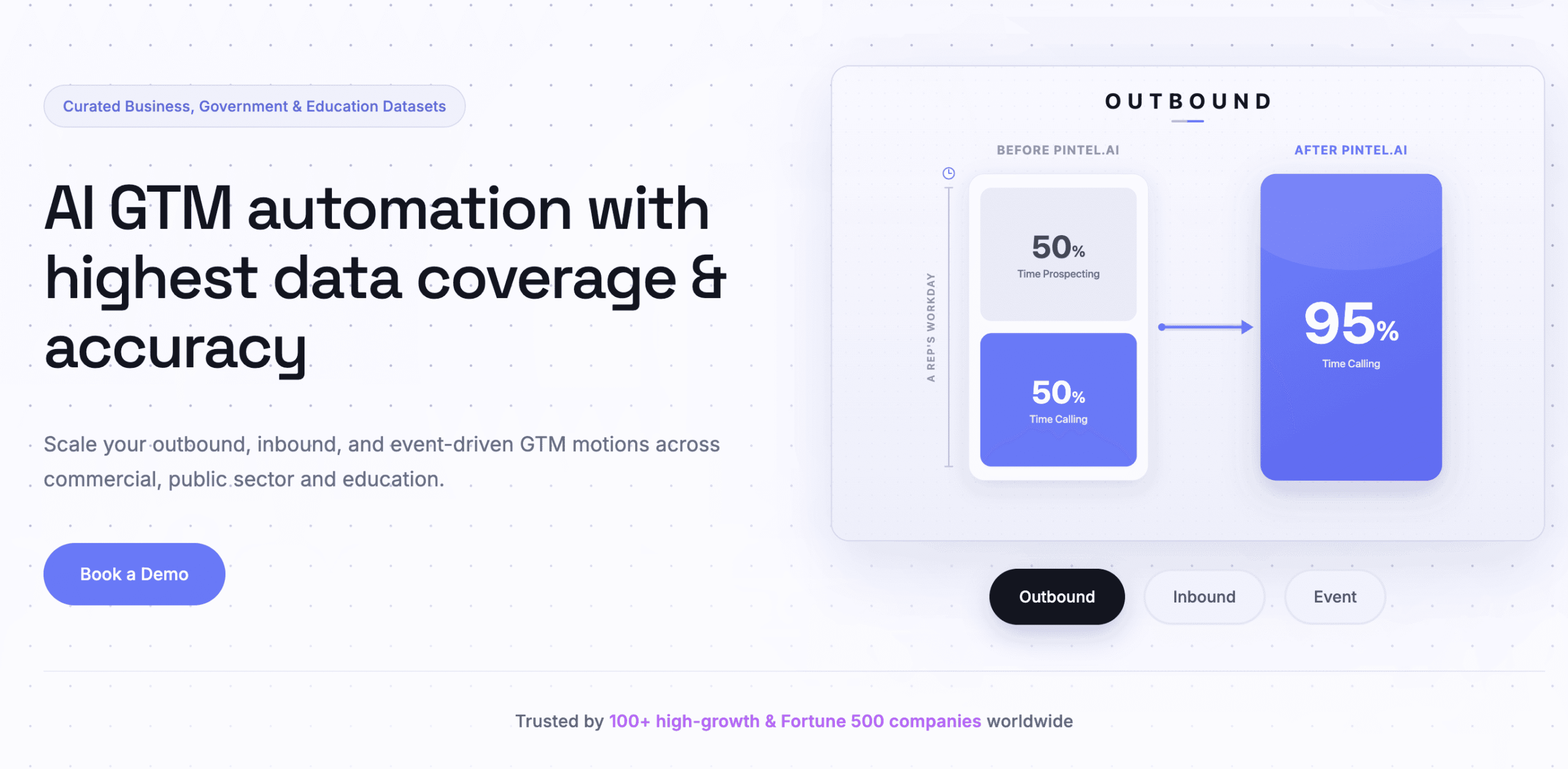
Pintel.ai is a B2B data provider that brings together company data, contact data, buying signals, data enrichment, and non-traditional data sources in one platform. Instead of using separate tools for each job, sales and GTM teams can find, enrich, and prioritize companies from a single place.
Company and Contact Data
- Identify the companies that best match your target market, helping sales teams spend less time on poor fit prospects.
- Find verified decision makers and enrich company and contact data through a waterfall of more than 30 data providers, helping you get more complete and up-to-date information.
Buying Signals
- Identify companies that are more likely to be ready to buy based on signals such as funding rounds, leadership changes, hiring growth, technology changes, and company expansion.
- Combine these signals with website visits, content engagement, and research activity to help your sales team reach companies at the right time.
Non-Traditional Data
- Find companies and organizations that many traditional B2B databases miss, including government agencies, schools, healthcare organizations, manufacturers, and local businesses.
- Reach industries that are difficult to cover with standard business databases.
Security and Compliance
Pintel.ai meets enterprise security and compliance requirements, including ISO 27001, SOC 2, GDPR, HIPAA, CCPA, and VAPT certification.
Strengths
- Covers company data, contact data, buying signals, enrichment, and non-traditional data in one platform.
- Uses a waterfall of more than 30 data providers to improve data quality and coverage.
- Supports global prospecting across commercial businesses, government, education, healthcare, and other industries.
- Helps sales teams find the right companies, the right people, and the best time to reach out.
Limitations
- Custom pricing may not be the best fit for teams that only need a basic contact database.
Pricing: Custom pricing. Contact sales.
Best for: Sales, RevOps, and GTM teams that want company data, contact data, buying signals, and enrichment in one platform without managing multiple tools.
2. ZoomInfo: Strong for US Contact and Account Data, Weak on Proprietary Signals
ZoomInfo builds a large US-focused account and contact database through community contribution, but its intent layer runs on Bombora, a licensed third-party source, not proprietary signal tracking, and it has no non-traditional data layer. Teams evaluating a switch can see the fuller picture in the ZoomInfo alternatives comparison.
- Strengths: strong US contact and account coverage; native Salesforce and HubSpot integrations; org chart mapping for enterprise accounts.
- Limitations: EMEA and APAC coverage weakens noticeably; signal data is licensed, not proprietary.
Pricing: $15,000+/yr, custom.
Best for: US enterprise teams with an established Salesforce or HubSpot stack.
3. Apollo.io: Strong for Bundled Database and Sequencing, Weak on Signal Depth
Apollo.io bundles account and contact data with sequencing in one accessible platform, but its signal layer is limited to basic job-change alerts, and neither enrichment nor non-traditional sourcing exist as dedicated layers.
- Strengths: database and sequencing in one tool; SMB-friendly pricing and fast setup.
- Limitations: accuracy is inconsistent outside North American tech accounts; no proprietary signal or enrichment layer.
Pricing: From $49/mo.
Best for: SMB teams that want a combined database and sequencing tool at low cost.
4. Clay: Strong for Custom Enrichment Recipes, Weak on Proprietary Data
Clay orchestrates enrichment across 50 or more third-party providers through a visual workflow builder, but it holds no proprietary account, contact, or signal database of its own, so its output is only as reliable as the providers plugged into each recipe.
- Strengths: flexible recipe-based orchestration; strong reputation among growth and outbound teams.
- Limitations: no proprietary data source; requires build time to configure recipes before it delivers value.
Pricing: From $185/mo, up to $495/mo, enterprise custom.
Best for: Teams with technical resources to build and maintain custom enrichment workflows.
5. Cognism: Strong for European Contact Coverage, Weak Outside Europe
Cognism provides GDPR-compliant, human-verified mobile numbers for UK and Western European contacts, but its account and signal layers are thin, and coverage outside Europe drops sharply.
- Strengths: GDPR-compliant sourcing built in; strong UK, DACH, and Nordics mobile coverage.
- Limitations: weak US and APAC coverage; signals limited to basic job-change alerts.
Pricing: Custom, commonly cited from $1,500+/mo.
Best for: European outbound teams where GDPR compliance is a hard requirement.
6. Lusha: Strong for Quick APAC Contact Lookups, Weak on Every Other Layer
Lusha gives fast contact lookups with strong APAC coverage through its LinkedIn-connected Chrome extension, but it functions as a lookup tool rather than a full data provider, with no account, signal, or enrichment layer.
- Strengths: strong APAC contact coverage; low-friction Chrome extension for quick exports.
- Limitations: no account discovery or signal layer; coverage drops outside LinkedIn-active professionals.
Pricing: From $29/mo.
Best for: APAC-focused SDRs who already know who they are contacting.
7. D&B Hoovers: Strong for Firmographic Depth, Weak on Contact and Signal Layers
D&B Hoovers draws on Dun & Bradstreet’s decades of business registry data for firmographic and credit-risk depth few competitors match, but senior-level contact coverage is thinner than dedicated contact providers, and signal data exists only as a paid add-on module.
- Strengths: deep firmographic and financial data on established companies; long-tenured business registry sourcing.
- Limitations: senior contact coverage is thinner than contact-first providers; intent signals are a separate paid module, not built in.
Pricing: Essentials from $49/mo; enterprise tiers from $25,000+/yr.
Best for: Teams that need company-level financial and firmographic depth first.
8. 6sense: Strong for Enterprise Intent Modeling, Weak on Raw Contact Data
6sense builds a proprietary intent model that predicts which accounts are in an active buying stage with real depth, but it returns almost no usable contact-level data, so teams still need a separate intent data provider pairing or a contact tool to act on what it surfaces.
- Strengths: deep, proprietary intent modeling for account-level buying stage prediction; strong ABM workflow tooling.
- Limitations: minimal contact-level data; enterprise pricing puts it out of reach for smaller teams.
Pricing: Custom, commonly cited from $25,000 to $120,000+/yr.
Best for: Enterprise ABM teams that already have a contact provider and need intent timing on top.
9. Bombora: Strong for Licensed Intent Data, Weak as a Standalone Provider
Bombora supplies third-party topic-research intent data licensed into other platforms like ZoomInfo, but on its own it has no account, contact, or enrichment layer at all, so it only adds value layered onto a data provider you already have.
- Strengths: broad publisher network for topic-research intent signals; widely licensed across other platforms.
- Limitations: zero account or contact data; not usable as a standalone provider.
Pricing: Custom, commonly cited from $25,000+/yr.
Best for: Teams layering third-party intent data onto an existing contact database.
10. Clearbit: Strong for Inbound Enrichment, Weak for Outbound List-Building
Clearbit, now part of HubSpot, enriches inbound leads and website visitors with strong company-level data, but it was not built for outbound prospecting and returns thin results when used to build a cold contact list from scratch.
- Strengths: strong company-level enrichment for inbound leads; native HubSpot integration.
- Limitations: weak standalone contact-finding for outbound; not designed for cold list-building.
Pricing: Custom via HubSpot.
Best for: HubSpot users enriching inbound leads, not building outbound lists from scratch.
The Five-Layer Coverage Scorecard: How to Audit Any B2B Data Provider Before You Buy
The Five-Layer Coverage Scorecard scores a B2B data provider across account, contact, signal, enrichment, and non-traditional data, so a buyer sees the real gaps before signing. A provider strong in two layers is not broken. It is only half finished. Most vendor demos show off the layer they are strongest in and stay quiet about the rest.
Run this check on any provider you are evaluating. Pull a sample of 25 to 50 accounts from your actual target market, then score the provider honestly on each of the five layers rather than accepting the vendor’s own claims.
Account layer: Does it return the right companies for your specific sub-industry, not just a broad industry code? Contact layer: Are records verified through more than one source, or pulled once and left to decay? Signal layer: Is the intent data proprietary, or licensed from the same third party every competitor also uses?
Enrichment layer: Does the provider re-verify records on a schedule, or only at the moment of first export? Non-traditional layer: If your ICP touches public sector, education, or local business, does the provider return anything at all outside LinkedIn and standard directories?
A provider that scores well on two or three layers is not a bad tool. It only solves part of the problem. Teams that mistake that for a finished stack are the ones adding a second or third contract a year later to close gaps this scorecard would have caught on day one.
Final Takeaway: Picking a B2B Data Provider That Covers the Whole Stack
The best B2B data provider for your team is not the one with the largest advertised database. It is the one that scores well across the layers your specific outbound motion actually depends on.
Run the Five-Layer Coverage Scorecard against your current provider before renewing anything. Renewing a contract before running the scorecard means renewing blind faith, not renewing coverage. Most teams discover they are paying full price for contact data alone, while account discovery, signal timing, and non-traditional coverage sit uncovered.
For teams that would rather cover all five layers under one contract than manage three vendors and three invoices, that gap is exactly where a full-stack platform earns its place in the stack.
See exactly which B2B data layers your current provider is missing
Pintel.ai covers all five B2B data layers, account, contact, signal, enrichment, and non-traditional sources, in one platform, so GTM teams stop patching coverage gaps with a second or third vendor.Book a demo
FAQ: B2B Data Providers
What Are B2B Data Providers?
B2B data providers are platforms that supply structured business information, company details, contact records, buying signals, and enrichment, to help sales teams find and reach the right buyers. Most cover two or three of these layers well and leave the rest as a gap.
What Is the Difference Between B2B Data Providers and B2B Contact Data Providers?
B2B contact data providers focus narrowly on verified emails and phone numbers. Full-stack B2B data providers add account discovery, signal timing, and enrichment on top of that same contact layer in one platform.
How Many B2B Data Providers Does a Sales Team Actually Need?
Most teams end up with two to four separate B2B data providers to cover account, contact, signal, and enrichment layers, unless they choose a single platform built to cover all five layers without a second contract.
Do B2B Data Providers Cover Signal and Intent Data, or Just Contacts?
Most B2B contact data providers license third-party intent data, commonly from Bombora, rather than tracking proprietary signals. Full-stack providers combine structural, contextual, and behavioral signals directly with contact records.
How Much Do B2B Data Providers Cost?
Pricing ranges from around $29 a month for lightweight contact lookup tools to $25,000 or more a year for enterprise account, signal, or full-stack platforms. Cost usually scales with how many of the five data layers a provider covers.
What Is the Five-Layer Coverage Scorecard?
The Five-Layer Coverage Scorecard is a framework that scores any B2B data provider across account, contact, signal, enrichment, and non-traditional data, the five layers a complete outbound stack needs.
Which B2B Data Provider Covers the Most Data Layers?
Pintel.ai is the only provider in this comparison covering all five data layers, account, contact, signal, enrichment, and non-traditional sources, in one contract rather than requiring separate vendors for each.
How Do I Test a B2B Data Provider Before Buying?
Pull 25 to 50 accounts from your actual target market and score the provider honestly across all five layers rather than accepting vendor claims. A match rate below 80% on your own data signals a real coverage gap.