A go-to-market strategy in B2B is the operating system that connects your ICP, revenue motion, channels, and execution infrastructure into a repeatable path to revenue. It’s not a slide deck or launch plan. It’s the system that determines which accounts enter your pipeline, how they get qualified, and whether conversion rates stay predictable or collapse under scale.
Most revenue leaders confuse their go-to-market strategy with having a sales process or a marketing plan. Your go-to-market strategy defines how market positioning, account targeting, motion design, and internal workflows work together to generate a consistent pipeline. When any component breaks or drifts, revenue becomes unpredictable.
This guide explains what a B2B go-to-market strategy actually is, why it fails in practice, and how revenue teams design, enforce, and measure GTM execution.

What a Go-To-Market Strategy Actually Means in B2B
A go-to-market strategy is the framework that answers: which accounts we target, how we reach them, what we say, and how we convert them into revenue.
GTM strategy is not marketing strategy. Marketing strategy focuses on brand positioning, demand generation, and content. GTM strategy defines the entire path from market to closed deal, including how Sales, Marketing, and RevOps execute together.
GTM strategy is also not sales strategy. Sales strategy covers territory design, quota allocation, and rep productivity. GTM strategy determines which accounts Sales should work, which motion they execute, and what infrastructure supports them.
The 6-Part B2B Go-To-Market Strategy Framework
A working B2B go-to-market strategy operates as a connected system of six components:
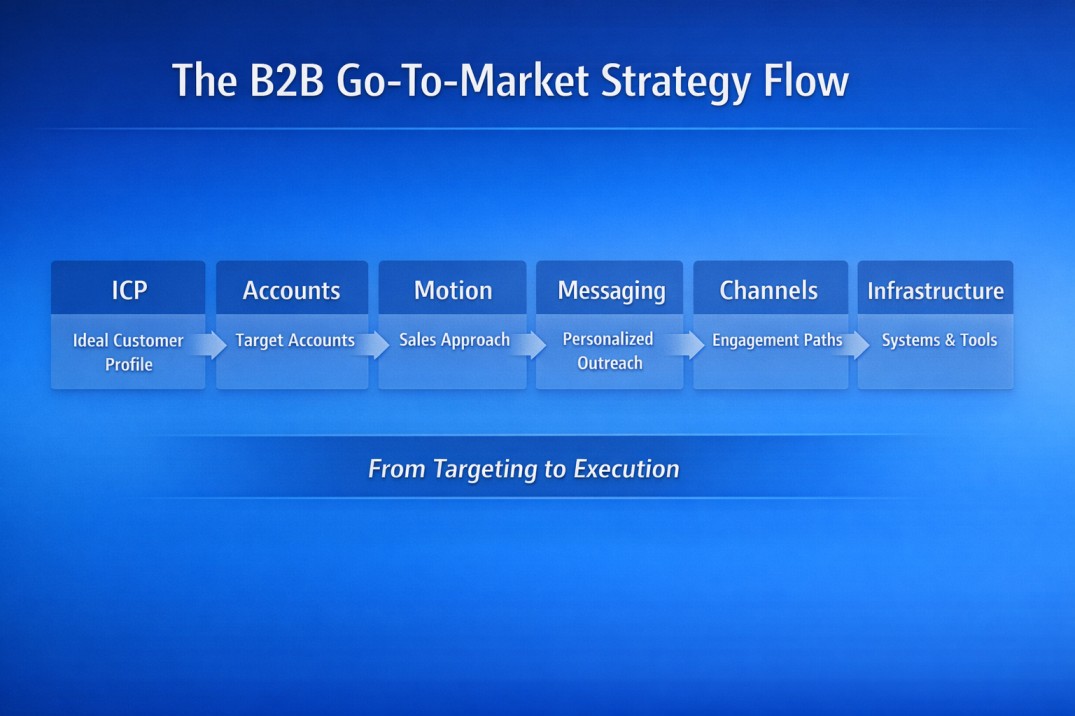
1. ICP Definition
Define the companies that belong in your pipeline, including inclusion and exclusion criteria.
2. Account Targeting & Segmentation
Identify which accounts to prioritize and how buying committees are structured.
3. Motion Selection
Choose the revenue motion that matches buyer behavior and product complexity.
4. Messaging & Positioning
Align value propositions to segment, persona, and buying stage.
5. Channels & Handoff Design
Ensure distribution channels match motion and internal workflows transfer context cleanly.
6. Data & Infrastructure Enforcement
Use CRM design, routing logic, and RevOps processes to enforce strategy consistently.
These six components must align. If one drifts, pipeline predictability declines.
Understanding what your go-to-market strategy should accomplish makes it easier to diagnose why most implementations fail in practice.
Why Most B2B GTM Strategies Fail in Practice
Most GTM strategies fail not because the plan was wrong, but because execution drifted. Here’s where GTM strategies break:
ICP Drift and Segmentation Instability
Your ICP definition was clear at launch. Six months later, Sales is chasing accounts outside the definition because “they showed interest.” Marketing is generating leads from segments that don’t convert. No one enforces the boundary, so targeting expands until it’s meaningless. Without clear enforcement, your go-to-market strategy becomes whatever individual reps decide it should be.
When accounts get categorized inconsistently—one rep calls it mid-market, another calls it enterprise—routing breaks, pricing gets misapplied, and conversion data becomes unreliable.
Misaligned Handoffs Between Marketing, Sales, and RevOps
Marketing generates MQLs based on engagement. Sales wants accounts showing intent and fit. RevOps built routing logic that doesn’t match either definition. The handoff breaks because no one agreed on what “qualified” means or when an account should enter the sales workflow.
Channel-Motion Mismatch
Your motion is outbound, but your channels are optimized for inbound response. Or you’re running ABM but measuring success with MQL volume. Channel and motion must align—when they don’t, you’re either reaching the wrong buyers or measuring the wrong outcomes.
Activity Volume Without Pipeline Movement
High email volume, high call activity, high meetings booked—but pipeline stays flat or declines. This usually happens when teams lack a clear, capacity-aware GTM plan for what actually runs each quarter. Reps hit activity quotas by working on easier accounts that don’t convert, and leadership makes mistakes to make progress.
Preventing these failure modes starts with building each component of your go-to-market strategy correctly from the beginning.

Core Components of a B2B Go-To-Market Strategy
Every effective go-to-market strategy is built on six interconnected components. Each must be defined clearly and enforced consistently.
ICP Definition & Segmentation Stability
Your ICP defines which companies belong in your pipeline. This isn’t “mid-market SaaS companies”—it’s the specific firmographic, technographic, and behavioral criteria that predict fit and conversion.
What stable ICP definition requires:
- Firmographic thresholds — employee count, revenue, industry with clear ranges
- Technographic signals — specific tools or stacks that indicate fit
- Behavioral indicators — growth signals, hiring patterns, funding events
- Exclusion criteria — what disqualifies an account, even if it matches other criteria
Account-Level Targeting & Buying Committees
B2B revenue comes from accounts, not individual leads. Lead-based GTM optimizes for contact volume and engagement. Account-based GTM optimizes for fit, buying committee coverage, and multi-threaded relationships.
That requires structured account research to understand the company context, decision-makers, priorities, and readiness before outreach begins. Your go-to-market strategy must reflect this reality by tracking engagement across entire buying committees, not just individual contacts.
Most B2B deals involve 3–7 stakeholders across multiple functions:
- Economic buyer — who controls budget and final approval
- Technical buyer — who evaluates fit and integration
- End users — who will adopt the product daily
- Influencers — who shape internal consensus
GTM Motion Selection
Your motion defines how you reach and convert accounts. Choosing the right motion is one of the most critical decisions in your go-to-market strategy:
Inbound: Buyers come to you through content, search, or word-of-mouth. Works when brand awareness is high, and buying intent is strong. Fails when you’re in a new category or targeting accounts that don’t search for solutions.
Outbound: You initiate contact with target accounts based on ICP fit and signals. Works when you have a clear ICP and specific value propositions. Fails when targeting is too broad or messaging is generic.
ABM: High-touch, coordinated engagement across multiple stakeholders in strategic accounts. Works for enterprise deals with long cycles. Fails when applied to high-volume, transactional sales.
PLG: Product adoption drives expansion and conversion. Works when the product delivers immediate value. Fails when products require implementation or change management.
Motion selection depends on market maturity, buyer behavior, product complexity, and internal execution capability.
Messaging & Positioning by Segment
Messaging is not brand voice. In a B2B go-to-market strategy, messaging is the specific value proposition, proof points, and objection handling tailored to each segment and buying stage.
A CFO cares about ROI and risk. A VP of Sales cares about quota attainment and rep productivity. The same product positioning doesn’t work for both. Your messaging must map to segment, buying stage, and buyer persona.
Channels, Distribution & Handoff Design
Channels are how you reach buyers. Handoff design is how internal teams pass accounts between stages without dropping context or momentum.
Channel selection depends on motion:
Inbound motion — SEO, paid search, content marketing, webinars
Outbound motion — cold email, LinkedIn outreach, cold calling
ABM motion — direct mail, field events, custom microsites
PLG motion — product virality, community, freemium onboarding
Critical handoffs in B2B GTM:
Marketing → SDR/BDR — what makes an account qualified to work?
SDR/BDR → AE — what context was gathered, what was promised?
AE → CS — what was sold, what does success look like?
When handoffs include context, conversion improves. When handoffs are just activity logs, reps start from scratch every time.
Building these components is only the first step. Making your go-to-market strategy operational requires clear ownership and enforcement mechanisms across your revenue organization.
Who Owns the GTM Strategy — and Who Enforces It
A go-to-market strategy isn’t owned by one function. It’s jointly owned by Sales, Marketing, and RevOps—but ownership without enforcement creates a strategy that exists only in documents.
Sales Leadership Owns Revenue Outcomes
Sales leadership defines what the revenue model requires: which segments to prioritize, what deal sizes to target, what conversion rates to expect.
Marketing Leadership Owns Market Positioning and Demand
Marketing leadership defines how the company shows up in the market, which channels generate demand, and how campaigns align with ICP and motion.
RevOps as GTM Enforcement
RevOps is the GTM enforcement layer. They ensure strategy is executed consistently by building the workflows, data models, routing logic, and reporting that make strategy operational.
What RevOps owns:
- CRM design and data infrastructure
- Lead and account routing logic
- Handoff workflows and SLAs
- GTM performance measurement
Ownership establishes accountability, but enforcement requires the right infrastructure and data foundation to execute your go-to-market strategy at scale.
GTM Strategy, Data, and Infrastructure
Your go-to-market strategy is only as strong as the infrastructure that supports it.
Data Quality and Freshness
Stale or incomplete data makes every GTM decision worse. If your firmographic data is six months old, your ICP filters are targeting companies that no longer fit. Your go-to-market strategy is only as accurate as the data that powers it.
Account vs Lead Models
Most CRMs default to lead-based data models. This works for transactional sales. It breaks for B2B go-to-market strategy, where deals involve multiple stakeholders, long cycles, and account-level qualification.
Account-based models track account-level fit, buying committee coverage, account engagement, and account lifecycle.
Routing Logic
Routing logic determines which accounts go to which reps. It must match your GTM strategy.
Routing logic should consider:
Segment match — SMB, mid-market, enterprise accounts routed appropriately
Geography — accounts assigned based on territory coverage
Industry or vertical — specialized reps handling specific industries
CRM as a System of Execution
Your CRM is not a reporting tool. It’s the system that makes your go-to-market strategy executable by enforcing qualification criteria, automating routing logic, capturing handoff context, and tracking pipeline consistently.
Signals and Account Readiness
GTM execution improves when teams distinguish between raw activity and real buying signals. Signals—such as hiring trends, tool adoption, internal initiatives, or market events—help prioritize which accounts are ready for outreach and which are not.
Once GTM is enforced through systems and data, its impact shows up immediately in pipeline behavior and revenue predictability.
With the right infrastructure in place, your go-to-market strategy directly influences pipeline quality and revenue outcomes.
How GTM Strategy Connects to Pipeline and Revenue
The strength of your go-to-market strategy determines whether pipeline converts predictably or stalls unpredictably.
Pipeline Quality and GTM Decisions
Pipeline quality isn’t volume. It’s the percentage of pipeline that converts at expected rates within expected timelines. When your go-to-market strategy is working, pipeline quality improves. When it drifts, pipeline fills with accounts that stall or never close.
Why High Activity ≠ Revenue
Activity volume—calls made, emails sent, meetings booked—feels productive. But activity without strategy produces random results. Reps target accounts that don’t match ICP but are easy to reach, messaging is generic, so response rates are low, and meetings don’t advance deals because qualification was weak.
Conversion Stability vs Volume
Conversion stability means your funnel ratios stay consistent across time and segments. When GTM strategy is strong, stage conversion rates are stable, segment performance is predictable, and forecasts are reliable.
Understanding this connection helps explain why certain GTM mistakes persist across B2B organizations despite their predictable consequences.
Common GTM Strategy Mistakes B2B Teams Keep Repeating
Even experienced revenue teams fall into recurring patterns that undermine their go-to-market strategy.
Enterprise GTM Without Enterprise Readiness
Companies declare they’re moving upmarket, rebrand their go-to-market strategy as enterprise-focused, and expect large deals to follow. But enterprise buyers require proof of scale, security, compliance, and support infrastructure.
Moving upmarket requires product, pricing, and operational changes—not just targeting adjustments.
Over-Indexing on Tools Before Fixing Strategy
Teams buy intent data, conversational AI, and account scoring platforms, hoping tools will solve GTM problems. They don’t. Tools amplify execution—good or bad. If your ICP is vague, intent data just surfaces more unqualified accounts faster.
Fix your go-to-market strategy first. Then add GTM tools that support execution workflows.
Launching New Motions Without Operational Support
Leadership decides to add outbound to an inbound motion, or launch ABM for enterprise. But no one builds the workflows, data models, or measurement frameworks the new motion requires.
What launching a new motion actually requires:
- Clear ICP and target account lists
- Segment-specific messaging and proof points
- Routing and handoff workflows
- Training on motion-specific execution
- Measuring Success by Activity Instead of Consistency
Dashboards show calls, emails, meetings booked, and MQLs generated. Leadership sees activity and assumes the GTM strategy is working.
Better metrics:
Qualification rate — percentage of engaged accounts that meet ICP criteria
Conversion stability — how consistent are stage-to-stage conversion rates?
Win rate by segment — which segments convert predictably?
Avoiding these mistakes requires ongoing measurement and the discipline to recognize when your go-to-market strategy is delivering real results versus creating the illusion of progress.
How to Tell If Your GTM Strategy Is Actually Working
Measuring go-to-market strategy effectiveness requires looking beyond surface-level activity metrics to indicators of system health.
Pipeline Consistency
Your pipeline coverage ratio should stay stable month over month. If you need 3x pipeline to hit quota, you should generate 3x pipeline every month, not 5x one month and 2x the next.
Segment-Level Conversion Stability
Each segment should convert at predictable rates. SMB might close at 30%, mid-market at 25%, enterprise at 15%. Those rates should hold quarter over quarter.
Forecast Confidence
Revenue leaders should forecast quarterly revenue within 10% accuracy based on pipeline coverage and conversion rates. If forecasts are consistently off by 20–30%, your GTM strategy isn’t producing predictable funnel performance.
Rep Productivity Quality
High-performing reps should produce results through process, not personality. If only your top 20% hit quota, your GTM strategy isn’t systematic—it’s dependent on individual skill.
Even when these indicators look healthy, certain market changes require rethinking your entire approach to go-to-market strategy.
When to Rethink or Rebuild Your GTM Strategy
Not every performance dip requires rebuilding your go-to-market strategy, but specific inflection points demand fundamental changes.
You’re Entering a New Segment
Moving from SMB to mid-market, or mid-market to enterprise, requires go-to-market strategy changes. Buyer behavior is different. Sales cycles are longer. Buying committees are larger.
You’re Launching a New Product
A new product often targets a different buyer, solves a different problem, or competes in a different category. Your existing go-to-market strategy was built for your original product—it may not fit the new one.
Growth Has Plateaued or Become Volatile
If growth flattens despite increased activity, or if revenue swings unpredictably quarter to quarter, your GTM strategy has drifted. ICP is no longer enforced, reps optimize for activity metrics, handoffs are breaking, and segments are blurry.
Recognizing these moments early prevents months of declining performance while leadership debates whether the issue is execution or strategy.
Final Take: GTM Strategy Is a Revenue System, Not a Slide Deck
A go-to-market strategy isn’t a document you write once and file away. It only works when supported by enforceable execution frameworks and plans.
It’s the operating system that connects market understanding, account targeting, motion execution, and infrastructure into predictable revenue.
Without enforcement, your go-to-market strategy drifts. Reps interpret targeting differently. Marketing and Sales optimize for conflicting goals. Within months, everyone is executing their own version of strategy, and results become random.
The companies that succeed treat go-to-market strategy as a system that requires clear ICP definition that’s enforced, stable segmentation that routing and forecasting depend on, motion alignment between how you sell and how buyers want to buy, and operational ownership through RevOps.
If you can’t clearly say which accounts deserve sales time this quarter and why, your GTM strategy isn’t operational—it’s aspirational. If your pipeline feels unpredictable, the issue isn’t effort or tooling—it’s that your go-to-market strategy isn’t enforced as a system.
FAQ
What is a go-to-market strategy in B2B?
A go-to-market strategy is the system that defines which accounts you target, how you reach them, what you say, and how you convert them into revenue. It connects ICP, motion, messaging, channels, and internal workflows into one repeatable process. Your go-to-market strategy determines whether pipeline stays consistent or becomes unpredictable as you scale.
What’s the difference between GTM strategy and sales strategy?
Sales strategy covers territory design, quota allocation, and rep productivity. A go-to-market strategy defines which accounts Sales should work, which motion they execute, and what infrastructure supports them. Sales strategy manages the team. Go-to-market strategy is the entire revenue system.
How do you know if your go-to-market strategy is working?
A working go-to-market strategy produces consistent pipeline coverage, stable segment-level conversion rates, reliable forecasts, and repeatable rep productivity. If results are volatile or only top reps succeed, your GTM strategy isn’t being executed consistently.
When should you change your go-to-market strategy?
Change your GTM strategy when you enter a new segment, launch a new product, need to shift motions, or growth becomes plateaued or unpredictable. Don’t change strategy because of one bad quarter.
What role does RevOps play in go-to-market strategy?
RevOps enforces your go-to-market strategy through systems and workflows. They build CRM infrastructure, routing logic, data quality processes, and measurement frameworks. Without RevOps, GTM strategy stays a document that isn’t followed.