ZoomInfo is one of the most well-known B2B sales intelligence platforms, but it isn’t the right fit for every sales team. Some businesses outgrow its pricing, while others look for better contact accuracy, wider global coverage, AI-powered prospecting, or more flexible enrichment options.
The challenge is that most ZoomInfo alternatives solve only one of those problems. A platform with lower pricing may have weaker data. One with better contact coverage may lack company research or AI capabilities.
This guide reviews the best ZoomInfo alternatives for 2026, comparing each platform on data quality, company research, verified contacts, pricing, and the features that matter most for modern B2B sales teams.
ZoomInfo Alternatives Compared
Here’s a quick comparison of the top ZoomInfo alternatives based on pricing, strengths, and typical use cases.
| Platform | Pricing | Data Model | Biggest Limitation |
|---|---|---|---|
| Pintel.AI | Custom pricing | Proprietary B2B data with regional waterfall enrichment across 30+ data providers. | No public pricing; less popular than legacy providers. |
| Apollo | Free / From $49/user/mo (annual) | Third-party database only — no proprietary data assets | Phone accuracy inconsistent; global data quality drops outside the US |
| Clay | Free / From $185/mo | Aggregates 30+ third-party providers — no proprietary data of its own | Requires dedicated RevOps to build and maintain; costs escalate with usage |
| Breeze Intelligence (HubSpot) | From $45/mo + HubSpot plan required | HubSpot-native enrichment only — company-level, not contact prospecting | No standalone contact prospecting; requires HubSpot subscription to function |
| Cognism | Custom pricing (no public rates) | Third-party, with phone-verified layer for EMEA mobile numbers | EMEA-focused; coverage collapses outside Europe; limited workflow automation |
| Lusha | Free / From $37.45/user/mo (annual) | Third-party database only — no proprietary data assets | Small database; credits deplete quickly for team-scale prospecting |
| Seamless.AI | Free (50 lifetime credits) / From $147/mo (annual) | AI-assisted real-time sourcing — no proprietary data layer | Lower accuracy than premium tools; charges credits even on failed lookups |
Note: This comparison is based on commonly observed GTM use cases, product documentation, and publicly available customer feedback.
What Are ZoomInfo Alternatives?
ZoomInfo alternatives are B2B sales intelligence platforms that help teams find companies, decision-makers, verified emails and phone numbers, buying signals, and enrichment data without relying entirely on ZoomInfo.

How We Evaluated These ZoomInfo Alternatives
Not all sales intelligence platforms solve the same problems. Some focus on contact data, while others prioritize enrichment, workflows, or mobile number accuracy. To make this comparison useful, we evaluated each tool using the criteria B2B sales and RevOps teams care about most.
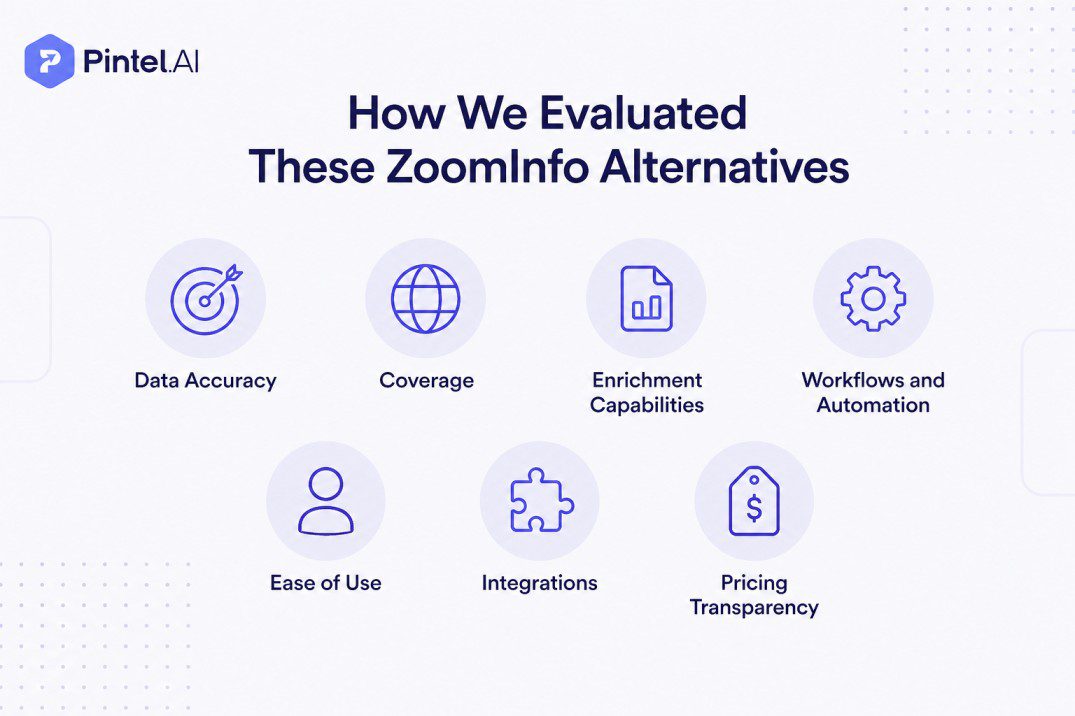
Data Accuracy
A database is only valuable if the information is usable. We looked at how well each platform delivers verified emails, phone numbers, job titles, and company information, along with recurring customer feedback about stale or inaccurate records.
Coverage
Coverage isn’t just about millions of contacts. We assessed how well each platform supports different industries, company sizes, and global markets, helping sales teams build prospect lists that match their ICP.
Enrichment Capabilities
Modern sales teams need more than contact details. We evaluated whether each platform can enrich records with company information, verified contacts, buying signals, and other sales intelligence without requiring multiple tools.
Prospecting Workflow
We assessed what happens after a company is found. Can the platform help teams research companies, score accounts, build buying committees, personalize outreach, and sync data to a CRM, or does the workflow stop after exporting a list?
Ease of Use
A powerful platform should also be easy to adopt. We considered how quickly sales teams can find companies, build prospect lists, and complete common prospecting tasks without extensive setup or training.
Integrations
Prospecting doesn’t happen in isolation. We reviewed how well each platform connects with CRMs, sales engagement platforms, enrichment tools, and other GTM applications to reduce manual work.
Pricing
Pricing affects adoption as much as features. We compared public pricing, custom pricing models, free plans, and usage-based options to understand the value each platform offers for different team sizes.
Best ZoomInfo Competitors and Alternatives Compared
An operational comparison of leading platforms and how their data models behave inside real GTM workflows.
Pintel.ai: Global B2B Data, AI Prospecting, and Waterfall Enrichment
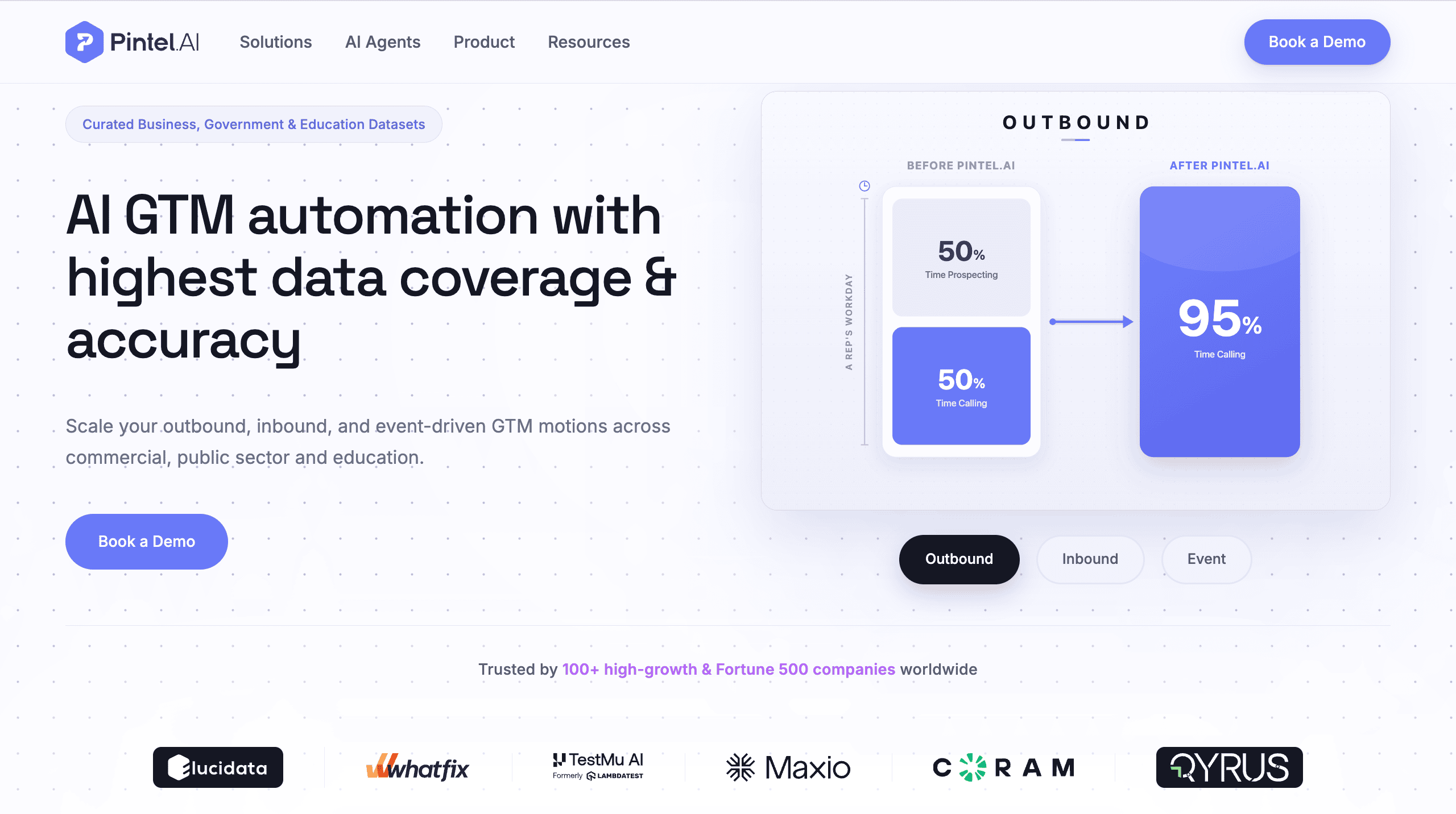
Pintel.ai combines proprietary B2B data, 30+ data providers, AI-powered prospecting, buying signals, and workflow automation in one platform. It helps sales teams discover ICP-fit companies, identify decision-makers, enrich contact data, and prioritize accounts before outreach.
Why it’s a ZoomInfo alternative:
- Combines proprietary B2B data with a 30+ provider waterfall, reducing reliance on a single data source
- Covers company discovery, contact enrichment, account prioritization, and prospecting in one workflow
Beyond ZoomInfo’s feature set:
- AI-powered account research: Uses AI to research and identify highly targeted companies based on your ICP.
- Buying signals: Identify hiring, funding, leadership changes, expansion, and technology adoption signals alongside company data
- AI account scoring: Rank companies based on ICP fit and buying signals before outreach
- Waterfall enrichment: Enrich company and contact records across 30+ providers when the required data is unavailable from the first source
- Decision-maker discovery: Find relevant contacts within ICP-fit accounts and access their verified business email addresses and phone numbers
- CRM enrichment: Sync enriched company and contact data directly with your CRM
Pros:
- Company data: Provides firmographic, technographic, and business data for target companies across global markets
- ICP matching: Helps sales teams discover companies that match their industry, company size, location, technology, and other ICP criteria
- Account scoring: Pintel.ai ranks target companies based on ICP fit and buying signals to identify which accounts to prioritize
- Decision-maker contacts: Provides verified business email addresses and phone numbers for relevant decision-makers at target companies
- Buying signals: Pintel.ai identifies hiring, funding, leadership changes, expansion, and technology adoption signals across target accounts
- Waterfall enrichment: Enriches company and contact records across 30+ data providers when the required data is unavailable from the first source
- AI-powered research: Lets sales teams describe their ICP and account research requirements in plain English instead of manually building complex filters
- CRM enrichment: Syncs enriched company and contact data directly with CRM and sales workflows
Cons: Custom pricing; lower brand recognition than established sales intelligence platforms.
Best for: B2B sales and GTM teams looking for a ZoomInfo alternative with global company data, ICP-based company discovery, verified decision-maker contacts, buying signals, AI-powered research, and multi-source enrichment.
Apollo: Data and Sales Engagement Platform, Weak on Data Consistency Outside the US
Apollo replaces a data-only subscription with one platform that also handles sequencing and outreach, a fit for teams consolidating tools, not just cutting data cost. Coverage outside the US is inconsistent, and credit-based pricing means real cost often runs above the headline price.
Pricing: Free (limited credits); Basic from $49/user/mo (annual); Professional from $79/user/mo (annual); Organization from $119/user/mo (annual, 3-user min)
Pros vs. ZoomInfo:
- Bundles sequencing, dialer, and A/B testing in the same platform, which ZoomInfo doesn’t include natively
- Free tier and $49/mo entry point vs. ZoomInfo’s enterprise-only contract structure
- Faster self-serve setup with no sales call required, unlike ZoomInfo’s quote-based onboarding
Cons: No proprietary data; phone accuracy weak outside US; credit pricing scales expensive; no built-in signals
Limitations vs. ZoomInfo:
- No proprietary research database; ZoomInfo maintains its own in-house data team, Apollo is entirely third-party sourced
- No built-in intent/buying-signal data comparable to ZoomInfo’s Bombora-powered intent feed; a separate subscription is required
- Phone accuracy outside the US trails ZoomInfo’s more mature global verification, especially for mobile and EMEA numbers
Best for: US-focused SDR teams on a budget who prioritize volume and built-in sequencing over global accuracy or signals.
Clay: Multi-Provider Data Enrichment Tool, Weak on Cost Predictability
Clay lets teams stop depending on one vendor’s database, orchestrating 30+ providers, including ZoomInfo itself, in one workflow. It has no proprietary data of its own, so output quality depends entirely on which providers you connect, and it needs a dedicated RevOps resource to build and maintain.
Pricing: Free (100 Data Credits/mo); Launch from $185/mo (2,500 Data Credits, 15,000 Actions); Growth from $495/mo (6,000 Data Credits, 40,000 Actions); Enterprise custom. Provider costs are billed separately, per lookup, on top of the plan.
Pros vs. ZoomInfo:
- Not locked into a single vendor: orchestrates 30+ providers, including ZoomInfo itself, instead of one static database
- Configurable waterfall logic gives more control over enrichment priority than ZoomInfo’s fixed data model
- Claygent AI automates web-based research that ZoomInfo doesn’t offer
Cons: No proprietary data; steep learning curve, needs dedicated RevOps; real cost equals plan plus every provider connected; no built-in signals/scoring/automation
Limitations vs. ZoomInfo:
- No proprietary data at all, unlike ZoomInfo’s own researched database; Clay’s output is only as good as whichever third-party providers you pay for separately
- No native intent data, account scoring, or outbound workflow automation the way ZoomInfo bundles them in one license
- Requires a dedicated technical RevOps resource to configure and maintain; ZoomInfo works largely out of the box
Best for: Technical RevOps teams with dedicated resources who want full control over enrichment logic and are comfortable managing provider costs.
Breeze Intelligence (HubSpot): Enrichment Tool Inside HubSpot, Weak on Contact-Level Data
Breeze Intelligence, formerly Clearbit, acquired by HubSpot in 2023, specializes in company-level enrichment and website visitor ID inside HubSpot. It’s not a standalone prospecting tool: contact-level data is thin, and it only functions with an active HubSpot subscription.
Pricing: From $45/mo for 100 credits; bundled by HubSpot plan (Starter 500/mo, Pro 3,000/mo, Enterprise 5,000/mo); requires an active HubSpot subscription, billed separately
Pros vs. ZoomInfo:
- Enriches records automatically inside HubSpot with zero manual export, a workflow ZoomInfo doesn’t natively offer HubSpot users
- Website visitor identification for inbound qualification, which isn’t part of ZoomInfo’s core product
- Lower entry price ($45/mo) if already paying for HubSpot, vs. ZoomInfo’s separate enterprise contract
Cons: Requires HubSpot subscription; thin contact-level data; no signals/scoring/outbound workflow; mostly US company coverage
Limitations vs. ZoomInfo:
- Contact-level (person) data is thin; ZoomInfo’s core strength is verified individual contacts and direct-dial numbers at scale
- Only usable inside HubSpot, while ZoomInfo runs as a standalone platform across any CRM or sales stack
- No outbound prospecting workflow, org charts, or buying-signal detection the way ZoomInfo provides
Best for: HubSpot-native marketing/inbound teams needing automatic company enrichment and visitor ID. Not a fit for outbound-led teams off HubSpot.
Cognism: Europe-Focused B2B Data Provider, Weak on Coverage Outside Europe
Cognism fits teams selling into Europe, where GDPR-aligned sourcing and verified mobile numbers matter more than global reach. Coverage collapses outside EMEA, and it has no proprietary data layer or workflow automation. Pricing isn’t published; third-party estimates put a 5-person team at $22,500 to $37,500 per year.
Pricing: Custom only. Contact Cognism for a quote (no public pricing).
Pros vs. ZoomInfo:
- Diamond Data tier delivers manually verified mobile numbers in EMEA markets where ZoomInfo’s coverage is comparatively thinner
- GDPR-aligned sourcing and documented data provenance, which matters more to EU-regulated teams than ZoomInfo’s more US-centric compliance framing
- Purpose-built for European outbound, where it out-performs ZoomInfo specifically on mobile number verification
Cons: Thin coverage in US/APAC/GCC; no proprietary data; no signals/scoring/automation; high cost, sales-conversation pricing; annual lock-in
Limitations vs. ZoomInfo:
- Coverage drops sharply outside EMEA, while ZoomInfo maintains stronger depth across US, APAC, and global markets
- No in-house research database beyond phone verification, versus ZoomInfo’s own proprietary data operation
- No self-serve pricing tiers or short-term contracts, unlike ZoomInfo’s more flexible licensing options
Best for: EMEA-only outbound teams where verified mobiles and GDPR compliance matter most, and global coverage isn’t needed.
Lusha: Contact Lookup Browser Extension, Weak on Database Depth
Lusha fits individual reps and small teams needing occasional contact lookups without a full data platform. Its database is smaller than any enterprise alternative, and the credit system depletes fast for phone-heavy teams.
Pricing: Free (limited credits); Starter from $37.45/user/mo (annual); Pro from $52.45/user/mo (annual); Premium from $299.95/mo (annual); Scale custom. 1 credit per email, 10 credits per phone number.
Pros vs. ZoomInfo:
- Far lower entry price than ZoomInfo, usable by an individual rep without an enterprise contract
- Fast, self-serve setup in minutes, no sales call or onboarding process the way ZoomInfo requires
- Works well for occasional one-off lookups, where ZoomInfo’s licensing is built around sustained team-wide usage
Cons: Small database, gaps outside enterprise/US; no proprietary data/signals/automation; credits deplete fast; not viable as a primary source for structured outbound
Limitations vs. ZoomInfo:
- Database is much smaller overall; not built for company-wide, high-volume prospecting the way ZoomInfo is
- No org charts, account-level intelligence, or intent signals that ZoomInfo includes natively
- Per-credit pricing gets expensive fast at team scale, unlike ZoomInfo’s more predictable seat-based licensing
Best for: Individual SDRs or very small teams doing occasional lookups who don’t need automation, global coverage, or team-scale prospecting.
Seamless.AI: AI-Assisted Prospecting Tool, Weak on Accuracy at Scale
Seamless.AI fits teams prioritizing contact volume and list-building speed over per-contact accuracy. It uses AI-assisted real-time sourcing, but accuracy trails premium alternatives, and credits are charged even on failed lookups.
Pricing: Free (50 lifetime credits only); Basic from $147/mo (annual, 250 credits/mo); Pro custom (contact sales); Enterprise custom
Pros vs. ZoomInfo:
- Lower cost per contact for high-volume list-building than ZoomInfo’s per-seat enterprise pricing
- Faster list-build speed for teams prioritizing volume over verification depth
- Free plan available to test before buying, unlike ZoomInfo’s quote-only model
Cons: Lower accuracy, higher bounce rates at scale; credits charged on failed lookups; no proprietary data/signals/automation; limited pricing transparency on Pro/Enterprise
Limitations vs. ZoomInfo:
- Lower overall data accuracy than ZoomInfo, leading to higher bounce and invalid-contact rates at scale
- No intent data, org charts, or account scoring comparable to what ZoomInfo bundles in
- Charges credits even on failed lookups, so effective cost per valid contact can exceed ZoomInfo’s model
Best for: High-volume outbound teams optimizing for speed and low cost per contact who can validate emails downstream and tolerate lower accuracy upfront.
Why Are Sales Teams Looking for ZoomInfo Alternatives?
ZoomInfo remains one of the most recognized B2B sales intelligence platforms, but it’s not the right fit for every sales team. As businesses scale their outbound efforts, common concerns such as data accuracy, pricing, and return on investment often lead them to evaluate other B2B prospecting and sales intelligence platforms.
Customer reviews across software review platforms frequently mention similar challenges, including:
- Outdated phone numbers, job titles, and company information.
- Contact data that requires manual verification before outreach.
- High subscription costs for growing sales teams.
- Limited ROI compared to the total investment.
The reviews below highlight some of these recurring concerns shared by customers.
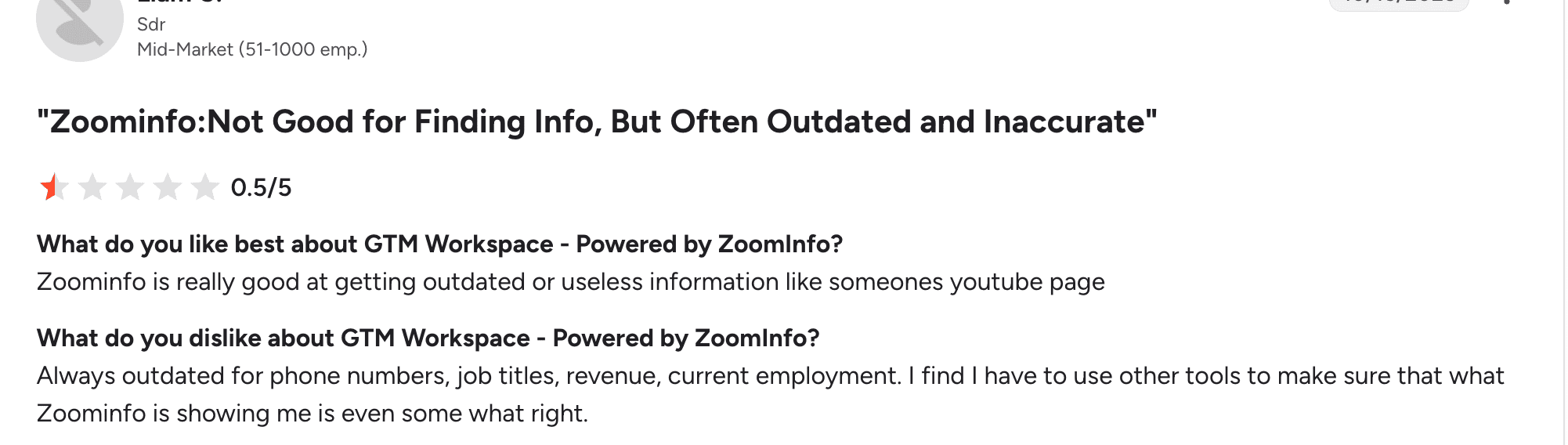
The first review describes issues with outdated phone numbers, employee information, revenue data, and current employment details. The reviewer also mentions relying on additional tools to verify the information before using it for sales prospecting.
Another customer highlights concerns around pricing, data quality, and return on investment, stating that the platform did not deliver the value they expected for the cost.
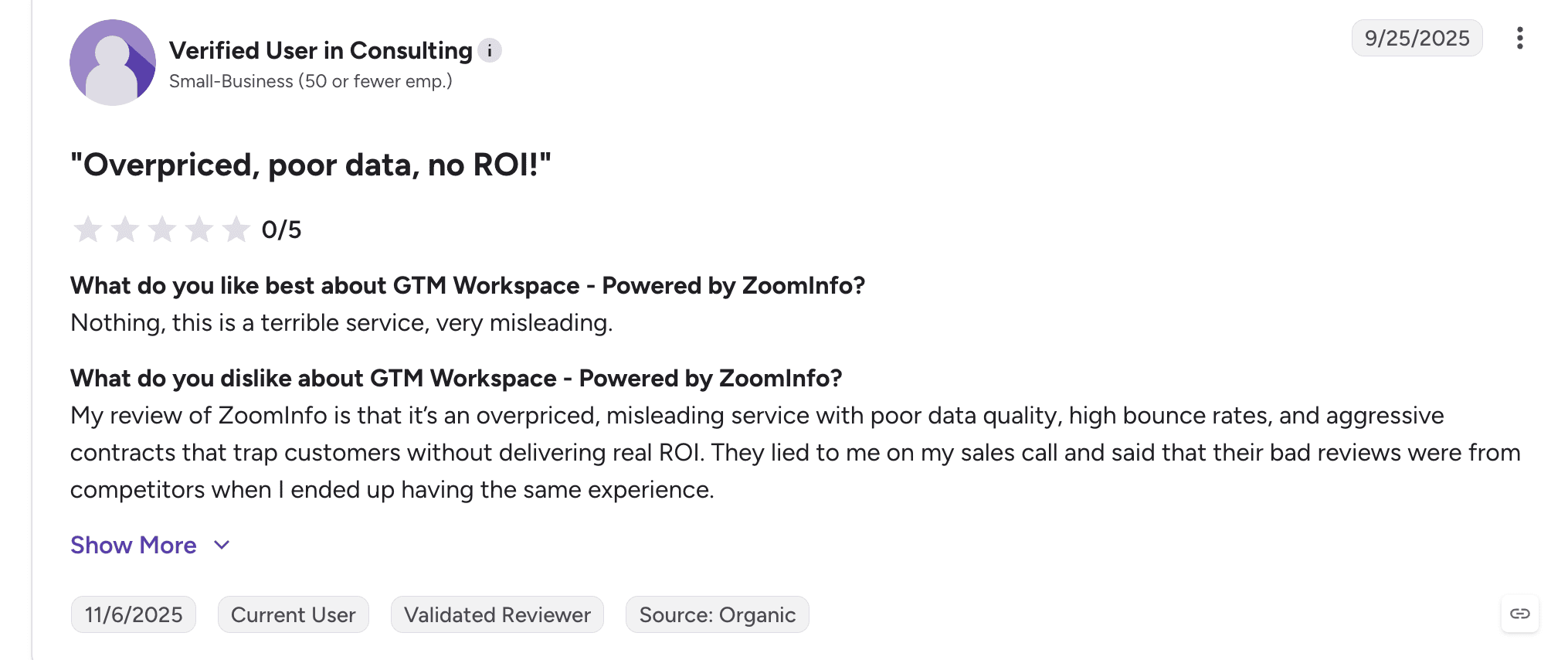
While these experiences do not represent every ZoomInfo customer, they show why businesses compare alternatives based on data quality, coverage, enrichment, AI capabilities, and pricing. Among these options, Pintel.ai stands out as a strong overall alternative for B2B sales teams.
Final Takeaway: Choosing Your ZoomInfo Alternative
Evaluating ZoomInfo alternatives is rarely about dissatisfaction with ZoomInfo itself. More often, it signals that your outbound motion has matured and that data reliability—not access or coverage—has become your limiting factor for continued growth.
As teams scale from early prospecting to sophisticated revenue operations, the fundamental question shifts from “How many contacts can we reach?” to “Can we trust the data driving our routing, qualification, and outreach without constant manual correction?”
When data behaves unpredictably, every downstream system absorbs the cost: CRM logic breaks unexpectedly, SDR productivity drops as validation time increases, scoring models misfire and route leads incorrectly, and pipeline predictability suffers. The operational impact of inconsistent data becomes exponentially more expensive than any platform subscription fee.
Choose your ZoomInfo competitor based on your dominant operational constraint:
- Speed and volume: Pintel.ai, Apollo, and Seamless.AI support high-volume B2B prospecting.
- Accuracy and stability: Pintel.ai combines proprietary B2B data with multi-source enrichment for more reliable company and contact data.
- Flexibility and customization: Pintel.ai and Clay support flexible multi-source enrichment workflows.
- Compliance and regional coverage: Pintel.ai and Cognism support B2B teams targeting different regional markets.
- Simplicity and cost: Pintel.ai, Lusha, and Apollo offer accessible options for different sales team requirements.
FAQs: ZoomInfo Alternatives
What are the best ZoomInfo alternatives for B2B data?
The best alternative depends on what your team needs. If the priority is reliable data that works across targeting, routing, and outreach, platforms like Pintel are designed to ensure data can be used directly without manual fixes. Other tools may focus more on data volume or outbound features.
Which ZoomInfo alternatives offer the most accurate B2B contact data?
Accuracy varies across providers, but teams increasingly look for solutions that go beyond raw data coverage. Platforms like Pintel focus on maintaining consistent and reliable data across enrichment cycles, helping reduce manual validation and improve trust in CRM workflows.
What are the top ZoomInfo alternatives for lead enrichment?
For teams focused on enrichment, the key is not just adding more data, but ensuring that enriched data can be used reliably in workflows. Solutions like Pintel focus on controlled enrichment and consistency, so scoring, routing, and outreach are not affected by data conflicts.
Are there ZoomInfo alternatives for SMB and scaling sales teams?
Yes. As teams grow, the need shifts from simply accessing data to using it efficiently. Platforms like Pintel help reduce manual validation and support scalable workflows, making them suitable for teams that want to maintain efficiency as they expand.
What tools are similar to ZoomInfo?
Several tools provide contact data and enrichment capabilities similar to ZoomInfo. However, they differ in how that data can be used. Platforms like Pintel focus on ensuring data remains reliable across workflows, rather than just providing access to contacts.
How do ZoomInfo alternatives compare in 2026?
ZoomInfo alternatives differ across data accuracy, pricing, and workflow support. Increasingly, teams prioritize solutions that deliver reliable data and reduce operational overhead. Platforms like Pintel address this by ensuring data works consistently across prospecting, enrichment, and outreach.
What should teams look for when comparing ZoomInfo competitors?
Teams should evaluate how reliable the data is, how easily it integrates into workflows, and how much manual effort is required. Solutions like Pintel stand out by reducing the need for re-validation and ensuring that data behaves predictably inside CRM systems.