Your sales team has a list of target accounts, but the contact data is incomplete. Some records have an email but no phone number. Others have the right contact but outdated details. And some high priority accounts have no usable contact data at all.
This is where waterfall enrichment comes in. Instead of relying on a single data provider, waterfall enrichment checks multiple providers in a defined sequence, using the next source when the previous one cannot fill the required data.
The result is a more complete contact or account record without manually searching across multiple databases. In this guide, we explain what waterfall enrichment is, how it works, and how B2B sales and RevOps teams can use it to fill data gaps and improve prospecting coverage.
What Is Waterfall Enrichment?
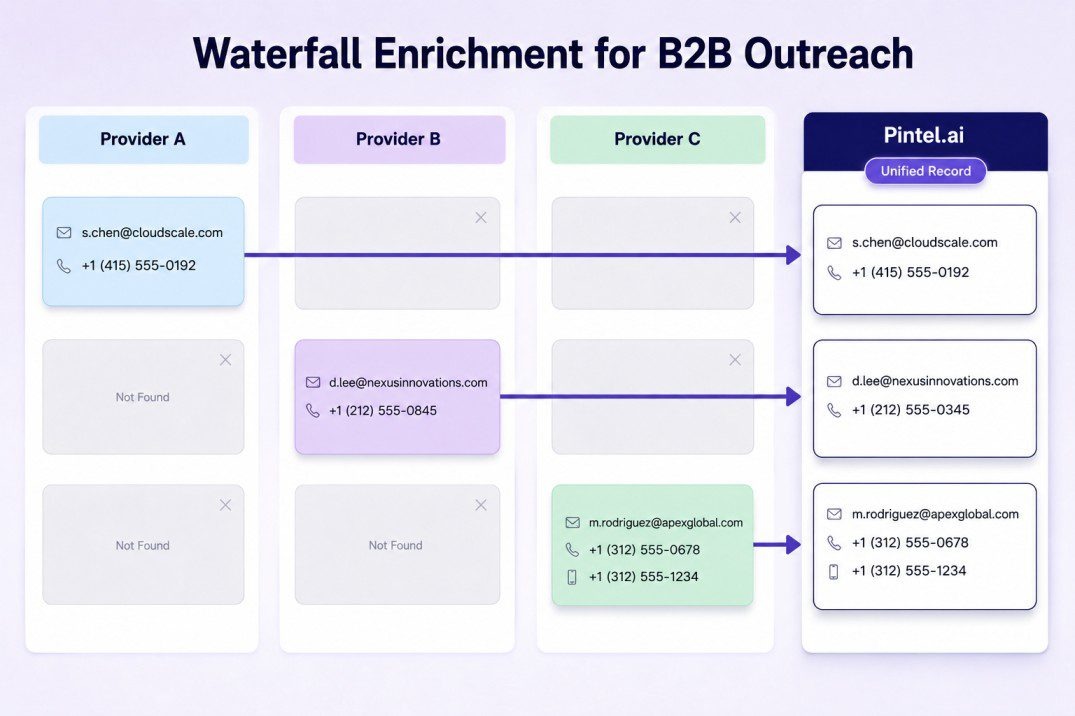
Waterfall enrichment is an automated process that sends a contact record through multiple data providers in a fixed priority order. Each provider attempts to fill missing fields. If a field is already populated, that provider skips it. The process continues until all required fields are filled or every provider in the sequence has been queried.
Single-source enrichment fills 60 to 80% of contact fields on average. A multi-provider approach routinely pushes that above 90%. The difference comes down to coverage: no single provider has complete data on every contact in every geography and every industry vertical.
Two Use Cases: Prospecting and Re-Enrichment
The waterfall approach applies at two different points in the outbound process. Both use the same provider-sequencing logic. The starting point is what differs.
Building Complete Records from Scratch
You have an ICP, a list of target companies, and identified personas. You have no contact data. The provider sequence starts from those identifiers and builds complete records. Company name, job title, and LinkedIn profile are enough to begin. Provider 1 fills what it can, Provider 2 fills what remains, and the process continues until the record meets your completeness threshold.
This is the prospecting motion. It generates net-new pipeline from a defined target list rather than repairing records you already have.
Filling Missing Contact Data in Existing CRM Records
You have contact records in your CRM, but key data is missing. A record may have a work email but no direct phone number, an outdated job title, no LinkedIn URL, or missing company details such as employee count or technology used. The waterfall runs those records through the provider sequence, filling only the missing or outdated fields while preserving data that is already verified.
This re-enrichment motion helps B2B sales teams make existing CRM contacts usable for outreach instead of manually checking multiple data tools for missing emails, phone numbers, titles, or company information.
Understanding why a single provider cannot reliably fill all these fields explains why the multi-provider approach exists.
Why Single-Source Enrichment Falls Short
Most teams frame it as a data quality problem. More often, it is a single-provider coverage problem.
One data provider, no matter how strong its core database, carries gaps. Those gaps vary by ICP geography, company size, and industry. When your outbound motion relies on a single source, you inherit those gaps directly as bounced emails, disconnected numbers, and sequences your prospects never receive.
Coverage Gaps by Geography and Vertical
Providers build their databases differently. A provider strong in North America may have thin contact coverage in EMEA or APAC. A provider with solid European company records may have outdated contacts for mid-market firms in Southeast Asia. When your ICP spans multiple regions, a single provider will underperform in at least one of them.
Data Staleness and Job Changes
B2B contact data decays at roughly 20 to 30% per year. People change jobs, get promoted, change email domains, and move companies. A provider that does not refresh records frequently passes stale contacts without flagging them. You discover the problem only when emails hard-bounce and calls go to the wrong voicemail, after the sequence has already run on bad data.
The Real Cost of Missing Fields
One team paying $20,000 per year for contact data found 37% of records were wrong or missing on delivery. After switching to waterfall enrichment across 30 or more vetted providers, their match rate reached 95%+. The cost of bad data is not the subscription fee. It is the revenue stalled on contacts that cannot be reached.
How Does B2B Waterfall Enrichment Work?
B2B waterfall enrichment works by checking multiple data providers in a defined sequence. Each provider fills only the information that is still missing, and the record moves to the next provider immediately when the required data cannot be found.
The process follows a simple sequence, from routing each record to the right provider through checking whether all required data has been found. Here is how it works step by step.
Step 1: The Record Enters the Sequence
A contact record enters the enrichment sequence. This may be a new import, a CRM export of stale records, or a batch of newly identified prospects. The system sends the record to the first provider, and if the required data is not found, it immediately moves to the next provider in the sequence.
Step 2: Provider 1 Attempts to Fill Missing Fields
The highest-accuracy provider in your stack receives the record. It queries its database using available identifiers such as name, employer, LinkedIn URL, or email domain. It returns the fields it can match. Fields already populated are not overwritten by default, unless you have configured explicit field-level override rules for specific field types.
Step 3: Fallback Providers Fill What Remains
If required fields are still missing after Provider 1, the record moves to Provider 2, which attempts to fill only the remaining gaps. This continues through each provider in sequence. Broader-coverage providers sit lower in the stack, catching contacts that specialist providers above them missed.
Step 4: Completeness Check and Exit
After each provider pass, the system checks whether the record meets its completeness threshold: the minimum set of fields a record must have before exiting the sequence. A typical threshold is a verified business email plus at least one phone number. Records that meet the threshold exit ready for outreach. Records that do not continue to the next provider, or are flagged for manual review if the stack is exhausted.
Single-Source Enrichment vs. Waterfall Enrichment
The table below compares both approaches across the dimensions that affect outbound sales teams most directly.
| Dimension | Single-Source Enrichment | Multi-Provider Waterfall |
|---|---|---|
| Typical fill rate | 60 to 80% | 90 to 95%+ |
| Providers queried per record | 1 | 3 to 6 (configurable) |
| Geographic coverage | Strong in provider’s core market | Broader, via region-specialized providers |
| Missing field handling | Left blank | Passed to next provider automatically |
| Data freshness risk | Tied to one provider’s refresh cadence | Multiple cadences reduce staleness exposure |
| Field-level source tracking | Not applicable | Each field tagged to its source provider |
| Setup complexity | Low | Moderate, requires priority ordering |
| Cost per complete record | Lower upfront, higher miss rate | Higher coverage per record processed |
Based on firsthand product experience, public information, and user reviews.
With the approach clear, the next question is which fields actually benefit from a multi-provider sequence.
What Contact Fields Does Multi-Provider Enrichment Fill?
A complete contact record for outreach needs a verified way to reach the person, identity information for personalization, and company context for qualification. The enrichment sequence prioritizes these categories in that order.
Primary Reachability Fields
- Verified business email address
- Direct dial phone number
- Mobile number
- LinkedIn profile URL
Identity and Role Fields
- Full name
- Current job title
- Department
- Seniority level
Company Context Fields
- Company name (current employer, not historical)
- Employee count range
- Industry classification
- Headquarters location
- Technology stack in use
Work email and direct phone receive the most provider coverage in a well-configured stack. These two fields also carry the highest bounce risk when wrong, which is why they belong at the center of any completeness threshold. Company context fields are generally more stable and can often be sourced from a single authoritative provider at the top of the stack.
Knowing which fields to fill is only useful if the workflow that fills them is set up correctly.
How to Build a Waterfall Enrichment Workflow
The setup comes down to four decisions. Each affects fill rate and cost, so making them deliberately matters more than accepting a vendor’s default configuration.
Step 1: Define Your Completeness Threshold
Before selecting providers, decide what a complete record means for your team. For most outbound workflows, the minimum is a verified business email and at least one phone number. More complex workflows may add seniority level, department, or technology stack to the threshold. The threshold should reflect what reps actually need before starting a sequence, not what is technically possible to source.
Step 2: Select and Rank Your Providers
Choose providers based on proven coverage strength for your specific ICP. Place the highest-accuracy provider for your primary market at the top of the stack. Add providers with broader coverage or specific geographic strength below it.
Three to six providers is the effective active range per workflow for most ICPs. This is the number of providers your sequence actually queries for a given record, not the total provider network a platform maintains. Pintel.ai, for example, routes each record through the most relevant subset of its 30 or more vetted providers based on ICP geography and persona, rather than querying all of them for every record. Beyond six active providers, additional sources may increase cost without delivering proportional coverage gains for most ICPs. Rank based on tested accuracy against your actual records, not vendor claims.
Step 3: Configure Field-Level Override Rules
Decide which fields each provider can fill or overwrite. A practical starting configuration:
- Provider 1: fill all matched fields
- Provider 2: fill only blank fields, no overwrites of Provider 1 results
- Provider 3: fill remaining blanks and may overwrite phone numbers where Provider 1 has known freshness issues
These rules prevent lower-priority providers from replacing verified data with lower-confidence results from a less authoritative source.
Step 4: Set a Re-Enrichment Cadence
Contact data decays continuously, and the sequence needs to run again on a schedule to stay current. A practical starting cadence:
- High-priority accounts: every 90 days
- Active pipeline contacts: every 60 days
- Cold or dormant records: every 180 days, or at the point of re-engagement
Automated re-enrichment on a schedule keeps your CRM current without manual batch exports on a fixed cycle.
How Waterfall Enrichment Helps B2B Sales Teams Fill Missing Contact Data
Incomplete contact data creates a common problem for B2B sales teams. One provider may find the right contact but not their work email. Another may have the email but no direct phone number. Reps then end up switching between multiple data tools, exporting lists, and manually searching for the missing information.
Waterfall enrichment solves this by checking multiple data providers in a defined sequence from a single workflow. When one provider cannot fill the required contact data, the record automatically moves to the next provider instead of forcing your team to search elsewhere.
For B2B prospecting and outreach, this means:
More Complete Contact Records
Find missing business emails, direct phone numbers, job titles, LinkedIn URLs, and other contact data without relying on a single provider to have every field.
Less Switching Between Data Tools
Instead of exporting a prospect list from one tool and checking other databases manually for missing details, the enrichment workflow handles provider fallback automatically.
Fewer Gaps Before Outreach
Sales teams can send prospects into their outreach workflows with more complete contact information, reducing the number of records that need manual research before sequencing.
Better Coverage Across Different ICPs and Markets
Different providers have different coverage strengths. A waterfall approach lets B2B sales teams use multiple sources for the same prospecting workflow instead of depending on one database to cover every role, company, or region.
The biggest value is simple: when a single data source leaves gaps, you do not need to manually switch to another tool. Waterfall enrichment automatically checks the next available provider until the required data is found or the sequence is exhausted.
What to Look for in a Waterfall Enrichment Tool
Not every enrichment platform runs a true multi-provider waterfall. Some bundle a few data sources under one API but apply fixed routing logic you cannot configure. Before committing to a platform, check for these capabilities.
- Configurable provider priority: You set the sequence order based on your ICP, not the vendor’s default ranking.
- Field-level source attribution: Each filled field is tagged to the provider that supplied it, so you can audit accuracy over time and adjust ranking when quality shifts.
- Completeness threshold controls: You define what a complete record looks like. The system enforces it, not a one-size vendor standard.
- Re-enrichment scheduling: Automated cadence-based re-enrichment runs without manual batch jobs.
- ICP-aware routing: Different provider sequences based on geography, company size, or persona type. Not every contact should run through the same stack in the same order.
- Verified coverage for your markets: Confirm provider strength against your actual ICP geographies before assuming coverage. North America, EMEA, and APAC need different sourcing depth.
Pintel.ai’s waterfall enrichment runs contact records through 30 or more vetted providers in configurable priority order, with field-level source attribution and built-in re-enrichment logic. Teams targeting US, EMEA, and APAC ICPs use it to maintain 95%+ match rates without managing multiple vendor contracts separately. See how it works: Waterfall contact enrichment.
Final Takeaway
A multi-provider enrichment process is not a single tool purchase. It is a process: multiple providers, priority-ordered, field-aware, and scheduled to re-run as data decays. Teams that build and maintain it consistently see fill rates above 90% and fewer wasted sequences on contacts that cannot be reached.
The teams that see the most consistent results treat it as an ongoing discipline: reviewing provider performance quarterly, updating priority rankings when accuracy shifts, and running re-enrichment on a schedule rather than in reactive batches.
For a broader comparison of the tools behind this process, see our guide to data enrichment tools for B2B sales. You can also explore contact data enrichment techniques that complement a multi-provider approach.
Frequently Asked Questions
What is waterfall enrichment?
Waterfall enrichment is an automated process that queries multiple data providers in priority order until required contact fields are filled. Each provider is a fallback for the previous one. Fill rates typically reach 90%+ compared to 60 to 80% from a single source.
How does it differ from standard data enrichment?
Standard enrichment queries one provider and stops, leaving gaps wherever that provider lacks data. The multi-provider approach passes incomplete records through additional providers automatically until required fields are filled. The result is higher fill rates with less manual effort.
Can waterfall enrichment be provided through an API?
Yes. Pintel.ai provides waterfall enrichment through a REST API that queries multiple B2B data providers in sequence and returns enriched contact and company data through a single integration. Pasted text
How many providers should an enrichment stack include?
A typical workflow actively queries three to six providers per record. This is distinct from the total provider network a platform maintains. Priority order matters more than quantity: the highest-accuracy source goes first, and broader-coverage sources follow as fallbacks.
Which contact fields can it fill?
Business email, direct phone, mobile number, job title, LinkedIn profile URL, company name, company size, industry, and technology stack. Work email and direct phone are highest priority since those carry the most risk when wrong.
How often should I re-enrich contact data?
High-priority accounts every 90 days, active pipeline contacts every 60 days, and dormant records every 180 days or on re-engagement. B2B contact data decays at roughly 20 to 30% per year, so static lists go stale fast.
What is a completeness threshold?
A completeness threshold is the minimum set of fields a record must have before it exits the enrichment sequence. A typical threshold requires at least a verified business email and one phone number before the record is considered ready for outreach.
Does this approach work for global ICPs?
Yes. Different providers have stronger coverage in different geographies. A multi-provider stack can route EMEA contacts to providers with stronger European sourcing and APAC contacts to stronger regional sources, filling gaps a single global provider misses.
What fill rate should I expect?
Most teams see 90 to 95% fill rates on verified contact fields with a well-configured stack. Single-source enrichment typically delivers 60 to 80% on the same fields. Results depend on ICP geography, persona complexity, and provider selection.
How do I know if my team needs it?
Check your CRM for records missing a verified email or phone. If a significant share of contacts lack a business email or direct phone, your current provider is likely not covering your full ICP. That is the gap this approach closes.
Does Pintel.ai use this approach?
Yes. Pintel.ai runs contact records through 30 or more vetted providers in configurable priority order, with field-level source attribution and re-enrichment logic built in. Teams reach 95%+ match rates across US, EMEA, and APAC without managing multiple vendor contracts.