Choosing between an SDR and a BDR isn’t about job titles. It’s an operating model decision that directly impacts pipeline quality, rep efficiency, and forecasting reliability.
Sales Development Representatives and Business Development Representatives may sit at the same layer of the funnel, but they support fundamentally different motions. One converts existing demand into qualified conversations. The other creates demand where none exists. When these roles are blurred, inbound slows down, outbound becomes noisy, and AEs inherit pipeline that looks full but doesn’t convert.
Understanding these role differences is critical before you scale your sales development team. Evaluating the difference between SDR and BDR responsibilities helps you avoid common structural mistakes. The wrong structure creates bottlenecks. The right one unlocks predictable growth.
Many GTM leaders struggle with the SDR vs BDR question because they treat it as a hiring decision rather than a go-to-market architecture choice. The reality is that both roles solve different pipeline problems, and understanding when to hire each one determines whether your sales development motion scales efficiently or stalls.

In this guide, we’ll walk you through:
- What SDRs and BDRs actually do day-to-day
- How their workflows differ
- Where each role fits in the revenue engine
- How to decide which role your team needs first
- The trends shaping modern SDR and BDR teams
Before we compare them side by side, let’s start with what each role actually does within the sales development process.
What Is an SDR? (Inbound Response & Qualification Workflow)
An SDR (Sales Development Representative) manages all inbound demand — demo requests, trial sign-ups, website forms, and marketing-generated leads. Their focus is speed and clarity: respond fast, qualify accurately, and keep inbound moving without friction. SDRs operate at the earliest stage of the buyer journey, making sure each lead is routed correctly and aligned with your ICP.
To understand how SDRs create value, let’s break down what their day actually looks like:
What an SDR actually does each day
Checks the inbound queue to review new leads and confirm basic fit factors using lead scoring and routing rules.
Responds quickly because inbound interest fades fast — minutes matter for conversion rates.
Runs short qualification calls to assess pains, urgency, buying authority, use case alignment, and next steps.
Documents thoroughly so CRM hygiene, scoring, and RevOps reporting stay reliable.
Hands off qualified leads to AEs with context that helps accelerate the sales cycle and improve forecasting accuracy.
SDRs keep inbound predictable and aligned with pipeline management requirements. The SDR workflow is optimized for velocity—getting warm leads to AEs as quickly as possible without sacrificing qualification quality. Now, let’s look at the outbound motion, which supports a completely different part of your GTM strategy.
What Is a BDR? (Outbound Prospecting & Pipeline Creation Workflow)
A BDR (Business Development Representative) focuses on building net-new opportunities from accounts that haven’t engaged yet. They don’t wait for leads — they go directly into the market to spark conversations with high-fit prospects and activate outbound prospecting sequences.
While SDRs react to inbound signals, BDRs proactively create them. Here’s what that looks like in practice:
What a BDR actually does each day
Reviews ICP-fit accounts using segmentation criteria like industry, size, tech stack, territory, or intent signals.
Identifies decision-makers and researches their challenges, priorities, and potential triggers.
Executes personalised outreach via email, phone, and LinkedIn over structured outbound sequences.
Warms cold accounts by providing relevance and value before asking for time, often multi-threading across stakeholders.
Creates outbound opportunities and hands them off to AEs once interest is established and validated.
The BDR motion requires patience and persistence that differs fundamentally from SDR work. Where SDRs optimize for response speed, BDRs optimize for account penetration and stakeholder mapping. Now that the workflows are clear, here’s how the two roles compare at a glance.
SDR vs BDR: Key Differences at a Glance
| Dimension | SDR (Sales Development Representative) | BDR (Business Development Representative) |
|---|---|---|
| Motion | Inbound | Outbound |
| Lead Type | Warm | Cold |
| Primary Goal | Qualify interest | Generate demand |
| Workflow Style | Speed-first | Research-first |
| Daily Focus | Respond → Qualify → Handoff | Research → Personalize → Engage |
| Success Metrics | SQL rate, response time | Meetings booked, outbound pipeline |
| Dependencies | Scoring, routing, CRM hygiene | ICP clarity, account lists |
| AE Handoff | Immediate | After warming an account |
With the basics laid out, let’s look at how these differences influence your GTM performance and why the BDR vs SDR distinction matters for pipeline predictability.
Understanding the Difference Between SDR and BDR Motions in Your GTM

Here’s how these motion differences show up inside your revenue engine and outbound strategy:
Different funnel responsibilities
SDRs handle leads already entering the sales funnel. BDRs work before the funnel begins, generating net-new demand.
Different tempos
SDRs move fast and manage volume. BDRs move intentionally and prioritise relevance.
Different success markers
SDR success = qualification and conversion. BDR success = pipeline creation.
Different impact on AE efficiency
SDRs remove qualification work from AEs, improving sales velocity. BDRs expand the opportunity pool for AEs, strengthening pipeline coverage.
These operational differences explain why the SDR vs BDR decision isn’t arbitrary—each role addresses a specific pipeline constraint. Next, let’s translate these differences into practical hiring decisions based on your revenue motion.
BDR vs SDR: Which Role Should You Hire First?
Choosing between an SDR or BDR as your first sales development hire depends entirely on where your pipeline comes from today and where your biggest bottleneck sits. The SDR vs BDR decision becomes clearer when you evaluate these specific signals:
Hire an SDR first if:
- Inbound volume is rising but response time is slipping
- AEs are stuck qualifying instead of selling
- Marketing leads aren’t progressing through the funnel
- You need a predictable inbound pipeline
Hire a BDR first if:
- You’re entering a new vertical or geography
- Inbound volume alone isn’t enough to hit targets
- You’re targeting mid-market or enterprise accounts
- You need outbound-created opportunities
Choose both when:
You want a balanced, repeatable pipeline across inbound and outbound motions.
Use a hybrid SDR/BDR role when:
You’re early-stage and still validating motion–market fit.
The difference between SDR and BDR workflows becomes most apparent at scale. Early-stage companies can often get by with hybrid roles, but as pipeline volume increases, splitting these motions becomes essential for maintaining quality and velocity across both inbound and outbound channels.
The difference between SDR and BDR workflows becomes most apparent at scale. Early-stage companies can often get by with hybrid roles, but as pipeline volume increases, splitting these motions becomes essential for maintaining quality and velocity across both inbound and outbound channels.
Hiring decisions solve the immediate need, but your SDR/BDR structure has to evolve with your GTM motion. Here’s a framework to design your team for long-term scale.
When SDRs, BDRs, Both, or Hybrid Roles Make Sense — A GTM Framework
Hiring an SDR or BDR is a tactical decision. Designing how these motions work together is a strategic one. Most companies don’t struggle because the roles are unclear — they struggle because the roles aren’t aligned with how the business actually generates pipeline.
This framework explains how to structure SDR, BDR, or hybrid roles based on motion maturity, ACV, and overall revenue strategy. Understanding the BDR vs SDR dynamic at each stage helps you build the right structure for your current growth phase. Let’s walk through each scenario:
1. When an SDR-First Model Makes Sense (Inbound-Led Growth)
Use SDRs as the primary development function when most of your pipeline comes from high-volume inbound, paid acquisition, organic demo requests, or product-led growth (PLG) motions. Inbound motions require speed, qualification accuracy, and routing precision — not deep research. In these environments, a BDR team adds little leverage until inbound demand plateaus.
SDRs own: Respond → Qualify → Route → Accelerate
Ideal for: SMB, PLG, high-volume inbound motions, and early-stage companies with strong marketing engines.
2. When a BDR-First Model Makes Sense (Outbound-Led Growth)
A BDR-first structure becomes essential when revenue depends on breaking into new markets, targeting mid-market or enterprise accounts, activating multi-threaded buying committees, or creating opportunities rather than catching them. Outbound pipeline doesn’t scale without reps who can research, personalise, and systematically break into accounts.
BDRs own: Research → Personalise → Engage → Create
Ideal for: Mid-market and enterprise teams, new vertical or geographic expansion, and higher-ACV products.
3. When You Need Both SDRs and BDRs (Dual-Motion Model)
Scaling companies eventually reach a point where inbound alone isn’t enough, outbound efficiency depends on SDR handoffs, and AEs need a predictable pipeline across both motions. This is where a dual SDR/BDR team becomes non-negotiable. The motions complement each other: SDRs stabilise inbound → BDRs expand outbound. This structure produces cleaner data, more consistent qualifications, and healthier AE calendars.
Ideal for: Series A → Series C companies, multi-channel GTM motions, and teams building toward a predictable pipeline.
4. When a Hybrid SDR/BDR Role Makes Sense (Motion–Market Fit Still Evolving)
Hybrid roles work only when the company is early-stage, the GTM motion is still being validated, and rep capacity is low enough for one person to manage both inbound and outbound without weakening either motion. Hybrid roles break once pipeline volume increases — inbound requires speed, while outbound requires depth. No rep can optimise for both at scale.
Hybrid reps own: Respond → Qualify → Prospect → Engage
Ideal for: Pre-seed, Seed, very early Series A, and teams still validating ICP, TAM, or channels.
5. When You Should NOT Split SDRs and BDRs
Avoid separating the roles when inbound volume is too low to justify dedicated SDRs, outbound activity is too inconsistent to justify BDRs, the product is too complex for junior outbound reps, or RevOps maturity isn’t ready for segmented motions (e.g., broken routing logic, missing firmographics, no lead scoring). Splitting too early creates role confusion, missed SLAs, and an unstable pipeline.
6. The Strategic Principle: Design Roles Around Motions, Not Titles
SDR and BDR titles don’t matter — motion clarity does. Your pipeline becomes predictable when each motion has clear ownership, clean inputs, accurate routing, consistent handoffs, and a strong operational backbone.
The difference between SDR and BDR success comes down to matching the right motion to the right revenue source. If inbound needs speed → you need SDRs. If outbound needs intentionality → you need BDRs. If both matter → you need both, with clean separation and shared standards. Your role structure should always follow the motion, not the title.
Beyond individual company structures, broader industry patterns are reshaping how SDR and BDR teams operate. Let’s look at the trends influencing these roles across SaaS companies.
Modern Trends in SDR & BDR Teams
The sales development landscape has shifted significantly in recent years. Here are the four trends reshaping how teams structure and scale their SDR and BDR functions:
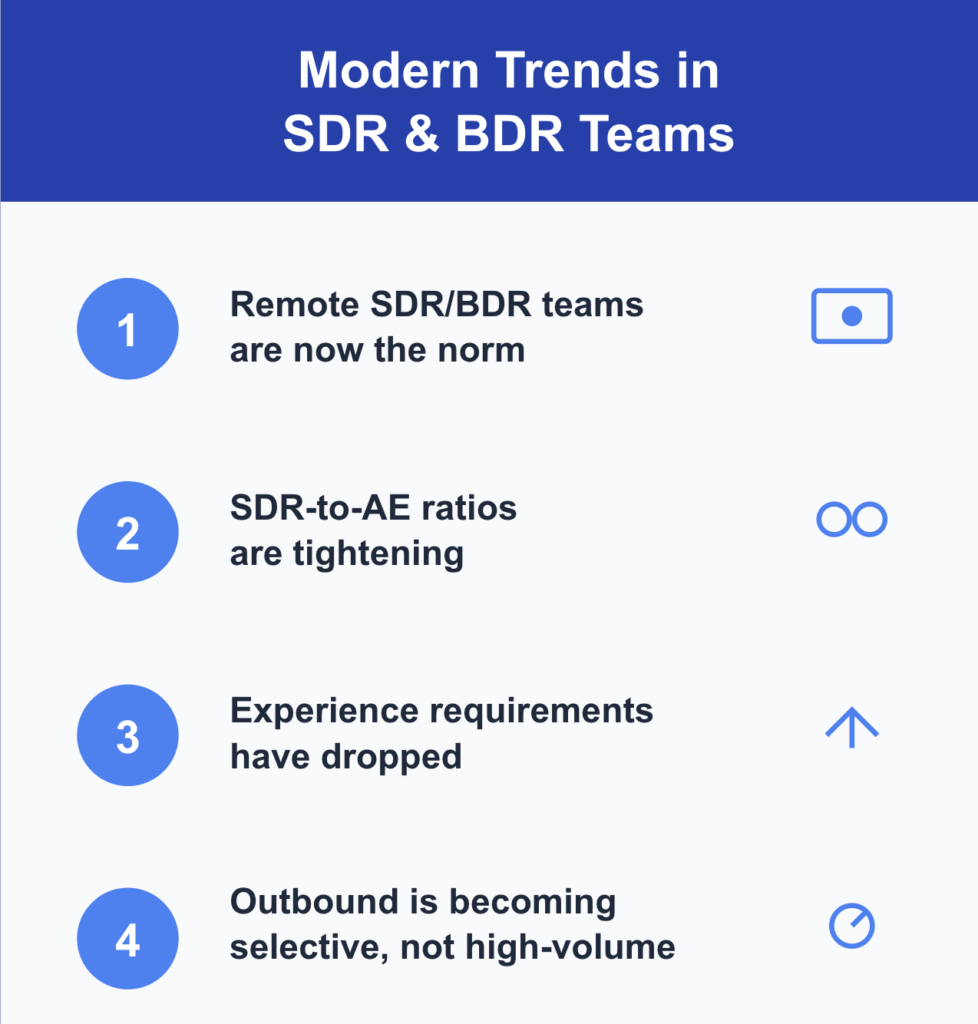
Trend 1: Remote SDR/BDR teams are now the norm
Remote setups have widened the talent pool and reduced hiring costs. Teams evaluating the BDR vs SDR structure now have access to global talent, making it easier to staff both motions simultaneously.
Trend 2: SDR-to-AE ratios are tightening
Most teams operate at 1 SDR to 2–3 AEs, reflecting efficiency improvements in sales engagement platforms.
Trend 3: Experience requirements have dropped
Companies hire earlier-career talent (6–12 months of experience) and build structured onboarding and ramp frameworks.
Trend 4: Outbound is becoming selective, not high-volume
High-performing BDR teams prioritise smaller ICP-focused lists, intent-driven targeting, and account prioritisation — not brute-force outreach.
While these trends show where the industry is heading, most SDR and BDR challenges aren’t about the roles themselves—they’re about what happens upstream. The SDR vs BDR distinction only matters when both roles have clean data and clear inputs to work with. Let’s examine where these motions typically break down.
As outbound becomes more selective and research-heavy, many teams are also exploring how AI supports modern BDR workflows.
Where SDR and BDR Workflows Actually Break
Before deciding whether to invest in SDRs, BDRs, or both, it’s important to understand where these motions typically break down inside most organisations. The roles themselves aren’t usually the problem — the inputs are.
Most breakdowns happen before outreach even begins – bad data, weak segmentation, missing firmographics, and poor routing logic. These upstream issues are exactly where strong lead enrichment and research automation make the biggest difference, preventing SDRs and BDRs from wasting cycles on low-fit leads and misrouted accounts.
As GTM workflows become more data-dependent, many teams are exploring how AI SDR tools support research and enrichment before outreach even begins.
The BDR vs SDR performance gap often has nothing to do with rep skill—it’s about data quality and operational infrastructure. Teams that fix these upstream inputs see faster qualification, fewer wasted touches, and more consistent pipeline creation across both motions. Choose the solution that gives your team cleaner data, clearer segments, and a more predictable top-of-funnel motion.
With all these frameworks, trends, and breakdown points in mind, here’s what it all comes down to:
Design Your Team Around Motions, Not Job Titles
SDRs and BDRs play distinct roles in how pipeline is created, qualified, and handed off. SDRs bring speed and structure to inbound demand; BDRs bring focus and intentionality to outbound prospecting. When each team operates with clarity and purpose, your AEs receive better opportunities, your forecasting becomes more reliable, and your GTM motion scales more smoothly.
There’s no single “correct” structure for every company — only the one aligned with how you generate revenue today. Whether you’re navigating the SDR vs BDR decision for your first hire, or building a dual-motion team, start by understanding where your pipeline comes from, where it slows down, and which role unlocks the next stage of growth.
Platforms like Pintel.AI are designed to support this motion-first approach by ensuring SDRs and BDRs receive clean, enriched, and correctly routed inputs before outreach begins.
The difference between SDR and BDR responsibilities might seem subtle on paper, but in execution, they represent fundamentally different approaches to pipeline generation. Build roles around those realities, and your top-of-funnel engine becomes far more predictable.
FAQs
1. SDR vs BDR: Who spends more time per account?
BDRs spend more time per account.
Outbound work requires deeper research, account mapping, personalisation, and repeated touchpoints. SDRs move faster because inbound leads already show intent, so their time is distributed across higher volume rather than depth.
2. SDR vs BDR: Who drives more revenue?
Neither role drives revenue directly.
SDRs improve revenue efficiency by qualifying and converting inbound demand quickly. BDRs expand revenue potential by creating new pipeline through outbound. Revenue is closed by AEs, but both roles are critical to pipeline health.
3. Is the SDR vs BDR distinction still relevant in modern GTM teams?
Yes. The SDR vs BDR distinction still matters because inbound and outbound require different workflows, tooling, and success metrics. Teams that blur these roles often see slower response times and less effective outbound.
4. Can AI tools replace SDRs or BDRs?
No. AI supports SDR and BDR teams by handling research, enrichment, prioritisation, and routing. It does not replace human judgment in qualification, objection handling, or live conversations.
5. How long should someone stay in an SDR or BDR role before moving to AE?
Most teams see readiness after 12–18 months. Shorter timelines often skip full qualification exposure, which leads to weaker performance later as an AE.
6. Do SDRs and BDRs need different onboarding and training?
Yes. SDR onboarding should focus on speed, qualification frameworks, and CRM accuracy. BDR onboarding should prioritise account research, personalisation depth, and multi-threaded outreach.
7. How does compensation differ in SDR vs BDR roles?
SDRs are measured on response time, SQL quality, and conversion rates. BDRs are measured on outbound-sourced meetings and pipeline creation. Using identical compensation plans blurs accountability.
8. What breaks most SDR vs BDR setups in practice?
Poor inputs. Weak data quality, unclear ICP definitions, broken routing, and inconsistent enrichment cause more failure than role design itself.